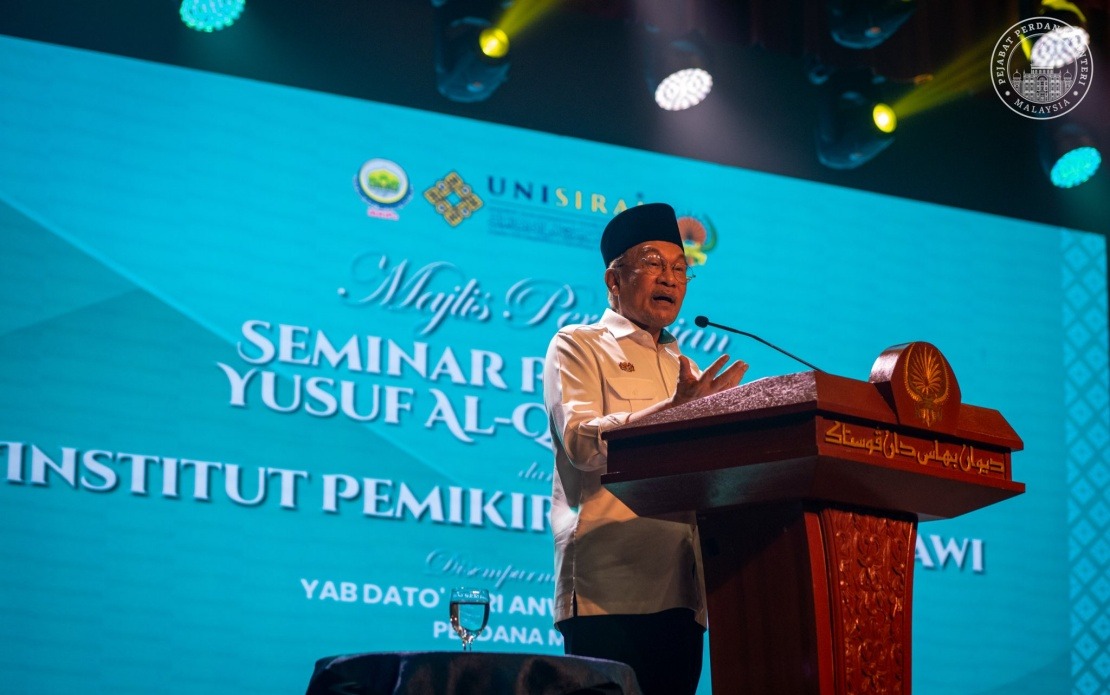
Prime Minister Datuk Seri Anwar Ibrahim has committed RM2 million in MADANI Government funding to the Al-Qaradawi Thought Institute, marking a significant investment in preserving and advancing the scholarly legacy of one of modern Islam's most influential thinkers. The announcement came during the formal opening of both the Yusuf Al-Qaradawi Thought Seminar and the institute itself at Wisma Dewan Bahasa dan Pustaka in Kuala Lumpur on July 21, underlining the government's recognition of Al-Qaradawi's intellectual contributions to contemporary Islamic thought and governance.
The Prime Minister articulated a deeply personal connection to the late Islamic scholar, drawing on decades of shared intellectual exchange and mutual respect. In remarks shared on social media, Anwar described feeling indebted to Al-Qaradawi across multiple dimensions—ideological foundations, emotional support, and a friendship grounded in authentic principles. He expressed hope that such institutional endeavours would be blessed with lasting benefit and serve to illuminate the broader Muslim community through rigorous scholarship and open inquiry.
Anwar's relationship with Al-Qaradawi extends back to his formative years as an active participant in the Malaysian Islamic Youth Movement, known as ABIM. During this period in the late 1970s and early 1980s, when Islamic revivalism was gaining considerable momentum across the Muslim world, the two maintained a substantive intellectual dialogue that would shape Anwar's own political and philosophical trajectory. The Prime Minister recalled how Al-Qaradawi had communicated directly with ABIM's leadership, offering guidance during a transformative moment in Malaysian Islamic activism.
A particularly pivotal intervention came when Al-Qaradawi urged ABIM to embrace moderation and resist the allure of ideological rigidity. Writing at a time when Islamic movements globally were increasingly fragmenting between progressive and hardline camps, the scholar counsel the Malaysian youth organization to maintain the principle of wasatiyyah—a cornerstone Islamic concept emphasizing balanced judgment, pragmatism, and openness to diverse perspectives. For Anwar, this counsel proved formative, arriving at a crucial juncture when fervor and doctrinal certainty were overwhelming more nuanced approaches to faith and social change.
The significance of Al-Qaradawi's intervention lay in its timing and relevance. The early 1980s witnessed a proliferation of closed ideological systems within Islamic discourse, many dismissive of contemporary realities or unwilling to engage seriously with alternative viewpoints. Al-Qaradawi's emphasis on intellectual flexibility and moderate reasoning thus represented a countercurrent to prevailing trends. His message to ABIM was particularly consequential because it validated the pursuit of Islamic reform without surrendering to doctrinal extremism or the false choice between tradition and progress.
Anwar characterized Al-Qaradawi as a true agent of transformative change—a figure who embodied the German concept of zeitgeist, the spirit animating an era. Rather than being captured by the ideological certainties of his age, the scholar actively pursued reform while remaining grounded in Islamic principles. This combination of rootedness and innovation, traditionalism and progressivism, became Al-Qaradawi's defining intellectual trademark. He demonstrated that Islamic scholarship need not be static or defensive when confronted with modernity's challenges; instead, rigorous engagement with contemporary problems through Islamic sources could generate fresh insights and practical guidance.
The establishment of the Al-Qaradawi Thought Institute represents more than commemorative investment. For Malaysia and the broader Southeast Asian region, the institute promises to become a repository and continuing research center dedicated to examining Al-Qaradawi's prolific intellectual output across jurisprudence, Islamic economics, political theory, and interfaith dialogue. His voluminous writings address perennial tensions within contemporary Islamic thought—how to honor tradition while adapting to change, how to pursue justice while maintaining social stability, and how to engage the non-Muslim world without compromising faith principles.
The funding announcement carries particular resonance for Malaysia's current political trajectory. Under the MADANI governance framework, the government has positioned itself as an advocate for inclusive development and pragmatic policy-making. By investing in an institute dedicated to Al-Qaradawi's thought, particularly his emphasis on moderation and openness, the administration signals alignment with intellectual traditions that inform its own development philosophy. This institutional support suggests recognition that Malaysia's political stability and economic progress depend partly on the wider Muslim intellectual ecosystem embracing balanced, reform-oriented Islamic thought.
Moreover, the establishment of this institute reflects a strategic understanding that Islamic scholarship remains vital to Southeast Asia's religious and social fabric. Countries in the region have long grappled with questions about how Islamic identity, governance, and economic systems can coexist with plural societies and global integration. Al-Qaradawi's body of work, with its insistence on wasatiyyah and intellectual engagement across boundaries, offers a proven intellectual resource for navigating these complex terrain. By institutionalizing access to his ideas through formal research structures, Malaysia positions itself as a center for moderate Islamic thought in the region.
The Al-Qaradawi Thought Institute will likely attract scholars, graduate students, and policymakers seeking to understand how Islamic principles can inform responses to contemporary challenges—from poverty alleviation and sustainable development to interfaith cooperation and technological disruption. In this sense, the RM2 million investment represents not merely a memorial to a departed scholar but an active investment in sustaining intellectual traditions that have proven valuable to Malaysia's nation-building project and regional stability.
Anwar's personal invocation of Al-Qaradawi's influence on his own intellectual development also underscores a broader pattern within Malaysian political leadership, where Islamic scholarship and religious thought continue shaping policy orientation and national identity. The Prime Minister's willingness to publicly credit an external Islamic scholar with guiding influence on his thinking demonstrates confidence in Malaysia's Islamic institutions while acknowledging the universal principles embedded within Islamic jurisprudence that transcend national boundaries. This cosmopolitan approach to Islamic scholarship—rooted yet globally connected, traditional yet reform-oriented—has become increasingly important as Southeast Asian societies navigate rapid social and technological change while maintaining religious authenticity and social cohesion.

