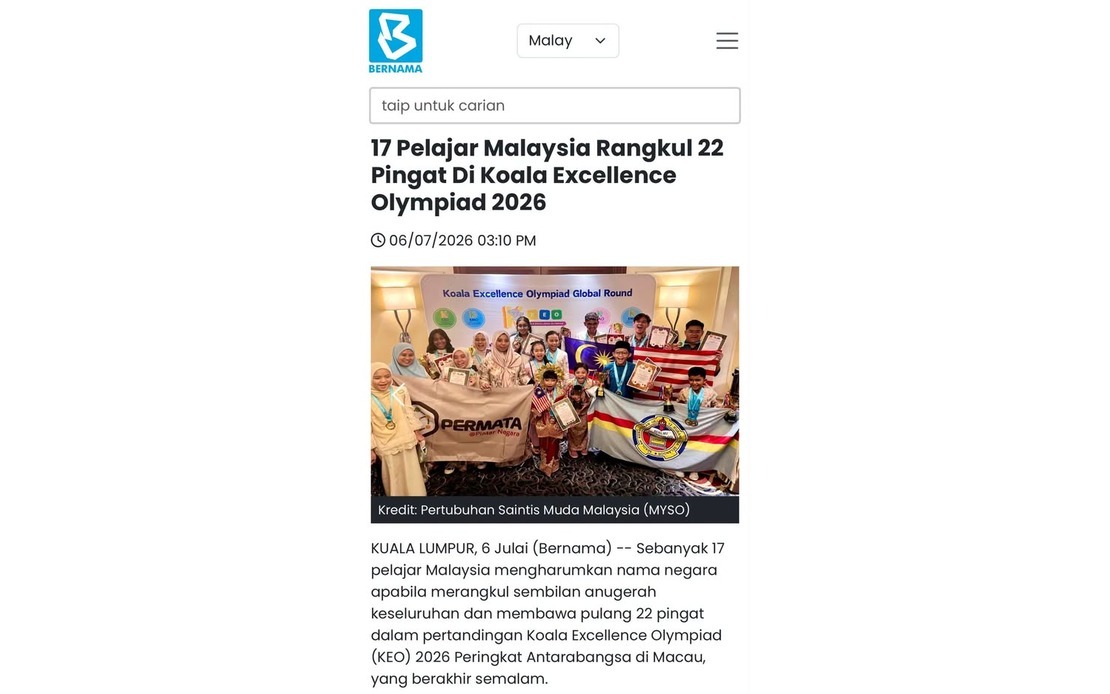
Prime Minister Datuk Seri Anwar Ibrahim has publicly acknowledged the exceptional achievements of 17 Malaysian students who represented the nation at the 2016 Koala Excellence Olympiad (KEO) Global Finals held in Macau. The cohort's success, marked by the collection of nine overall awards and 22 medals, underscores Malaysia's continuing presence among international academic competition circuits. In a message posted on social media platform X, Anwar extended his congratulations to the young competitors, encouraging them to maintain their pursuit of educational excellence and to aspire toward even greater accomplishments in their academic endeavours.
The medal haul achieved by the Malaysian contingent comprised five gold, six silver, and eleven bronze awards, reflecting a balanced distribution of success across the competitive categories. This breakdown suggests that the team performed consistently across multiple disciplines rather than excelling in isolated areas, a positive indicator of the depth of talent within Malaysia's student population. The overall awards figure of nine demonstrates that several students achieved top rankings within their respective event categories, distinguishing themselves among an international field of competitors.
Aidah Misran, who served as coordinator of the Malaysia Young Scientists Organisation (MYSO) and headed the Malaysian delegation to Macau, confirmed these results following the competition's conclusion. Her role in organising and leading the team reflects the structured approach Malaysia has taken toward nurturing talent in international academic competitions. The MYSO's continued involvement in such initiatives highlights the importance placed by Malaysian educational bodies on providing platforms for young learners to test their capabilities against international peers and to develop confidence in their academic abilities.
The Koala Excellence Olympiad itself represents an increasingly competitive arena within the international education landscape. Developed by a consortium of Australian educational experts and graduates, KEO encompasses four primary disciplines: English, Mathematics, Science, and Arts. This multi-disciplinary approach ensures that students with varied academic strengths and interests can participate meaningfully, rather than limiting competition to narrow specialisations. By spanning these four broad areas of study, the competition encourages well-rounded intellectual development and provides pathways for recognition across diverse academic domains.
The 2016 edition of KEO Global Finals drew participants from multiple countries to Macau, creating an environment where Malaysian students could measure their progress against peers from different educational systems and backgrounds. Such international exposure carries significant value beyond the medals themselves. Exposure to different teaching methodologies, problem-solving approaches, and competitive standards helps young people develop resilience and adaptability—qualities that extend far beyond academic competition into professional and personal life.
Malaysia's institutional involvement in KEO comes through its partnership with MYSO, which coordinates the national participation and selection process. This organisational structure enables systematic identification of talented students and their preparation for international-level competition. The involvement of organisations like MYSO demonstrates that Malaysia's engagement with international academic competitions is not sporadic or opportunistic, but rather part of a deliberate strategy to develop human capital and maintain visibility within global educational networks.
For Malaysian students, success at competitions like KEO serves multiple purposes. Beyond the immediate recognition and achievement, such accomplishments provide valuable credentials for university applications, particularly for international institutions where extracurricular academic achievements are weighted heavily in admissions decisions. Furthermore, these experiences contribute to the development of critical thinking skills, perseverance under pressure, and the confidence necessary to succeed in demanding academic and professional environments.
The Prime Minister's public acknowledgment of these achievements reflects the importance placed by Malaysia's leadership on educational excellence and youth development. In an increasingly competitive global economy, nations that nurture and demonstrate strong talent pipelines gain advantages in attracting investment, retaining skilled workers, and building capacity in knowledge-intensive sectors. Public recognition of student accomplishments also serves to motivate other young Malaysians to pursue similar paths and to raise the profile of academic achievement within society.
The success of Malaysian students at international competitions such as KEO also provides valuable feedback on the effectiveness of the nation's educational systems and curricula. When Malaysian students perform well against international benchmarks, it suggests that their preparation and foundational knowledge are competitive by global standards. Such information helps education policymakers identify what is working well and where adjustments might be necessary to further enhance learning outcomes across the system.
Looking forward, the continuation of Malaysia's participation in platforms like KEO remains important for sustaining momentum in youth development and international academic engagement. The investments made in identifying, preparing, and supporting students for such competitions generate returns that extend across multiple dimensions—from individual student achievement and university prospects to national reputation and competitiveness in human capital development. As countries across Southeast Asia and globally compete to position their young people as leaders and innovators, Malaysia's demonstrated success in these arenas reinforces its standing as a nation committed to educational excellence and youth empowerment.

