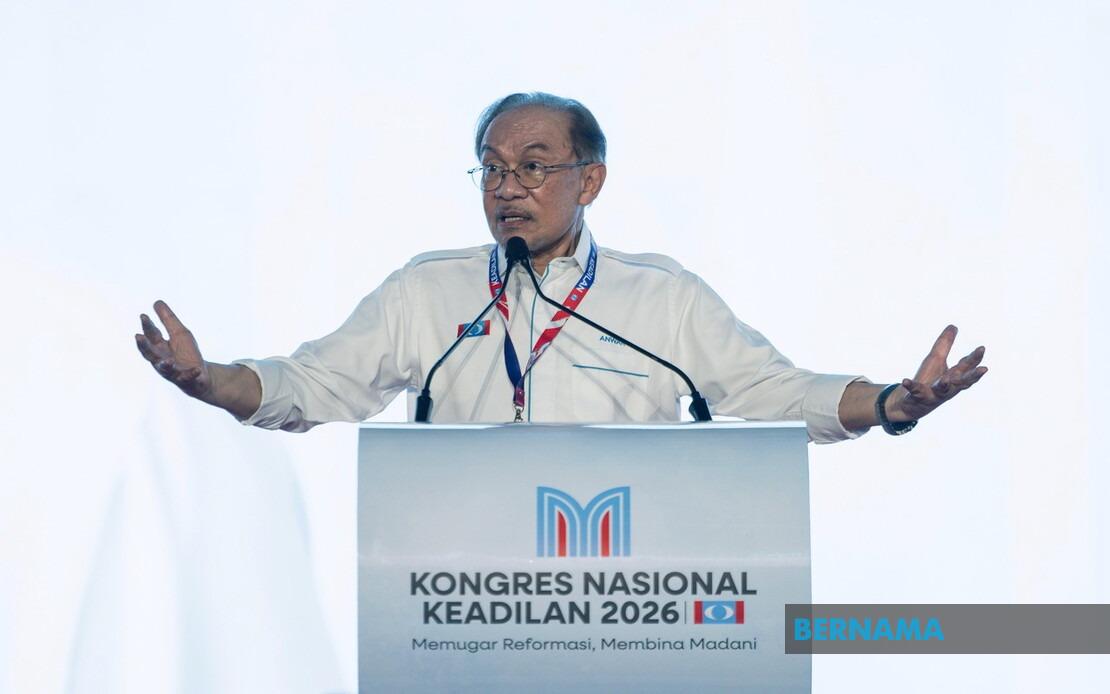
Prime Minister Datuk Seri Anwar Ibrahim has unveiled a significant financial commitment to Malaysia's 222 parliamentary constituencies, approving an additional RM1 million in direct allocations to each area. The announcement, made during his closing address at the 2026 PKR National Congress at the Melaka International Trade Centre, signals a fresh attempt by the MADANI Government to streamline welfare delivery and respond more swiftly to pressing local concerns without the administrative obstacles that have historically slowed such initiatives.
The additional funding represents a strategic pivot toward decentralised decision-making, empowering elected representatives at the constituency level to identify and address needs that matter most to their communities. Rather than funnelling resources through multiple governmental layers where they risk delays and inefficiency, the scheme facilitates direct disbursement for welfare programmes, basic infrastructure, and community-centred projects. This approach acknowledges a persistent frustration among MPs and constituents alike: that centrally-managed funds, while well-intentioned, often fail to respond promptly to time-sensitive local crises.
Anwar, who holds the concurrent portfolio of Finance Minister, contextualised the announcement within the government's broader anti-poverty framework. He emphasised that the allocation complements rather than replaces existing cash assistance schemes, particularly the Sumbangan Tunai Rahmah and Sumbangan Asas Rahmah initiatives, which together command RM16 billion in annual expenditure. This layering of programmes reflects recognition that poverty alleviation requires simultaneous interventions at multiple levels: universal targeted cash transfers address immediate household liquidity shortfalls, while constituency-level allocations tackle localised infrastructure deficits and community welfare gaps that blanket policies cannot reach.
The government has presented poverty reduction as a centrepiece of MADANI's economic policy, citing the decline of the hardcore poverty rate to 0.09 per cent as evidence of success. While international observers might debate the methodology behind such figures, the political significance is unmistakable: the announcement crystallises a narrative in which the administration has delivered tangible economic gains to ordinary Malaysians, particularly the bottom 40 per cent of income earners. Anwar's invocation of M40 households—the middle 40 per cent—alongside B40 beneficiaries suggests an intentional broadening of the coalition the government claims to serve, signalling that cost-of-living relief extends beyond the poorest segments.
For Malaysia's parliamentary system, the allocation carries implications for constituency representation and the leverage wielded by backbench MPs. Previously, local funds often depended on ministerial discretion or party political affiliation; a more systematic per-constituency allocation potentially reduces patronage dynamics and creates clearer baselines for community expectations. However, the scheme's effectiveness ultimately hinges on how transparently MPs utilise the funds and whether constituents can meaningfully participate in priority-setting, rather than passively receiving projects selected from above.
The Prime Minister's call for PKR cadres and party machinery to engage grassroots populations reveals an underlying concern: that government initiatives, however generous, fail to translate into public awareness or political credit if poor communication intermediates between policy and beneficiary. Anwar explicitly instructed party workers to venture into communities, explain available assistance, and ensure eligible residents navigate application processes successfully. This recognition of a communications and execution gap is candid, suggesting that previous programme launches encountered friction between government intent and ground-level realisation.
For Southeast Asian readers watching Malaysia's governance trajectory, the initiative demonstrates how a coalition government grappling with cost-of-living pressures adapts fiscal strategy to maintain political cohesion. Rather than attempting comprehensive structural economic reform—which carries risks and generates opposition—the administration opts for targeted cash and discretionary allocations that distribute largesse across constituencies and income segments. This approach preserves spending flexibility and reserves patronage capacity for politically critical moments, though critics contend it sidesteps deeper productivity and structural competitiveness challenges.
The timing of the announcement, during a major ruling coalition party congress, underscores its political function beyond economic policy. PKR members, who often contest marginal seats where constituency services determine electoral margins, gain resources to demonstrate tangible delivery to voters. This calculation is particularly relevant in Malaysia's polarised political landscape, where swing constituencies in Selangor, Johor, and Sabah frequently determine parliamentary majorities and each electoral cycle involves nail-thin margins.
Regional comparisons prove instructive: Indonesia and Thailand have similarly experimented with decentralised poverty alleviation funds, with mixed results dependent on local accountability mechanisms and anti-corruption oversight. Malaysia's experience will partly reflect whether RM1 million per constituency proves adequate for genuinely transformative local projects or merely funds incremental improvements, and whether independent monitoring prevents misallocation or nepotistic deployment of resources.
The announcement reflects MADANI's broader positioning as a government prioritising immediate material welfare over structural reform. Whether this approach sufficiently addresses underlying economic anxieties—stagnant real wages, housing affordability, skills mismatches—or merely postpones harder policy decisions remains contested among economists and political analysts. Nonetheless, for ordinary Malaysians confronting monthly inflation in food and transport costs, the promise of RM1 million per constituency directed toward local needs carries tangible appeal, and the government appears betting that visible, incremental improvements in community welfare will bolster its political standing ahead of the next general election.

