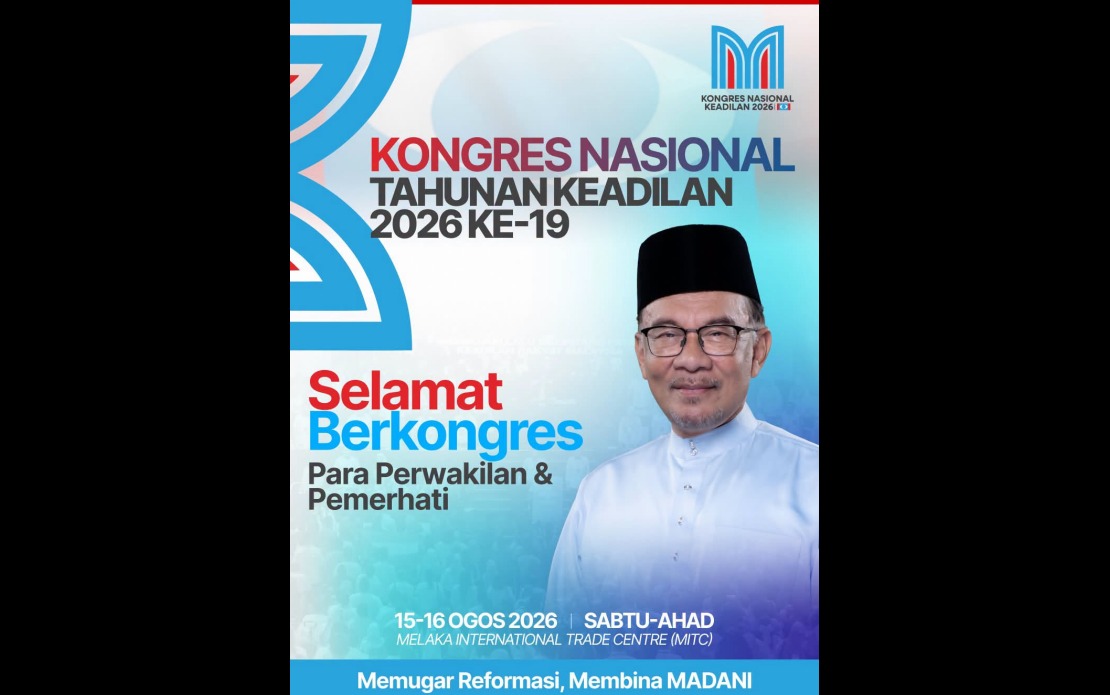
Datuk Seri Anwar Ibrahim, PKR president and Malaysia's Prime Minister, has issued a call for the party to maintain its identity as a mass movement grounded in principles of integrity, social justice and unity, rather than allowing itself to become merely a mechanism for winning elections. His remarks, delivered through a Facebook statement on August 14, come as the party prepares to convene its major gathering in Melaka, signalling an effort to refocus the organisation on foundational values that defined its origins during the reformasi era.
The timing of Anwar's message carries particular weight, arriving on the eve of PKR National Congress 2026, which begins on August 15 at the Melaka International Trade Centre in Ayer Keroh. By emphasising the distinction between a movement driven by principle and a party driven purely by power-seeking, Anwar appears to be steering the organisation toward deeper introspection about its trajectory and role within Malaysia's political landscape. This framing suggests internal discussions may be underway about how PKR positions itself in the current coalition government environment, where pragmatism and electoral calculations often dominate strategic thinking.
Anwar has signalled that the congress will serve as a moment for collective reflection. He expressed hope that delegates would use the platform for honest assessment of what the party has achieved since its formation and its evolution through the Reformasi movement, the political upheaval of the late 1990s that challenged established power structures. Such an exercise in self-evaluation could address questions about whether PKR has successfully translated its historical mandate into concrete policy achievements and whether the party's grassroots membership feels adequately represented in leadership decisions.
The congress operates under the theme "Memugar Reformasi, Membina MADANI," a phrase that explicitly links the party's founding struggle to the current government's MADANI agenda. This thematic choice underscores an attempt to draw continuity between PKR's historical identity and its contemporary role in governance. For Malaysian observers, the invocation of Reformasi—a watershed moment in the nation's recent political history—serves as a reminder of the idealism that energised a generation of political activists and voters seeking accountability and institutional reform.
PKR's significance extends beyond its direct membership. As the anchor component of the Democratic Action Party-led coalition within the broader federal government framework, the party's internal health and strategic clarity affect not only its own trajectory but the stability and direction of coalition governance itself. Any weakening of morale or confusion about purpose at PKR could ripple through the government's legislative agenda and its capacity to manage diverse political constituencies across Malaysia's states and regions.
In his address, Anwar invoked trust in the people as a central pillar of the party's mission. Public trust, he suggested, cannot be secured through electoral tactics alone but rather through demonstrated commitment to the values the party claims to represent. This framing acknowledges a persistent challenge facing established parties in Malaysia: the tension between activist idealism and electoral pragmatism. For voters who supported PKR on the basis of its reform credentials, the question of whether the party has delivered meaningful institutional change remains contested.
Anwar's scheduled keynote address to the congress, which will include a policy speech outlining the party's strategic direction, will provide more concrete insight into how PKR intends to operationalise these principles. The speech represents an opportunity for the Prime Minister to articulate specific policy commitments and electoral priorities while attempting to demonstrate alignment between governmental action and party ideology. Malaysian political observers will be watching closely for any indication of how the party plans to balance its role as part of the ruling coalition with its identity as a reformist movement.
The congress gathering itself carries symbolic importance beyond its immediate business. In Malaysia's political culture, major party congresses function as venues for renewing organisational cohesion, validating leadership, and recalibrating priorities. For PKR specifically, a congress focused on principles and movement values rather than purely internal power contests signals an effort to project unity and forward momentum at a moment when coalition politics often generates centrifugal pressures toward factionalism and competition for ministerial portfolios.
The reformation of PKR's identity and messaging also occurs within a broader Southeast Asian context of democratic erosion and the increasing difficulty faced by reformist parties in maintaining both electoral competitiveness and ideological integrity. Across the region, parties that emerged from anti-authoritarian movements have struggled to sustain grassroots engagement and principled governance once they achieve power. Anwar's explicit call for PKR to resist reducing itself to an electoral machine suggests awareness of these regional patterns and a determination to chart a different course.
For Malaysia specifically, the health and direction of PKR carries implications for the broader coalition arrangement and the government's capacity to pursue transformative governance. A PKR energised by renewed commitment to justice and accountability could strengthen civil society engagement with the government. Conversely, if the party were to drift toward pure transactionalism, it could undermine the legitimacy that reformist credentials provide to the current government configuration.
The congress also provides PKR delegates with an opportunity to discuss generational renewal and the party's appeal to younger voters. Malaysia's demographic trajectory means that voters aged under 40 constitute an increasingly significant bloc. These voters may have limited direct memory of the Reformasi era and may evaluate PKR's worth based on contemporary governance outcomes rather than historical narrative. How the party communicates and bridges this generational gap will influence its medium-term electoral prospects and organisational vitality.
Anwar's invocation of divine blessing for the nation—expressed through the phrase "May Allah SWT bless all our efforts for our beloved homeland, Insya-Allah"—adds a spiritual dimension to the political message. In Malaysian political discourse, such framing resonates with audiences who understand governance as inseparable from moral and religious dimensions. This rhetorical choice also implicitly acknowledges that PKR's appeal has always encompassed not merely programmatic politics but also moral persuasion and values-based mobilisation.

