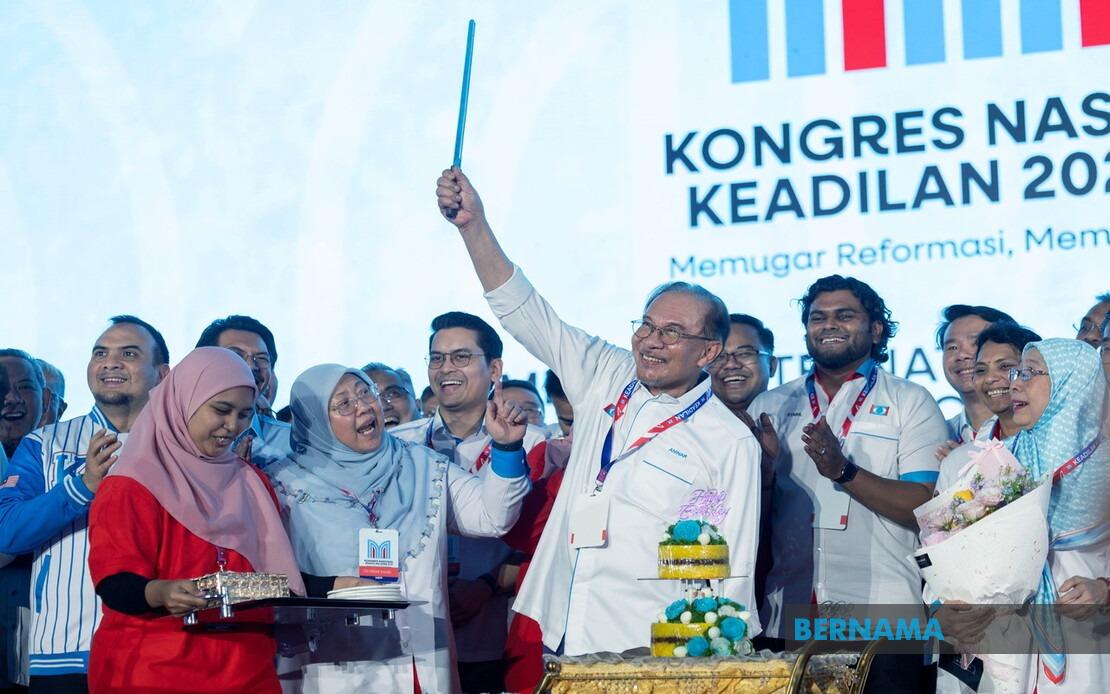
The PKR National Congress 2026 concluded in Melaka on August 16 with party leadership reiterating their commitment to two seemingly competing priorities: sustaining the political stability underpinning the Unity Government while simultaneously advancing the reformist agenda that has defined the party's identity since its establishment. In his closing remarks, PKR president Datuk Seri Anwar Ibrahim pledged continued support for the inter-party cooperation that has become the foundation of Malaysia's current governance structure, framing political stability and sustained economic growth as prerequisites for broad-based prosperity across the nation's population.
Anwar's position reflects the delicate balance PKR must maintain as both a reform-oriented party and a sitting member of government. The Prime Minister acknowledged that while his personal stance favours continued cooperation within the Unity Government framework, the durability of this arrangement ultimately depends on decisions and actions by partner coalition members, particularly UMNO and its Barisan Nasional allies. This frank recognition of interdependency underscores the fragility of Malaysia's current political settlement and the potential vulnerabilities that could emerge if any major stakeholder moves toward unilateral advantage. Anwar cautioned all parties against pursuing strategies that might destabilise the arrangement, emphasising that the Unity Government was constructed on pragmatic recognition of shared national interest rather than ideological alignment.
PKR deputy president Nurul Izzah Anwar advanced a compelling argument that the party's reform credentials need not—and indeed must not—be compromised by its participation in government structures. Rather than viewing administrative responsibility as a constraint on transformative ambition, she contended that embedding reform principles within governmental institutions represents the truest test of PKR's commitment to institutional change. Her remarks implied that genuine reform transcends rhetorical pronouncements and requires implementing substantive policy modifications. She cited the repeal of the Universities and University Colleges Act 1971 as a concrete example of this philosophy in practice, demonstrating that legislative change remains achievable even within a coalition arrangement.
The AUKU repeal itself carries particular significance for Malaysian higher education and political culture. This legislation had long restricted student political engagement and activism, serving as a symbolic constraint on youth freedoms. Anwar's assurance that the government would not introduce replacement legislation imposing similar restrictions, and his commitment to table this matter at Cabinet level, suggests PKR intends to consolidate this reform rather than allow subsequent governments to reimpose comparable controls. His point that existing criminal and administrative laws provide adequate tools for addressing genuine misconduct, without requiring special student-specific restrictions, reflects a normative stance that academic communities represent integral components of civil society rather than separately regulated populations requiring exceptional constraints.
A distinctive dimension of the congress involved PKR's organisational preparation for political contingencies. Party leadership emphasised the importance of maintaining readiness across all wings regardless of parliamentary dissolution timelines or candidate selection announcements. This preoccupation with organisational vigilance suggests party strategists anticipate potential instability within the coalition arrangement and wish to ensure PKR maintains internal cohesion and mobilisation capacity to respond swiftly to shifting political circumstances. Such positioning implies neither confidence in the indefinite stability of the present arrangement nor pessimism, but rather prudent recognition that Malaysian politics operates within inherent uncertainties.
Women's representation and leadership emerged as a substantial theme throughout the congress proceedings. PKR Wanita chief and Education Minister Fadhlina Sidek articulated demands for expanded opportunities for women in senior decision-making roles within both the party and government apparatus. Her remarks linking these aspirations to broader governance improvement—specifically the need for leaders to demonstrate genuine receptiveness toward external criticism and evidence-based policy refinement—positioned gender diversity not merely as an equity concern but as a governance competency issue. The framing suggests that women's substantive participation in leadership directly improves organisational responsiveness and institutional accountability.
Fadhlina's emphasis on constructive criticism and openness to accountability mechanisms addresses a recurrent tension within Malaysia's political discourse. Public discourse frequently characterises criticism of government performance as disloyalty or opportunistic opposition, a framing that can inhibit legitimate institutional feedback mechanisms. Her articulation of critique as compatible with committed party membership and governmental service potentially reframes political culture in ways that could enhance institutional learning and adaptive governance capacity.
Angkatan Muda Keadilan's interventions focused attention on technology sector development and generational employment dynamics. The youth wing's emphasis on expanding Bumiputera participation within strategic technology domains—artificial intelligence, semiconductors, and biotechnology—reflects recognition that economic competitiveness increasingly depends on capability within these sectors. Their concurrent attention to gig economy recognition and broader social protection frameworks acknowledges that labour market structures have transformed substantially, with growing proportions of Generation Z entering employment arrangements that existing regulatory frameworks inadequately address. Mental health and social well-being priorities resonate with documented challenges affecting younger Malaysian workers navigating economic uncertainty and rapidly shifting skill requirements.
The congress's overall trajectory suggests PKR leadership believes the party can simultaneously advance transformative reform agendas and contribute to political stability. This position requires PMX nuance: reform initiatives must be pursued in ways that reinforce rather than destabilise coalition arrangements. The party's engagement with women's leadership development, technology sector participation, and youth employment dynamics indicates PKR interprets reform broadly, encompassing both institutional changes and policy innovation responsive to evolving demographic and economic circumstances.
For Malaysian readers observing coalition politics from outside PKR ranks, the congress underscores the practical compromises required to sustain multi-party governments while maintaining distinctive party identities and reform aspirations. The congress demonstrated that PKR leadership recognises these tensions explicitly and has developed rhetorical and strategic frameworks for navigating them, though the durability of this balance remains contingent on broader coalition dynamics and broader political circumstances that extend beyond any single party's control. The emphasis on organisational preparedness suggests party strategists retain flexibility to respond to potential developments that could alter present political arrangements.

