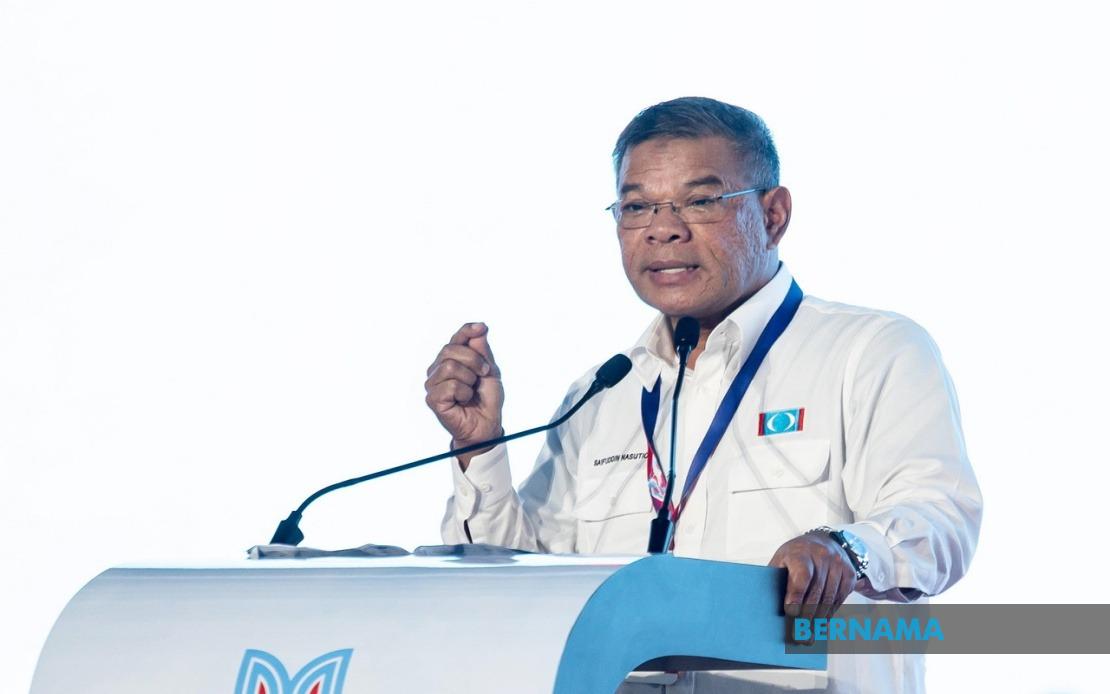
PKR's leadership has issued a forceful repudiation of identity and racial politics, arguing that such divisions undermine national progress and calling instead for Malaysian voters to judge their government on tangible economic outcomes and improved living standards. Speaking at the 2026 PKR National Congress in Melaka, Datuk Seri Saifuddin Nasution Ismail, who holds the position of Home Minister and is currently discharging the duties of deputy president, characterised identity-based politics as inherently sterile, producing no constructive benefits for the nation's development trajectory.
Saifuddin Nasution framed the choice starkly: competition rooted in ethnic or religious identity represents a "zero-sum game" where victory for one community necessarily implies loss for another, a dynamic he argues is fundamentally incompatible with national progress. Instead, he advocated for what he termed "performance-based politics," a framework in which governing parties are evaluated principally on measurable criteria such as job creation, wage growth, poverty reduction, and improvements in public services. This rhetorical shift reflects a broader strategic repositioning by PKR ahead of the next general election, one in which the party seeks to neutralise opposition narratives rooted in communal grievance by redirecting public discourse toward bread-and-butter concerns that transcend ethnic boundaries.
The Home Minister's metaphor of "making the pie of prosperity bigger" captures the philosophical departure his party is attempting. Rather than redistributing existing resources in ways that may generate zero-sum perceptions, PKR argues that inclusive economic growth creates room for all communities to advance simultaneously without requiring any group to sacrifice its interests. This framing has particular resonance in Malaysia, where rapid economic slowdown and rising cost-of-living pressures have eroded public confidence in government capacity to deliver tangible improvements, especially among younger voters and urban professionals.
Crucially, Saifuddin Nasution did not dismiss the reality of Malaysia's plural society, nor did he deny the legitimacy of communal identities themselves. Rather, he distinguished sharply between identity as a fact of social reality and identity weaponised as a political instrument designed to cultivate fear and division. He enumerated the various identities that constitute Malaysian nationhood—Malay, Islamic, Chinese, Indian, Sabah, and Sarawak identities—and characterised their coexistence as an irreducible feature of the nation that must be accepted as given. The problem emerges only when political actors instrumentalise these identities to amplify grievances and foster interethnic suspicion, a dynamic he implied has become increasingly prevalent in Malaysian political competition.
The party outlined a tripartite governance agenda underpinning its platform. First, economic expansion through what Saifuddin Nasution described as enlarging the collective prosperity available to all Malaysians, ensuring that growth reaches beyond urban centres and corporate beneficiaries to improve conditions for working-class and rural populations. Second, a shift toward needs-based rather than ethnicity-based assistance, whereby government support targets individuals and households according to measurable economic criteria—household income, family size, disability status—rather than racial or religious identity. This approach has long been advocated by reformist policymakers as both more efficient and more equitable, though implementation remains contested given Malaysia's history of community-targeted programmes.
Third, the party commits to governance reform and anti-corruption measures that directly safeguard public resources and restore confidence in state institutions. Saifuddin Nasution argued that corruption represents a hidden tax on all Malaysians, diverting funds intended for healthcare, education, and infrastructure into private hands, thereby degrading the actual capacity of government to improve living standards. By emphasising integrity and institutional accountability, PKR positions itself as distinct from the opacity and self-dealing that characterised previous administrations.
Saifuddin Nasution reframed the competition for communal support by identifying different threats. Rather than portraying other ethnic communities as inherent competitors for national resources, he argued that the genuine threats facing all Malaysians—poverty, drug abuse, inadequate education, underemployment—operate indiscriminately across ethnic lines. Youth drug addiction, for instance, devastates Malay families, Chinese families, and Indian families alike, making it a shared societal challenge rather than a community-specific problem. This depiction attempts to create common cause among voters of diverse backgrounds by identifying shared vulnerabilities.
The emphasis on communicating government success stories, particularly to younger voters, indicates PKR's recognition that performance-based politics requires demonstrable results. The party is betting that investments in education subsidies, job creation initiatives, infrastructure development, and social safety nets, once properly publicised, will generate political returns at the ballot box. For Malaysian voters, this represents an implicit promise that their evaluations will hinge on measurable improvements in personal economic security and public service quality.
The timing of Saifuddin Nasution's remarks merits consideration. Malaysia's political landscape has increasingly fractionalised, with various parties competing for ethnic-based voter blocs through increasingly personalised and communal messaging. PKR's call for depoliticising ethnicity and recentring governance around performance occurs against a backdrop of stubbornly slow economic growth, rising household debt, and persistent inequality. Whether Malaysian voters will respond to performance-based messaging or whether entrenched communal loyalties and elite-driven narratives will ultimately prevail remains an open question that will substantially shape the outcome of the next electoral cycle.
For observers in Southeast Asia more broadly, PKR's approach offers a case study in how dominant political coalitions attempt to manage plural societies under conditions of economic pressure. The experiment being conducted in Malaysia—whether multiethnic coalitions can sustain power by shifting discourse from identity to performance—carries implications for other nations in the region managing their own deepening social divisions and economic challenges.

