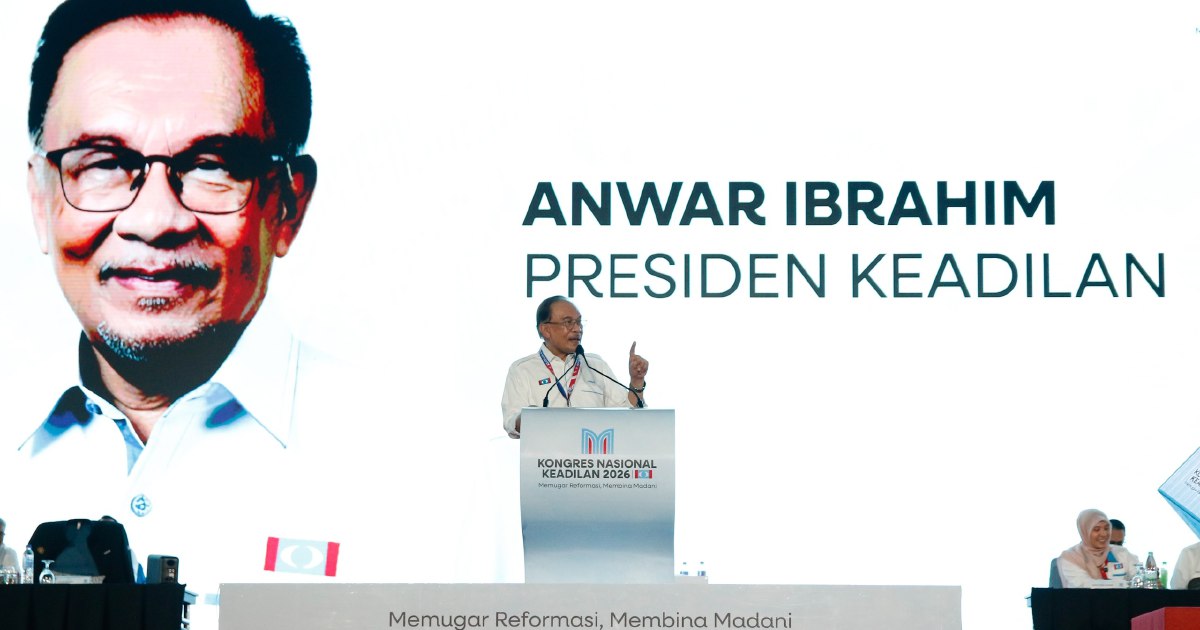
Datuk Seri Anwar Ibrahim has reaffirmed that PKR intends to maintain its multilayered coalition architecture, operating simultaneously within the federal Barisan Nasional-Umno structure while preserving its Pakatan Harapan partnership with DAP and Amanah. The party president's statement, delivered in Ayer Keroh, clarifies PKR's intricate political positioning at a moment when Malaysian coalition dynamics remain fluid and subject to considerable scrutiny from party members and the electorate alike.
The statement addresses persistent tensions surrounding PKR's dual allegiances, which have sparked debate within political circles and among grassroots supporters. Since the formation of the Perikatan Nasional government and the subsequent realignment of federal coalitions, PKR has navigated a precarious balance between maintaining its historic Pakatan Harapan bonds and functioning as an essential component of the BN-backed federal administration. This balancing act reflects the broader complexities of Malaysian politics, where single-party majorities remain elusive and coalition management requires sophisticated diplomatic choreography.
For Malaysian observers, PKR's position carries significant implications for governmental stability and policy continuity. As the party led by the Prime Minister, PKR serves as a bridging institution between ostensible rivals within the BN framework and the reform-oriented vision espoused by Pakatan Harapan. This dual role enables policy dialogue across traditionally opposing factions while simultaneously creating risks of internal contradictions and perceived inconsistency.
The Pakatan Harapan relationship, particularly with DAP and Amanah, remains foundational to PKR's identity despite the 2020 political transition that reshaped federal governance. These alliances were forged on shared platforms of governmental accountability, anti-corruption measures, and institutional reform. Anwar's reaffirmation of these commitments signals that PKR does not view its Barisan Nasional cooperation as ideological betrayal but rather as pragmatic governance necessity, given Malaysia's fractionalised parliamentary mathematics.
Within the broader Southeast Asian context, Malaysia's coalition instability reflects patterns seen across the region where entrenched two-party systems have fractured, forcing complex multi-party negotiations. Unlike Thailand or Indonesia, where dominant parties can sustain narrow majorities, Malaysian politics demands the kind of creative alliance management that PKR now demonstrates. The party's willingness to operate across coalition boundaries, while risky, provides potential stability advantages when compared to zero-sum confrontation.
Barisan Nasional, particularly Umno, has itself undergone considerable transformation since 2018. The two parties' current cooperation represents a recalibration rather than a simple return to previous patterns, as both organisations navigate reduced support levels and electoral volatility. PKR's maintenance of this relationship reflects recognition that sustainable governance requires accommodating diverse political constituencies and institutional interests within the dominant coalition.
Yet this strategy contains inherent contradictions that merit examination. Pakatan Harapan partners, particularly DAP, may interpret PKR's federal cooperation with former rivals as dilution of reformist commitments, especially regarding economic policy, institutional transformation, and approaches to contentious social issues. The party risks appearing to abandon principles when convenient while maintaining ideological commitments selectively, a perception that could damage its credibility among urban, educated voters who formed the core of Pakatan's 2018 mandate.
Anwar's explicit statement appears designed to forestall rebellion from both directions. To Pakatan partners, the message conveys that federal cooperation with Barisan Nasional does not constitute abandonment of the broader coalition. To internal PKR members concerned about legitimacy and ideological coherence, the affirmation suggests the party remains committed to its foundational values despite governmental necessities. This rhetorical positioning, however, may not satisfy constituencies demanding clearer commitment to singular coalition identity.
Regionally, Malaysia's experience offers instruction for other Southeast Asian democracies grappling with fractionalised party systems. PKR's approach, if sustainable, demonstrates that competing coalitions need not lead to governmental paralysis or institutional breakdown, provided sufficient elite consensus exists regarding procedural legitimacy and power-sharing norms. Conversely, the strain evident in managing these multiple commitments suggests limits to how long complex three-way or multi-coalition arrangements can persist without clarification of fundamental political loyalties.
For ordinary Malaysians, PKR's coalition architecture raises practical questions regarding policy direction and accountability. If the party simultaneously serves multiple masters—Barisan Nasional, Pakatan Harapan, and its own electoral base—to whom does it ultimately answer? This ambiguity complicates citizens' ability to enforce accountability or predict governmental behaviour on crucial matters from economic distribution to democratic governance.
Moving forward, PKR faces pressure to demonstrate that dual coalition membership produces substantive governance benefits rather than serving merely as a vehicle for power consolidation. The party's continued stress on commitment to both frameworks, rather than choosing definitively between them, reflects political reality in contemporary Malaysia—where absolute clarity and singular loyalty have become luxury goods that fractionalised parliaments cannot afford. Whether this arrangement provides sufficient stability for reform implementation or merely perpetuates stagnation through compromise remains an open question for the coming political term.

