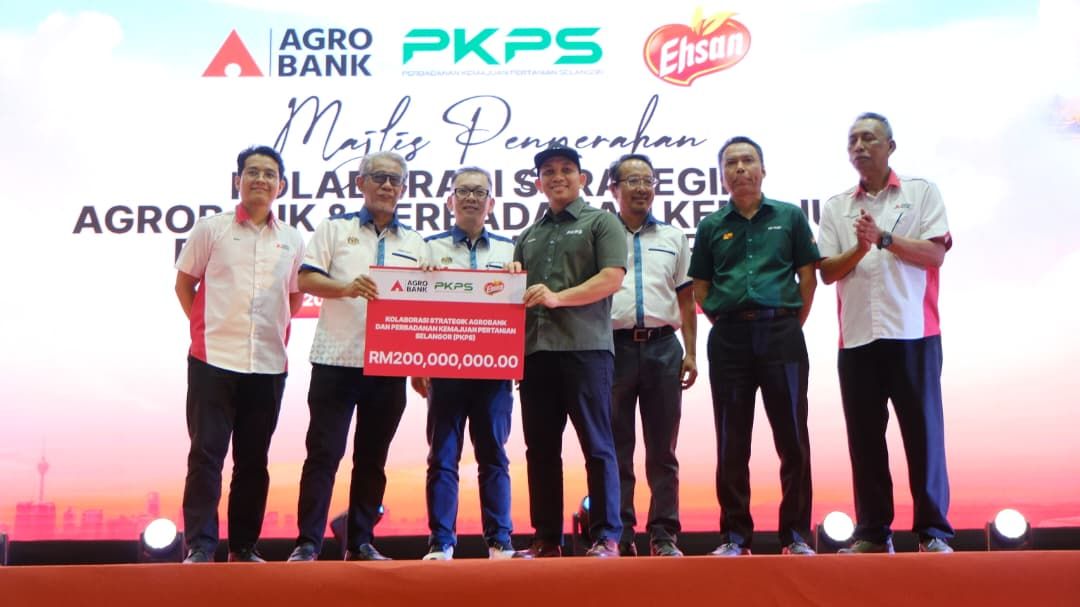
Selangor's agricultural sector has taken a significant step forward with the signing of a RM200 million trade financing facility between the Selangor Agricultural Development Corporation (PKPS) and Agrobank, marking a strategic move to bolster the state's agrifood infrastructure and resilience. The agreement was formalised during the Malaysia Agriculture, Horticulture and Agrotourism Exhibition (MAHA) 2026 at the Malaysia Agro Exposition Park in Serdang on August 29, with Agrobank group president and chief executive officer Datuk Tengku Ahmad Badli Shah Raja Hussin presenting a symbolic mock cheque to PKPS group chief executive officer Datuk Dr Mohamad Khairil Mohamad Razi in the presence of Deputy Agriculture and Food Security Minister Datuk Chan Foong Hin.
The financing facility addresses multiple dimensions of agricultural development across the state, from tangible infrastructure projects to operational requirements and research initiatives that collectively aim to create a more robust food supply system. The facility is structured to support project financing, replenish PKPS's working capital reserves, and invest in capacity-building activities that will enhance Selangor's self-sufficiency in food production. This comprehensive approach reflects growing recognition that food security depends not merely on production volumes but on integrated supply chains, technological innovation, and human expertise.
The inaugural project under this arrangement will be construction of the Selangor halal food warehouse, positioned as a central storage and logistics facility that will anchor the state's food distribution network. This warehouse represents more than a storage facility; it underscores Malaysia's commitment to halal-certified supply chains and addresses the growing international demand for authentically certified Malaysian agrifood products. The facility will serve as both a domestic distribution hub and an export platform, aligning Selangor's agricultural sector with the nation's broader positioning in global halal markets.
Beyond the flagship warehouse, the financing will support construction of a halal chicken processing centre and an Ehsan product processing centre, alongside the development and upgrading of central distribution warehouses spanning all districts in Selangor. These complementary infrastructure investments create a vertically integrated system where production, processing, storage, and distribution operate seamlessly. Such integration is critical for perishable agricultural goods, where inefficiencies at any node can result in significant waste and economic loss. For Malaysian consumers and regional buyers, this means fresher products and more reliable supply chains.
The operational scope of the facility extends considerably beyond physical infrastructure. PKPS will utilise the financing to support production and marketing of ready-to-eat and ready-to-heat food products under the Ehsan brand, positioning the corporation to compete in the growing convenience food market where demand among urban and time-pressed consumers continues to expand. This pivot toward value-added products represents a strategic diversification beyond commodity production, allowing PKPS to capture higher margins and build consumer brand equity.
Research and development activities form another pillar of the facility's application. The financing will enable operation of the Ehsan Agricultural Research Centre, which focuses on advancing smart agriculture methodologies and practices tailored to Selangor's climate and soil conditions. As conventional agricultural land faces continued pressure from urbanisation and changing weather patterns, the adoption of precision farming techniques, vertical agriculture, and data-driven resource management becomes increasingly essential. Such research investments have multiplier effects, generating knowledge that can be disseminated across the broader Malaysian farming community.
Human capital development receives deliberate attention through the Ehsan Agricultural Training Centre, recognising that technological modernisation requires a workforce equipped with contemporary skills and knowledge. The training centre will develop the next generation of agricultural professionals capable of managing sophisticated farming systems and supply chain operations. For Malaysia, where agricultural employment has declined over recent decades, upgrading the sector's knowledge base is vital for attracting younger workers and reversing perceptions of farming as an outdated livelihood.
The partnership also encompasses agritourism development at the Ehsan Resort and Convention Centre, adding a recreational and educational dimension to Selangor's agrifood ecosystem. Agritourism represents an emerging income stream for agricultural areas, allowing farmers and agricultural corporations to diversify revenue and build consumer understanding of production realities. Visitors to such facilities develop greater appreciation for farmers' work and become more receptive to premium pricing for quality produce, creating positive feedback loops for agricultural sustainability.
The financing structure incorporates deliberate governance mechanisms to ensure responsible deployment. Disbursements will be made progressively based on documented project progress, with cash flow management maintained through transparent, controlled procedures throughout the partnership period. The facility is scheduled to become officially operational in March 2027, providing time for proper documentation, regulatory clearance, and operational preparation. This measured timeline reflects best practice in development finance, avoiding the rushed implementation that often undermines large financing initiatives.
The strategic partnership aligns with MAHA 2026's declared theme of "Value Creation for Food Security", emphasising that food security transcends simple production figures to encompass sustainable practices, technological modernisation, and supply chain efficiency. For Malaysian policymakers grappling with urbanisation, climate variability, and import dependency, the PKPS-Agrobank arrangement offers a tangible model of how public-private collaboration can address systemic agricultural challenges. The RM200 million commitment signals confidence in Selangor's agricultural potential and demonstrates financial sector recognition that sustainable food systems merit substantial capital investment.
Selangor's significance as the nation's economic and population centre makes its food security trajectory particularly consequential for Malaysia's broader self-sufficiency objectives. As the state continues rapid urbanisation, preserving agricultural productivity while building modern infrastructure becomes paradoxically both more urgent and more difficult. This financing facility represents an institutional response to that tension, channelling capital toward integrated systems designed to maximise output and efficiency within constrained land availability. The model may offer instructive lessons for other Malaysian states facing similar pressures as they navigate the balance between development and agricultural preservation.

