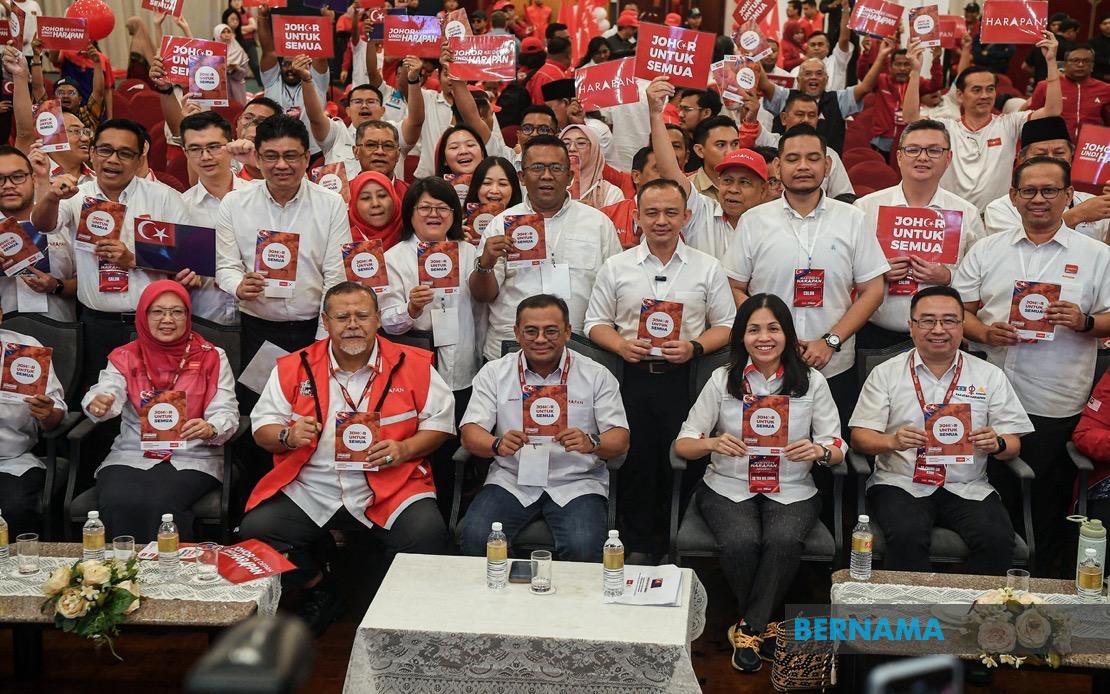
Pakatan Harapan unveiled its election manifesto for Johor on Wednesday, framing it not as mere campaign rhetoric but as a carefully calibrated response to tangible community concerns and the state's economic landscape. The 'Johor Untuk Semua' (Johor For All) manifesto, unveiled ahead of the July 11 state election, represents the coalition's strategic blueprint for governing Malaysia's southernmost peninsula, with Johor DAP chairman Teo Nie Ching emphasising that the pledges therein reflect genuine consultation with constituents rather than aspirational politics detached from ground realities.
The manifesto's substance lies in its ten core offerings, which span healthcare access, housing affordability, youth empowerment, and educational advancement. Among the centrepiece commitments is the Johor Health Scheme, designed to broaden medical coverage for residents, alongside a RM500 million youth development fund intended to create economic opportunities for younger Johor citizens facing an increasingly competitive job market. First-time homebuyers will receive deposit assistance, addressing a persistent pain point in Malaysia's property sector where down payment requirements have locked many young professionals out of ownership. These measures collectively suggest PH has attempted to construct a manifesto that acknowledges the needs of multiple demographic groups rather than concentrating benefits among a narrow constituency.
Teo, who holds the position of Deputy Communications Minister at the federal level, projected confidence that implementation of these initiatives hinges critically on sustained backing from Putrajaya. Her framing underscores a political reality in Malaysia's federal system: state governments pursuing ambitious agendas require cooperation from federal institutions, whether through budgetary support, regulatory coordination, or administrative alignment. This dependency dynamic becomes especially acute for opposition-held or PH-contested states navigating relationships with a federal apparatus that may not always prioritise their priorities, making Teo's explicit call for federal-state coordination a tacit acknowledgement of institutional friction that could impede manifesto delivery.
The education sector receives particular emphasis within PH's Johor agenda, reflecting broader Malaysian concerns about teaching quality, infrastructure, and skills alignment with economic demands. Johor, as an industrial and manufacturing hub adjacent to Singapore, faces distinct educational pressures: its workforce must compete not only with other Malaysian states but effectively with cross-border labour markets. By prioritising education within the manifesto, PH signals recognition that Johor's economic competitiveness depends on human capital development, a positioning that resonates with both working-class families seeking quality schooling and middle-class professionals concerned about their children's global competitiveness.
Border efficiency emerges as a particularly astute manifesto element given Johor's geographic positioning. The commitment to reducing waiting times at the Johor-Singapore frontier by fifty percent addresses a persistent grievance among commuters, traders, and logistics operators who traverse one of Southeast Asia's busiest international borders daily. Long queues at immigration and customs checkpoints impose tangible economic costs on businesses and quality-of-life costs on workers. Teo's confidence in achieving this target, contingent on Home Ministry coordination, reflects her assessment that the bottleneck is primarily administrative rather than infrastructural—a distinction important for evaluating manifesto feasibility. If correct, improved border management protocols could deliver visible improvements without requiring massive capital expenditure, making this a potentially high-impact, lower-cost commitment.
The Johor Health Scheme represents the manifesto's most ambitious social policy plank. By proposing a state-level health initiative, PH effectively adopts a model already operating in Selangor, another opposition-held state where similar schemes have garnered positive reception. Teo's explicit reference to Selangor's experience serves multiple strategic purposes: it provides empirical proof that such schemes function in practice, assuages voter concerns about implementation capacity, and implicitly argues that PH possesses institutional learning mechanisms that allow successful policies to be replicated across territories. For Malaysian voters accustomed to unfunded or poorly executed promises, Selangor's demonstrated competence becomes a powerful asset in persuading Johor residents that healthcare commitments carry real substance.
The RM500 million youth development allocation warrants examination within Malaysia's broader economic context. Youth unemployment and underemployment remain significant challenges, particularly in Johor where manufacturing sector restructuring has displaced traditional employment pathways. A dedicated fund signifies PH's recognition that young Johor residents face distinct economic pressures that generic national policies may inadequately address. The manifesto's framing suggests these funds will support entrepreneurship, skills training, and employment pathways rather than consumption subsidies—a more economically sustainable approach, though implementation details will ultimately determine whether the fund represents genuine opportunity creation or becomes another campaign promise obscured by bureaucratic complexity.
The deposit assistance for first-time homebuyers taps into a particularly acute Malaysian concern. Property affordability has deteriorated markedly over the past decade, with median house prices in urban Johor rising substantially faster than wage growth. Young professionals and young families increasingly find homeownership functionally impossible without parental assistance or debt accumulation, a structural problem that undermines social stability and wealth accumulation among younger cohorts. PH's manifesto addresses this by reducing entry barriers, though the mechanics—whether through direct grants, loan guarantees, or tax incentives—will substantially affect the policy's actual reach and effectiveness.
The manifesto's emphasis on inclusivity, captured in its 'For All' framing, reflects PH's strategic calculation that Johor's electorate spans diverse economic circumstances, ethnic backgrounds, and sectoral interests. The state encompasses urban professionals in Johor Bahru, rubber and palm oil workers in rural districts, manufacturing employees in Iskandar Malaysia, and agricultural communities in outlying areas. A manifesto addressing youth, mothers, children, and homebuyers attempts synthetis across these constituencies, though critics might argue that attempting to serve everyone risks delivering substantively to none. The manifesto's actual electoral impact will depend partly on whether Johor voters perceive these commitments as coherent strategic priorities or as scattered offerings designed to offend no one while committing to nothing specific.
The timing of this manifesto launch, occurring approximately one week before polling, concentrates scrutiny on PH's capacity to deliver. In Malaysia's political environment, manifestos function partly as electoral documents and partly as governance blueprints—the degree to which they become operational policy depends on multiple factors including electoral victory margins, federal cooperation, fiscal capacity, and sustained political will beyond the campaign period. Teo's emphasis on the manifesto's grounding in actual needs and economic realities represents an attempt to elevate PH's pitch beyond aspirational rhetoric, positioning the coalition as a sober, competent political force capable of translating public demand into functional policy. Whether Johor voters find this framing persuasive will become apparent when they cast ballots on July 11, determining both the state's immediate political direction and potentially signalling broader regional attitudes toward Pakatan Harapan's governance model.

