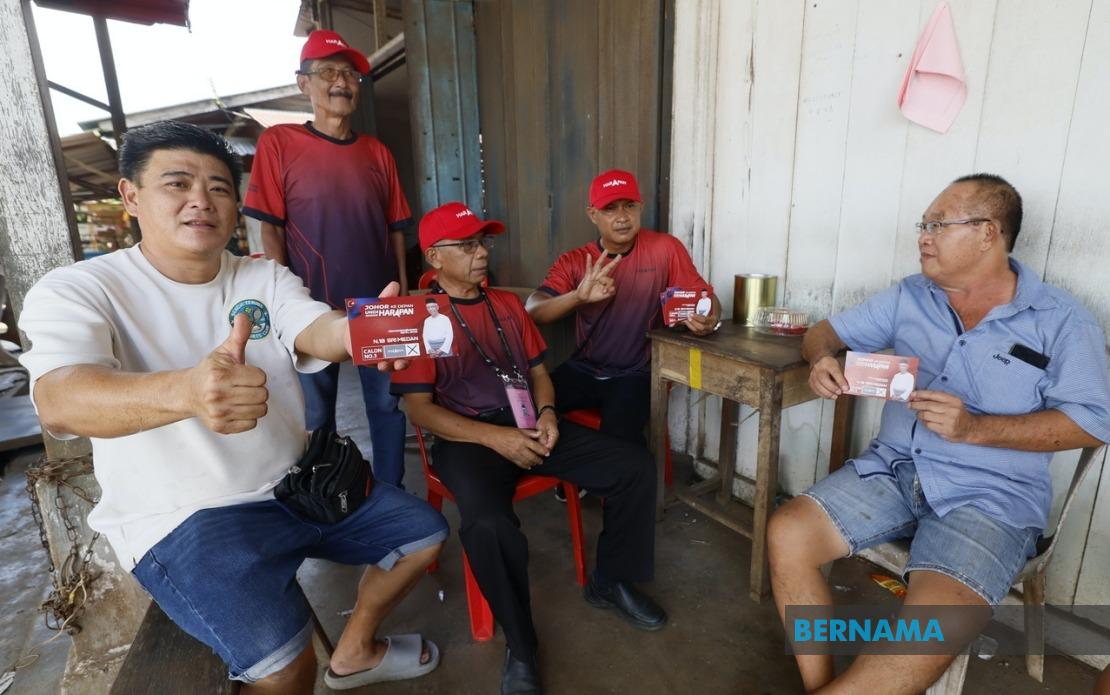
The Pakatan Harapan campaign machinery in Johor is banking on a grassroots appeal as it challenges the ruling Barisan Nasional in traditionally stronghold seats. In Sri Medan, the coalition's candidate Hishamudin @ Misrin Ishak is gambling on his background as a former mathematics teacher and village head to dislodge incumbent Datuk Zulkurnain Kamisan, who represents the entrenched BN machinery in this constituency.
Known locally as "Cikgu Misrin", Hishamudin has anchored his campaign narrative around accessibility and direct constituent engagement. Speaking during campaign activities in Pekan Kangkar Senangar, the PH hopeful articulated a vision centred on service delivery and cross-partisan governance, emphasising that his door would remain open to all residents regardless of their political leanings. This positioning reflects broader PH strategy to shift electoral discourse away from partisan rhetoric towards practical problem-solving—a calculated bid to win over swing voters in constituencies where opposition presence has traditionally been weak.
Flood mitigation emerges as a cornerstone of Hishamudin's platform, targeting a chronic problem that has vexed Sri Medan residents for years. Rather than vague promises of infrastructure overhauls, his framing emphasises incremental improvement and sustained commitment to addressing drainage and water management challenges. This localist focus resonates particularly in semi-urban Malaysian constituencies where infrastructure deficiencies disproportionately affect lower-income households, making infrastructure reliability a decisive electoral factor.
Beyond physical infrastructure, Hishamudin is positioning himself as a champion of inclusive economic development, particularly for youth and small enterprises. His commitment to facilitating Technical and Vocational Education and Training programmes addresses a genuine gap in Malaysia's education ecosystem, where pathways beyond the traditional academic route remain underdeveloped. By explicitly linking skills training to market access and entrepreneurship support, he taps into frustrations among younger voters who perceive limited economic mobility in their home districts.
The candidate's emphasis on balanced development across urban, semi-urban, and rural zones within Sri Medan reflects deeper tensions within Johor's uneven spatial development. Suburban constituencies often experience infrastructure neglect in peripheral villages despite proximity to developed urban centres, creating pockets of relative deprivation that fuel electoral volatility. Hishamudin's pledge to ensure equitable facility provision across these zones addresses a tangible grievance that previous administrations have failed to adequately resolve.
Digital education exposure forms another dimension of his youth-oriented agenda, signalling awareness that post-pandemic Malaysia faces mounting pressure to ensure technological literacy among rural and semi-urban populations. This appeals to younger parents concerned about their children's competitiveness in an increasingly digital economy, particularly those in areas where digital infrastructure and quality online learning remain patchy.
Hishamudin's credentials as a former village head carry particular weight in Malaysian electoral calculus. Village leadership experience, though often unglamorous, confers legitimacy in managing quotidian governance challenges—rubbish collection, village road maintenance, community cohesion—that state assemblypersons frequently overlook. His framing of this experience as preparation for state-level service suggests a ground-up understanding of how local frustrations accumulate into electoral dissatisfaction.
The phrase "work first, talk later" encapsulates a broader strategic repositioning by PH in Johor. Having governed the state from 2018 to 2020 before losing power to an internally fractured Perikatan Nasional-BN alliance, the coalition has adopted a more cautious, action-oriented messaging approach. Rather than sweeping policy announcements, PH candidates increasingly emphasise delivery capacity and constituent focus—implicitly critiquing years of performative governance under successive administrations.
Hishamudin faces a formidable electoral challenge. Sri Medan has long been BN territory, reflecting the coalition's historical dominance in Johor's semi-urban constituencies where Umno retains organisational depth and rural networks. His opponent Zulkurnain, as the sitting assemblyperson, commands incumbent advantages including resource allocation authority and administrative machinery. Perikatan Nasional's Ahmad Rosdi Bahari adds a three-way contest that could fragment opposition votes, benefiting the BN incumbent.
Yet Hishamudin's positioning contains recognisable strengths. As a "new face" without baggage from previous administrations, he offers voters a reset option. His teaching background potentially resonates with Johor's education-conscious middle class, while his village leadership experience appeals to rural constituencies that form Sri Medan's demographic backbone. His explicit commitment to non-partisan service delivery, whether genuine or strategically calculated, addresses voter fatigue with factional politics.
The 16th Johor state election, scheduled for July 11, represents a critical test of PH's electoral viability in Malaysia's most complex political terrain. Johor's fractured coalition politics, legacy of three consecutive administrations in four years, and deep-rooted communal networks create unpredictable voting patterns that defy simple prediction. Sri Medan's contest exemplifies the granular, constituency-level challenges facing opposition parties attempting to break BN's structural advantages in semi-urban Johor.
Hishamudin's campaign thus represents a microcosm of PH's wider Johor strategy: patient, local, problem-focused engagement designed to erode BN's taken-for-granted dominance. Early voting occurs on July 7, providing a preliminary indicator of whether his constituent-centred approach translates into electoral movement in a traditionally inert political terrain.

