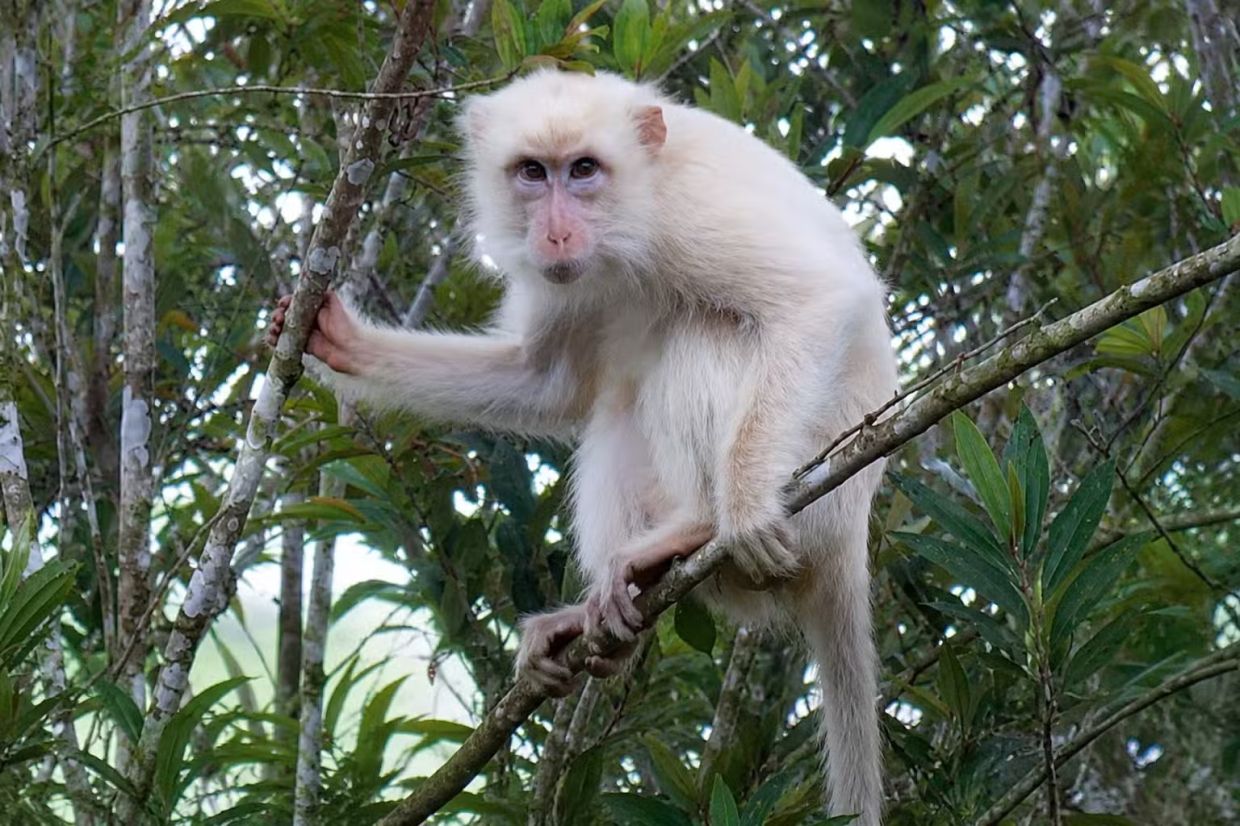
A visibly distinctive white macaque that has inhabited forests in Sultan Kudarat province for nearly a decade has become the focus of an intensive conservation initiative following widespread social media circulation of its images. The unusually pigmented primate, long familiar to nearby residents, now faces coordinated protection measures implemented by the Department of Environment and Natural Resources and local government agencies concerned about the consequences of sudden internet fame.
The animal represents a Philippine long-tailed macaque carrying what scientists believe is a pigmentation anomaly rather than albinism. Initial field assessments by a composite monitoring team from DENR Region XII revealed that the macaque's eyes display brown to dark brown coloration, indicating the condition may be leucism or another hereditary pigmentation disorder. Definitive scientific identification remains pending formal expert evaluation, though specialists acknowledge the rarity of such visible anomalies in wild macaque populations across Southeast Asia.
Local resident Armando documented the macaque's presence since 2016, when the animal began regular appearances in the area. For years, the monkey moved through its forest habitat with minimal external interference, forming part of the natural wildlife tapestry that residents observed and accepted as part of their environment. The situation changed dramatically when digital images and video recordings reached social media platforms, transforming a locally known phenomenon into a topic attracting national and international attention.
This sudden visibility triggered legitimate conservation alarms. Environmental authorities identified multiple threats accompanying online exposure: habitat disturbance from curious visitors, poaching risk, potential capture for illegal collection, and involvement in wildlife trafficking networks that exploit animals of unusual appearance. Such concerns reflect broader Southeast Asian patterns where social media virality has previously endangered rare species through uncontrolled human access and criminal exploitation.
Conservation authorities responded with swift geographical restrictions. The municipal government of Senator Ninoy Aquino town temporarily closed the area where the macaque frequents, preventing unauthorized public access while allowing controlled scientific observation. This measure addresses dual concerns: protecting the animal from human-induced stress and eliminating opportunities for illegal wildlife collection. The closure represents acknowledgment that fame itself constitutes an environmental threat requiring active management.
Field assessments confirmed that the macaque's habitat retains sufficient ecological integrity to support the resident population. Secondary forest vegetation persists, and natural food sources remain adequate for the group's nutritional requirements. This positive assessment suggests that habitat degradation has not yet undermined the population's sustainability, though ongoing monitoring remains essential given pressures from deforestation common to the broader region.
Barangay Bugso is advancing formal legislative protection through a municipal ordinance that would institutionalize safeguards for the white macaque, its immediate habitat, and the surrounding forest ecosystem. This approach converts temporary administrative measures into permanent legal protections, establishing enforceable boundaries and establishing protocols for future management decisions. The ordinance structure reflects best practices in Philippine biodiversity law, grounding conservation actions in formal governance frameworks.
Simultaneously, local authorities are advancing habitat restoration initiatives including tree-planting campaigns designed to strengthen forest resilience and expand the macaque population's ecological carrying capacity. These efforts reframe the white macaque as a flagship species for broader ecosystem protection, leveraging its unusual appeal to generate community support for conservation measures that benefit entire habitats and interconnected wildlife communities. Responsible ecotourism development represents a secondary objective, potentially generating sustainable economic activity while maintaining species protection.
National environmental law provides foundational protections for the macaque and all Philippine wildlife. Republic Act No. 9147, the Wildlife Resources Conservation and Protection Act, establishes comprehensive prohibitions against hunting, capturing, collecting, possessing, transporting, or trading protected species without proper permits. These legal instruments create enforcement mechanisms for protecting the macaque against criminal exploitation, though implementation effectiveness depends on adequate agency resources and consistent inter-agency coordination.
Authorities have explicitly appealed to digital content creators—vloggers, photographers, journalists, and social media users—to refrain from disclosing precise sighting locations or posting geotagged content that could compromise species security. This guidance recognizes that well-intentioned documentation paradoxically endangers wildlife by enabling targeted poaching and trafficking operations. The appeal extends traditional conservation ethics into digital contexts, acknowledging that contemporary information-sharing infrastructure creates novel vulnerabilities requiring new protective strategies.
The DENR's ongoing activities include submitting comprehensive macaque documentation to the Biodiversity Management Bureau for technical evaluation and formal species status assessment. Continuous habitat monitoring, strengthened coordination with community stakeholders, and intensified public education campaigns constitute institutional commitments to sustaining protection across multiple administrative levels. This multi-layered approach addresses the complexity of modern conservation challenges in Philippine contexts where biological significance intersects with social media dynamics, tourism pressures, and trafficking networks.
The white macaque's trajectory—from quiet decades of local acceptance to sudden global attention and formal protection status—illustrates contemporary conservation realities across Southeast Asia. Digital connectivity transforms previously isolated wildlife into potential commodities within trafficking networks while simultaneously creating opportunities for coordinated protection. Success depends on rapid institutional response, sustained community engagement, and strategic communication discouraging the very visibility that initially endangered the species. For now, the macaque remains protected within its forest, its survival dependent on authorities' ability to balance scientific study with robust safeguarding against human interference.

