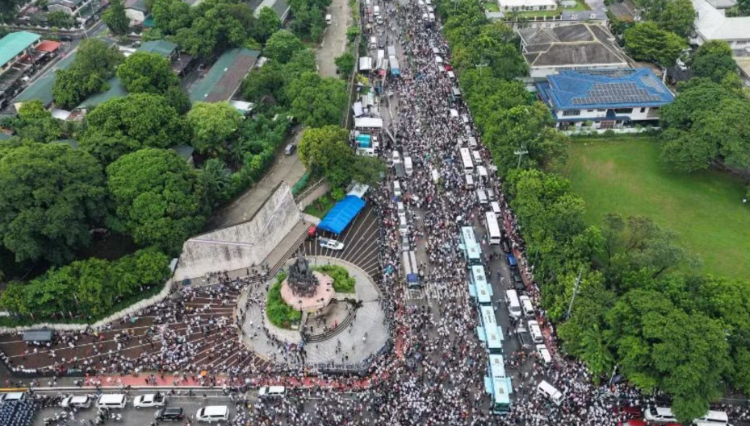
Thousands of members of the Iglesia Ni Cristo gathered on Manila's main thoroughfare on Tuesday in a show of force that paralysed the capital's rush hour traffic, demonstrating the religious sect's continued ability to mobilise supporters in defence of one of its most prominent political figures. The demonstration centred on Senator Rodante Marcoleta, a senior INC member and staunch ally of Vice President Sara Duterte, who faces imminent graft charges relating to alleged failures to disclose 75 million pesos in unused election campaign funds. The scale of the congregation alarmed authorities, with police initially estimating 8,000 attendees and warning that numbers would swell throughout the day as commuters struggled to navigate the gridlocked streets around EDSA, with only dedicated bus lanes remaining passable for peak-hour traffic.
The timing of the rally carries particular significance within the volatile landscape of Philippine politics. Marcoleta's legal troubles emerged just one day before the announcement that formal charges would be filed against him, following a decision by Government Ombudsman Jesus Remulla to pursue the case. Yet the speed with which the INC mobilised its membership suggests the church leadership had anticipated these developments and strategised its response accordingly. This coordination underscores how tightly integrated the sect remains within Filipino political structures, capable of orchestrating nationwide demonstrations on short notice to protect its institutional interests and those of its allied politicians.
The INC's intervention on Marcoleta's behalf must be understood within the broader context of the Duterte family's fractured political standing. Vice President Duterte, once considered President Ferdinand Marcos's closest political partner, has undergone a dramatic reversal in their relationship, resulting in two separate impeachment proceedings against her. The House of Representatives impeached her last month, setting the stage for a Senate trial beginning July 6, where her fate rests upon securing a simple majority vote of guilty verdicts. With only 16 affirmative votes required out of 24 senators to remove her from office and bar her permanently from electoral politics, the alignment of every potential ally becomes critical to her survival.
Marcoleta's position as a senator makes him indispensable to these calculations. Political observers widely acknowledge that he represents a reliable vote against conviction, meaning his removal from the Senate through arrest or imprisonment would significantly strengthen Duterte's opposition. This explains why the INC threw its institutional weight behind the senator, framing the graft charges not as a matter of individual accountability but as a question of systemic justice. Through spokesman Edwil Zabala, the church rejected what it characterised as selective prosecution, declaring that "even if they imprison Senator Marcoleta, we will not stop demanding justice" and condemning the charges as an example of injustice masquerading as law enforcement.
The INC's claims of selective justice carry a certain irony given the broader scandals enveloping multiple Duterte loyalists in the Senate. Just weeks prior, prosecutors filed charges against Senator Jose "Jinggoy" Estrada, another Duterte ally, implicating him in a massive corruption scheme involving bogus flood control projects that generated significant public outrage. More dramatically, Senator Ronald "Bato" Dela Rosa, a former police chief and close associate of ex-president Rodrigo Duterte, entered hiding after narrowly evading arrest on an International Criminal Court warrant relating to alleged extrajudicial killings during the Duterte administration's infamous drug war. These concurrent developments paint a picture of the Duterte political ecosystem facing unprecedented legal jeopardy across multiple fronts.
Paradoxically, the INC itself has demonstrated considerable political agency independent of protecting individual Duterte allies. In November, the church mobilised what observers estimated to be hundreds of thousands of supporters to rally against the flood control scandal that ensnared multiple officials and lawmakers, using the occasion to direct blame toward President Marcos. In January, the sect organised another massive demonstration opposing Duterte's initial impeachment, only to see those efforts vindicated when the Supreme Court reversed the charges before the House proceeded with fresh impeachment articles last month. This pattern suggests the INC calculates its political interventions based on protecting the broader Duterte faction rather than merely responding to immediate crises.
The church's historical role as a voting bloc cannot be understated in evaluating its contemporary political significance. The INC commands the loyalty of millions of Filipino voters who prioritise the church's political directives when casting ballots. During presidential and legislative elections, the sect's endorsement or opposition can shift outcomes across multiple races, making it an invaluable ally for any political faction seeking durable electoral support. The Duterte family benefited enormously from INC backing during the rise of Rodrigo Duterte to the presidency and continues to depend upon this relationship as multiple family members navigate legal challenges and jockey for political positioning.
President Marcos's decision to cancel a planned luncheon with foreign press corps to monitor the situation signals how seriously the administration views the INC's mobilisation as a potential flashpoint. Rather than dismiss the demonstration as routine political theatre, Marcos's office recognised the rally as an indicator of mobilised opposition with potential consequences for his administration's broader governing agenda. The cancellation itself constitutes a symbolic acknowledgment of the church's power to disrupt normal governmental operations and capture the president's direct attention at moments when political calculations shift rapidly.
Looking forward, the intersection of Marcoleta's legal troubles, Duterte's impending Senate trial, and the INC's demonstrated commitment to defending its political allies will likely generate further confrontations between Duterte-aligned factions and the Marcos administration. Southeast Asian observers of Philippine politics should note that these dynamics extend beyond mere personalistic conflicts between rival elites. Instead, they reflect deeper constitutional tensions about the proper scope of prosecutorial discretion, the relationship between religious institutions and state power, and the extent to which organised voting blocs can legitimately exert pressure on judicial proceedings. The coming weeks will reveal whether the INC's street mobilisation succeeds in tempering government pressure against Marcoleta or whether his prosecution proceeds regardless, establishing important precedent for how Philippine authorities balance institutional independence against organised political pressure.

