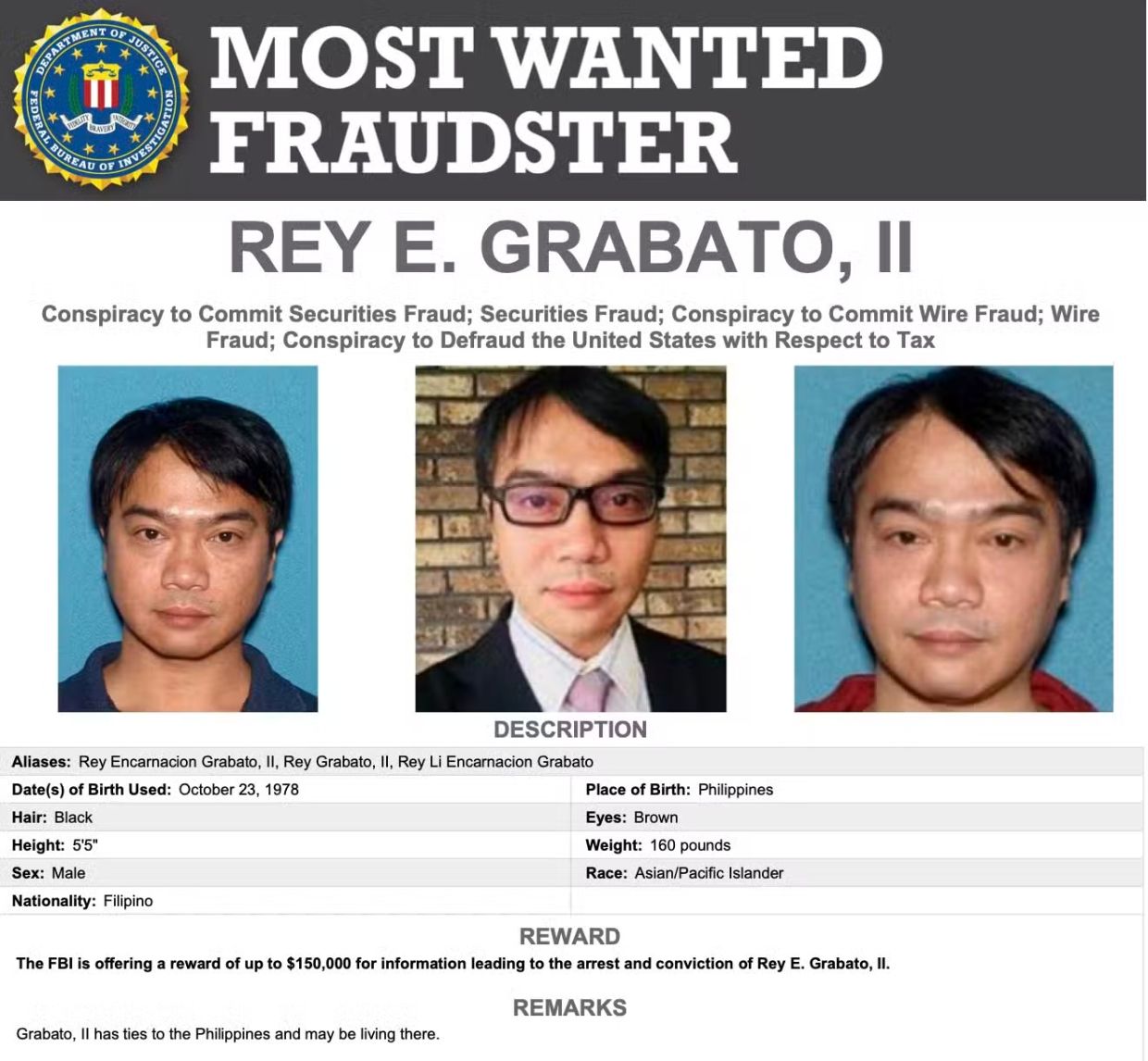
Rey E. Grabato II, whose father serves as mayor of Mina in Iloilo province, has been designated as a fugitive on the Federal Bureau of Investigation's Most Wanted Fraudsters list. The action follows serious charges related to an investment scheme that authorities allege defrauded roughly 2,000 investors of more than US$650 million between 2018 and 2022. Grabato's addition to the prominent law enforcement roster underscores ongoing international criminal activity with Philippine connections, a development that carries implications for financial regulatory cooperation across Southeast Asia and between the Philippines and the United States.
Grabato comes from a family with deep ties to municipal governance in Iloilo. His father, Rey P. Grabato, currently holds the position of mayor of Mina, whilst his mother, Lydia Encarnacion Grabato, previously served as mayor of the same municipality. The family's involvement in local politics contrasts sharply with the allegations against Grabato II, who operated investment businesses in the United States and maintained residences in New Jersey and the Philippines. This juxtaposition highlights how transnational criminal networks can emerge from families with public standing, complicating governance and community trust dynamics in the municipalities concerned.
The core allegations centre on Grabato's leadership of National Realty Investment Advisors LLC (NRIA), where he served as former president and majority owner. Federal prosecutors have characterised the operation as a sophisticated Ponzi scheme that operated through the NRIA Partners Portfolio Fund I LLC, purportedly a real estate investment vehicle. Working alongside co-conspirator Thomas Nicholas Salzano, Grabato allegedly deployed an extensive marketing strategy encompassing thousands of email communications, television and radio advertisements, billboard placements, and direct investor presentations. This multi-channel promotional approach amplified the scheme's reach, particularly affecting hundreds of investors in New Jersey and other states across America.
The marketing campaign conveyed deliberately false information to potential investors regarding NRIA's financial health and investment performance. Prosecutors allege that Grabato and Salzano misrepresented the company as financially robust and capable of generating substantial profits through real estate ventures. In reality, federal investigators determined that NRIA produced minimal to negligible profits and instead operated as a classic Ponzi structure—relying entirely on capital infusions from newly recruited investors to generate fictitious returns and maintain earlier investor confidence. This deceptive mechanism perpetuated the fraud across the four-year operational window, enabling the scheme to accumulate enormous losses for unsuspecting participants.
Beyond the investment fraud, prosecutors have levelled additional charges involving the misappropriation of investor funds. Grabato and his associates are accused of directly siphoning millions of dollars contributed by investors, diverting these resources away from legitimate investment activities and into personal or undisclosed accounts. Such allegations suggest a layered fraud structure combining both Ponzi mechanics and outright embezzlement, indicating a sophisticated criminal enterprise rather than inadvertent business failure. The scale of alleged misappropriation demonstrates the predatory nature of the scheme and the depth of criminal intent attributed to Grabato by federal authorities.
Parallel to the investment fraud charges, Grabato faces separate allegations concerning obstruction of tax collection by the United States Internal Revenue Service. Federal prosecutors allege that between November 2007 and August 2022, Grabato engaged in a scheme designed to thwart IRS efforts to recover approximately US$26 million in outstanding tax liabilities owed to the American government. This extended temporal scope, spanning nearly fifteen years, suggests a pattern of financial misconduct extending well beyond the investment fraud window. The tax obstruction charges indicate Grabato's alleged involvement in systematic efforts to evade governmental financial claims, potentially involving asset concealment or fraudulent reporting mechanisms.
A federal arrest warrant for Grabato was formally issued on October 12, 2022, by the US District Court for the District of New Jersey in Newark, following his official charging in connection with securities and wire fraud, as well as conspiracy to defraud the United States regarding tax matters. At the time of charging, Grabato was identified as residing in Hoboken, New Jersey, with additional ties to the Philippines. He remained a fugitive despite the formal charges, whilst his alleged co-conspirator Salzano was apprehended in October 2022. Grabato's continued evasion of law enforcement suggests he may have fled to jurisdictions with limited US extradition agreements or established alternative identities to evade detection.
The FBI has indicated that Grabato has utilised multiple aliases throughout his criminal activity, including Rey Encarnacion Grabato II, Rey Grabato II, and Rey Li Encarnacion Grabato. This pattern of identity variation is typical among sophisticated white-collar fugitives seeking to obscure their movements and evade international law enforcement tracking. The use of multiple names complicates apprehension efforts and enables individuals to establish separate financial and legal identities across different jurisdictions. Such practices indicate premeditated evasion planning and suggest Grabato's awareness of criminal exposure prior to formal charges.
The FBI established its Most Wanted Fraudsters list in June 2024 as part of a strategic initiative to prioritise the identification and apprehension of high-profile fraud fugitives. This specialised designation reflects law enforcement's recognition that financial crimes of unprecedented scale require focused prosecutorial and investigative resources. Grabato's inclusion places him among an international cohort of fugitives implicated in major fraud offences, signalling the cross-border nature of contemporary financial crime. The FBI is offering a substantial reward of up to US$150,000 for information culminating in Grabato's arrest and conviction, reflecting both the severity of allegations and the operational costs associated with apprehending international fugitives.
Other individuals with Philippine connections feature prominently on the FBI's Most Wanted Fraudsters roster, illustrating a troubling pattern. Michael Lizaso Marasigan, a Filipino-American dual citizen with connections to Guam and the Philippines, was convicted in May 2025 on charges encompassing illegal gambling operations, money laundering, and wire fraud. Additionally, married couple John Michael Dimitrion and Julieanne Baldueza Dimitrion, who pleaded guilty in 2009 to orchestrating a mortgage fraud scheme in Hawaii, remain at large after failing to appear for sentencing in July 2010. This clustering of Philippine-linked fugitives suggests either heightened exposure of Filipino and Filipino-American involvement in transnational fraud, or increased US law enforcement attention to such cases.
For Malaysian readers and Southeast Asian observers, Grabato's case illustrates several critical dynamics affecting the region. First, transnational financial fraud increasingly emanates from individuals with roots in Southeast Asia, highlighting the importance of robust domestic financial regulatory frameworks and cross-border cooperation mechanisms. Second, the sophistication of modern investment fraud—leveraging digital marketing, false documentation, and complex corporate structures—presents challenges for both individual investor protection and regulatory oversight. Third, the involvement of individuals from prominent families underscores that financial crime transcends socioeconomic boundaries and can compromise institutional integrity.
The case also demonstrates the evolving capacity of US law enforcement to pursue complex financial crimes with international dimensions. The FBI's creation of a dedicated Most Wanted Fraudsters list reflects recognition that white-collar crime requires specialised investigative resources comparable to those traditionally deployed against violent crime. For Southeast Asian jurisdictions, including Malaysia, this development suggests the necessity for comparable institutional capacity-building and intelligence-sharing arrangements to combat organised financial crime within the region. Enhanced cooperation with US authorities, combined with strengthened domestic financial crime investigation units, remains essential to protecting regional investors and maintaining financial system integrity.
Individuals possessing information regarding Grabato's whereabouts are encouraged to contact local FBI field offices or the nearest US embassy or consular mission. The international nature of this manhunt reflects broader law enforcement coordination mechanisms spanning multiple countries and jurisdictions. For Southeast Asian governments, including Malaysia, such cases underscore the importance of maintaining effective diplomatic channels with US authorities and implementing robust financial crime prevention protocols domestically.

