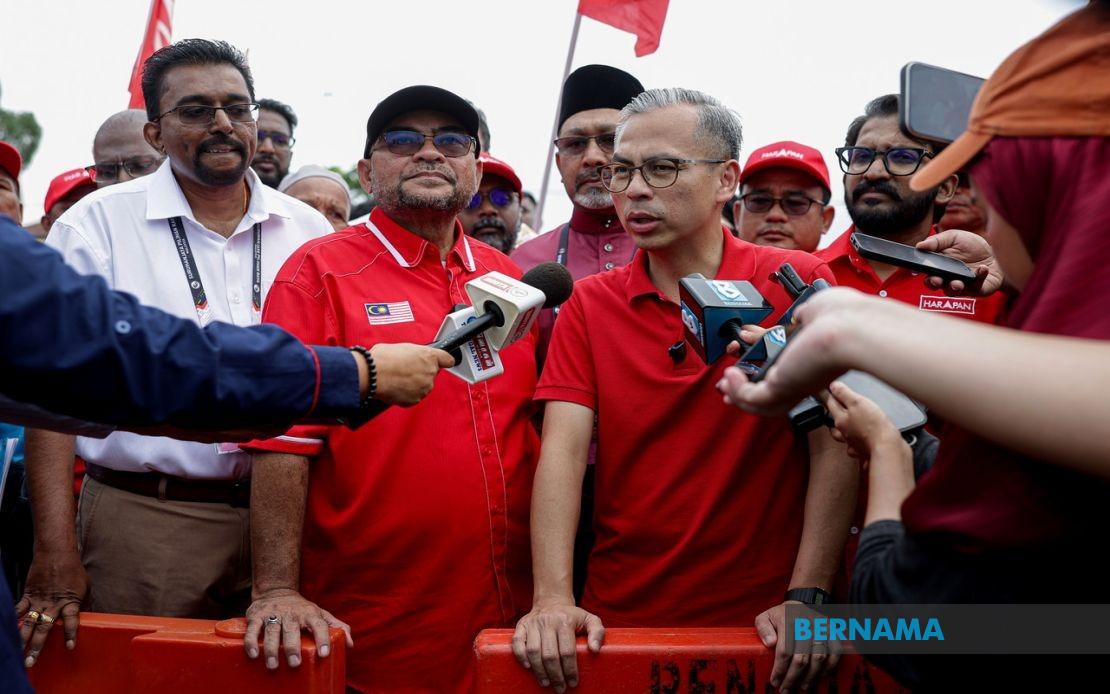
Pakatan Harapan has unveiled a campaign strategy anchored squarely on administrative continuity and the established performance record of Menteri Besar Datuk Seri Aminuddin Harun as the coalition gears up for the Negeri Sembilan state election. The approach signals PH's confidence that voters will reward the incumbent administration based on tangible results delivered over the past six years, rather than on promises or ideological appeals alone.
Communications director Datuk Seri Fahmi Fadzil articulated the coalition's central message during the candidate nomination process at Jempol, emphasizing that PH will place the spotlight on what it characterizes as the proven leadership of Aminuddin and the measurable economic benefits that have flowed to the state. The strategy represents a deliberate choice to campaign on incumbency and demonstrated competence rather than pivoting toward broader national political narratives that might overshadow local governance achievements.
Among the specific accomplishments that PH intends to highlight are increased zakat collections, improved state revenue generation, and sustained foreign investment inflows into Negeri Sembilan. The construction of a new port emerges as a flagship infrastructure project symbolizing economic dynamism, offering a concrete example of how state administration has translated policy into tangible development. These metrics resonate with Malaysian voters who increasingly prioritize bread-and-butter issues and visible infrastructure improvements over abstract political messaging.
For Malaysian readers and regional observers, this campaign emphasis carries broader significance. The Negeri Sembilan contest represents an early test of whether PH can successfully defend state-level strongholds and consolidate support in the post-2018 transition period. The coalition's decision to lean heavily on administrative performance rather than factional or personality-based narratives suggests organizational maturity and recognition that electoral viability depends on sustained delivery of public goods and economic management rather than novelty or anti-establishment sentiment alone.
Fahmi's statements regarding specific constituencies reveal how PH is tailoring messaging to local concerns. In the four-cornered Jeram Padang contest, the coalition has identified employment opportunities as the decisive issue animating young voters, a particularly salient focus given Malaysia's persistent youth underemployment despite national economic recovery. By positioning PH candidate G. Manivannan, a lawyer and Prime Minister Anwar Ibrahim's political secretary, as a conduit for new economic opportunities emerging from state-level initiatives, PH seeks to translate abstract administrative achievements into concrete career prospects that resonate with demographic cohorts historically responsive to employment-focused platforms.
The nomination process itself proceeded without incident across the four Jempol parliamentary constituency seats—Serting, Palong, Jeram Padang, and Bahau—reflecting organizational coordination and internal party discipline. The seat-by-seat contest configurations reveal a fractured opposition landscape that PH may exploit strategically. Bahau presents a straight fight between DAP incumbent Teo Kok Seong and MCA's Chong Fui Ming, while Serting and Palong feature three-cornered contests involving Perikatan Nasional and Bersatu candidates respectively, potentially diluting opposition vote shares and improving PH's winning prospects in constituencies where the coalition maintains organizational presence.
The inclusion of Dayana Dal as an Asli candidate contesting Jeram Padang underscores growing electoral recognition of indigenous representation, though her positioning against better-resourced established party candidates suggests symbolic rather than substantively competitive candidacy. Nevertheless, the presence of Orang Asli nominees in formal contests marks incremental progress in ensuring minority community visibility within electoral processes, an consideration that carries implications for PH's social contract messaging and perceived inclusivity.
Fahmi's explicit admonition regarding campaign conduct and responsible social media engagement addresses concerns that have shadowed recent Malaysian elections. His directive that candidates and party machinery avoid religious, racial, and ruler-related contentious matters—the colloquial 3Rs framework—while abstaining from misinformation propagation reflects institutional learning from polarizing campaigns that fractured social cohesion. As Communications Minister, Fahmi's dual responsibility for both party campaign oversight and national media environment stewardship creates potential conflicts of interest, yet his public commitment to monitoring media practitioner welfare during the campaign suggests acknowledgment that election integrity depends partly on protecting journalistic independence.
The Election Commission's scheduling of early voting on July 28 and polling day on August 1 compresses the campaign period to two weeks, a compressed timeframe that may advantage incumbents possessing administrative infrastructure and media reach over challengers dependent on rapid ground mobilization. For PH, this abbreviated timeline favors a campaign centered on demonstrable achievements and existing voter familiarity with the Aminuddin administration rather than strategies requiring extended persuasion or complex messaging development. The condensed election calendar thus structurally reinforces PH's stated preference for continuity-focused campaigning.
Regional observers should recognize that Negeri Sembilan occupies strategic importance within Malaysian federalism as a relatively prosperous state with significant Malay-Muslim majorities and substantial foreign investment presence. PH's performance here will signal whether the coalition can maintain momentum in state contests during the broader political cycle, and whether administrative performance metrics genuinely influence voter behavior or whether deeper structural forces—communal identity, national partisan polarization, or leadership personality factors—remain determinative. The election thus functions as a microcosm testing competing theories of contemporary Malaysian electoral behavior.
The diversity of candidacies—from lawyer-administrator Manivannan to trade union-connected contenders across various constituencies—reflects efforts to construct cross-class coalition appeals. Yet the ultimate viability of PH's administrative continuity platform depends fundamentally on whether ordinary Negeri Sembilan residents perceive the promised economic benefits as having materially improved their circumstances, rather than accruing primarily to state-level elites or foreign investors. This perception gap, unquantifiable in pre-election reporting, may ultimately determine whether voters reward or punish the incumbent administration come August 1.

