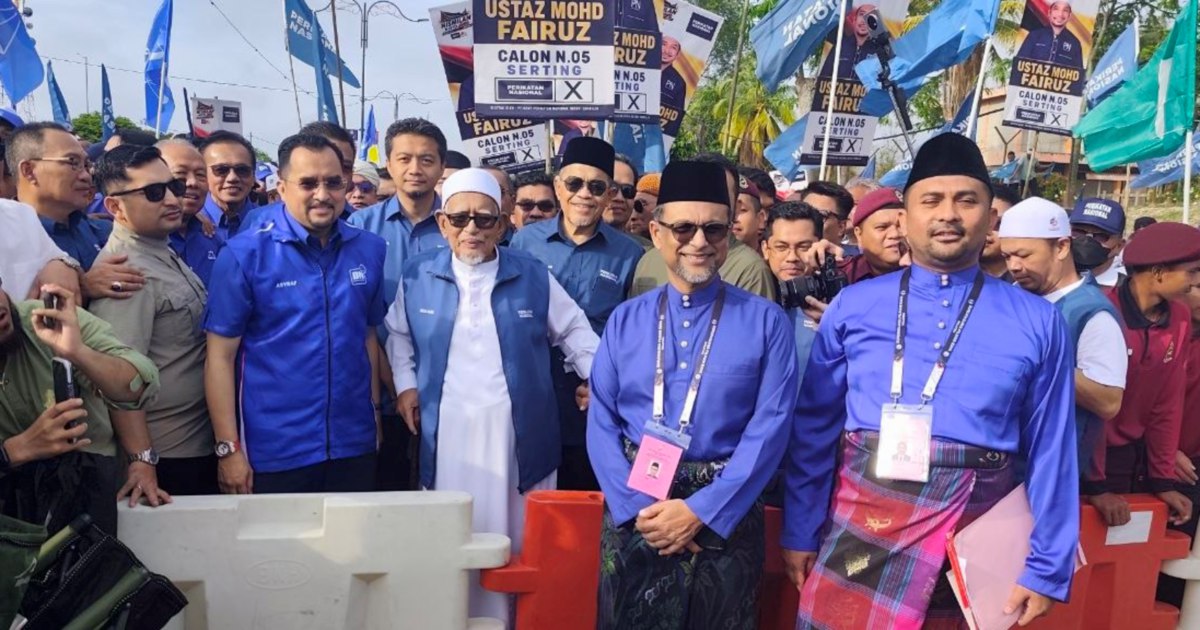
The Perikatan Nasional coalition has committed to providing campaign support for Barisan Nasional during the forthcoming Negri Sembilan state election, according to an announcement made by PAS president Tan Sri Abdul Hadi Awang in Jempol. This pledge signals a continuation of the political cooperation between the two major coalitions that has defined Malaysian politics over recent years.
The commitment represents an extension of the informal alliance that has existed between Perikatan Nasional and Barisan Nasional at the federal level since 2020, when the collapse of the Sheraton Move government reshaped the country's political landscape. While the two coalitions have maintained this working relationship through several parliamentary sessions, electoral cooperation at the state level has been less consistent, making this declaration for Negri Sembilan noteworthy.
Negri Sembilan has traditionally been a Barisan Nasional stronghold, with the coalition controlling the state government for decades before recent political shifts. The state election, whenever it is scheduled, will test the effectiveness of this partnership on the ground, particularly in constituencies where voters have become increasingly unpredictable across multiple electoral cycles. The involvement of Perikatan Nasional's machinery, particularly PAS and other member parties, could prove significant in marginal seats where election victories are determined by narrow margins.
Tan Sri Hadi's statement underscores PAS's central role within the Perikatan Nasional framework as a coalition partner with substantial grassroots organisation, particularly in rural areas of Negri Sembilan. PAS's traditional strongholds and voter networks, especially among the Malay-Muslim demographic, could complement Barisan Nasional's electoral strategies in districts where the two coalitions have previously competed directly for the same voter base.
The cooperation between these coalitions carries implications for opposition parties, particularly Pakatan Harapan, which has struggled to build momentum in Negri Sembilan despite securing significant electoral support elsewhere in the country. A unified campaign effort between Perikatan Nasional and Barisan Nasional could further squeeze the political space available to opposition candidates, particularly in three-cornered fights where vote-splitting remains a critical factor in determining outcomes.
From a broader regional perspective, this Negri Sembilan arrangement reflects the pragmatic calculations driving Malaysian politics, where electoral agreements and campaign coordination frequently override ideological differences or previous competitive rivalries. The willingness of both coalitions to support a common slate, or at minimum to avoid splitting votes in key contests, demonstrates how contemporary Malaysian electoral politics operates through negotiated settlements rather than purely principled party competition.
The mechanics of this cooperation remain partially unclear, including whether it extends to fielding joint candidates in certain constituencies or merely involves voluntary campaign assistance and party member mobilisation. The level of formal coordination between Perikatan Nasional and Barisan Nasional machinery will ultimately determine whether this pledge translates into meaningful electoral advantages or remains primarily symbolic.
For Malaysian voters in Negri Sembilan, this development suggests a narrowing of apparent political choices, with the state effectively becoming a contest between the combined Perikatan Nasional-Barisan Nasional alliance and the opposition coalition. This consolidation of the political landscape at the state level mirrors similar patterns observed in several other Malaysian states, where two-coalition politics has become increasingly pronounced.
Historically, Negri Sembilan has demonstrated volatility during recent election cycles, with swing voters across multiple constituencies proving responsive to localized issues and grassroots mobilisation rather than purely national political narratives. The provision of additional campaign resources and organisational support from Perikatan Nasional could amplify the reach of Barisan Nasional's messaging in constituencies where both coalitions maintain functional party structures and loyal voter bases.

