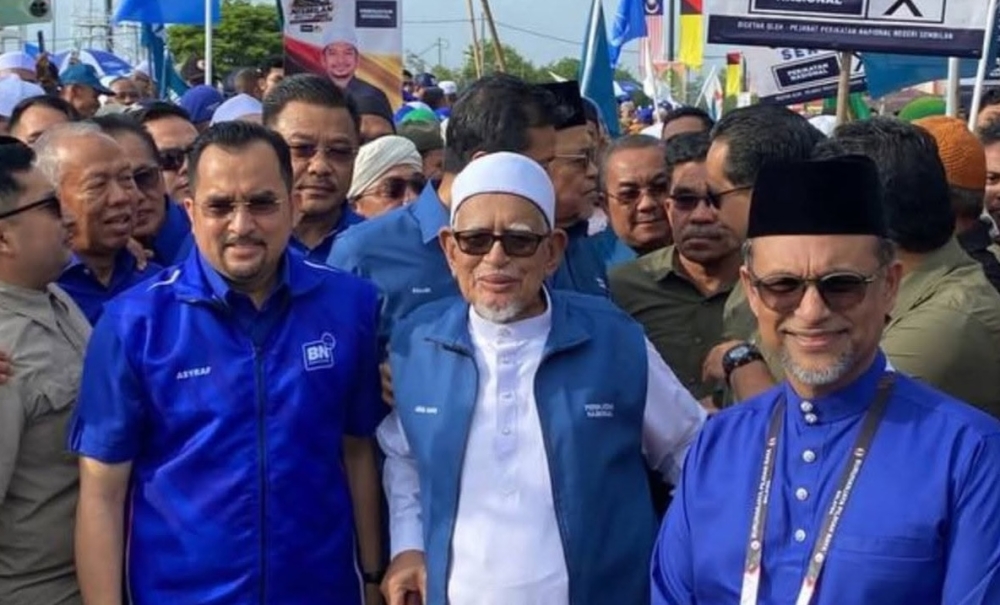
Perikatan Nasional and Barisan Nasional have agreed to conduct a joint campaign for the Negeri Sembilan state election, according to an announcement by PAS president Tan Sri Abdul Hadi Awang. The coordinated effort represents a continuation of the political alliance that has governed Malaysia at the federal level since the 2022 general election, extending the partnership into state-level contests.
This strategic alignment between the two major coalitions underscores the stability of their working relationship, despite periodic tensions that have surfaced in various state and federal contexts. The decision to mount a unified campaign in Negeri Sembilan suggests both coalitions view their shared interests as outweighing internal disagreements, at least for the purpose of the state election campaign. Such joint efforts typically involve shared messaging, coordinated candidate support, and cross-coalition campaign events.
Negeri Sembilan represents a key battleground in Malaysian electoral politics. The state has historically been competitive, with different coalitions winning representation across its nine parliamentary constituencies. Control of the state assembly holds symbolic and practical significance for both PN and BN, influencing their standing heading into future federal elections and affecting resource allocation across the region.
For Perikatan Nasional, which comprises PAS, Bersatu, and several smaller parties, this joint campaign approach with the BN represents a demonstration of unity despite occasional friction within their federal partnership. PAS, as the largest component of PN, has sought to consolidate its political position particularly in Peninsular Malaysia, where its base remains strongest. Negeri Sembilan, while not traditionally a PAS stronghold compared to states like Kelantan and Terengganu, offers opportunities for expansion.
Barisan Nasional, historically Malaysia's dominant political force, faces the ongoing challenge of rebuilding its electoral machinery after losing federal power in 2018 and suffering reduced representation in 2022. The coalition, anchored by UMNO with MCA and MIC as component parties, views state elections as crucial opportunities to demonstrate renewed relevance and strengthen its hand in negotiations with federal partners.
The timing of Tan Sri Abdul Hadi Awang's announcement reflects the approach of what is expected to be a competitive campaign period. Election Commission guidelines require specific timeframes for campaign activities, and early coordination between coalition partners allows for logistical planning and resource mobilization. Malaysian voters, accustomed to seeing federal coalition partners contest state elections separately with varying degrees of cooperation, may find the explicit commitment to joint campaigning noteworthy.
For Malaysian observers and political analysts, this development carries implications for the broader trajectory of federal politics. The ability of PN and BN to cooperate smoothly in campaign settings suggests their partnership possesses institutional depth beyond mere electoral convenience. However, such joint exercises also create potential friction points if campaign outcomes disappoint either coalition's leadership or activist base, potentially affecting their federal cooperation thereafter.
Regional observers from Southeast Asia watch Malaysian coalition politics closely, as Malaysia's relatively stable democratic framework and complex multi-party system offer important lessons. The willingness of major coalitions to maintain working relationships despite ideological differences demonstrates institutional pragmatism that has become characteristic of Malaysian politics since 2018.
The implications for Malaysian voters in Negeri Sembilan merit consideration. Joint PN-BN campaigning may reduce the visibility of opposition parties such as Pakatan Harapan, which will need to mount an independent challenge to the combined coalition effort. This creates an asymmetry in campaign resources and visibility that could influence electoral outcomes. Whether voters view such joint campaigns as evidence of stable, predictable governance or as a consolidation of power limiting democratic choice may determine electoral response.
Tan Sri Abdul Hadi Awang's confirmation of the campaign arrangement also signals clarity on party positioning ahead of what is likely to be a contentious campaign season. By making the announcement publicly, PAS leadership sends messages both to its internal base and to coalition partners about the seriousness with which it approaches the Negeri Sembilan contest. This transparency aids in coordinating expectations among the various stakeholders within both coalitions.
Looking forward, the outcome of the Negeri Sembilan election will provide insights into whether the PN-BN federal partnership retains sufficient cohesion and voter appeal to translate into state-level success. The campaign itself will be closely monitored by political observers seeking to understand the current state of Malaysian coalition politics and the durability of arrangements established following the 2022 general election.

