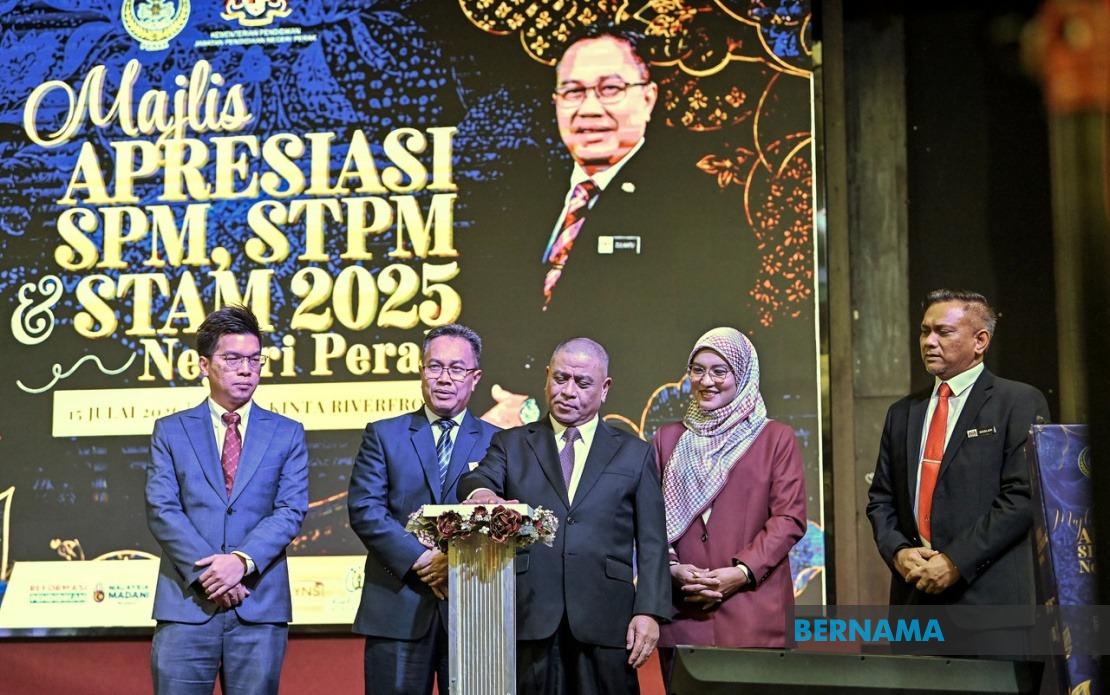
The Perak state government's investment in student welfare through its Menteri Besar Scholarship programme is yielding tangible benefits for recipients navigating the escalating costs of secondary and tertiary education. At a state-level appreciation ceremony held in Ipoh on July 15, education leaders highlighted how the scholarship scheme not only alleviates immediate financial strain on households but also functions as a catalyst for sustained academic performance across the state's student population.
For Yoong Lam, a 20-year-old graduate from Sekolah Menengah Kebangsaan Sultan Yussuff, the RM1,200 semester allowance represents far more than pocket money—it directly addresses her family's pressing educational expenses. The straight-A student, who achieved a perfect 4.00 Overall Grade Point Average in her Sijil Tinggi Persekolahan Malaysia examinations, allocates the funds toward examination fees, academic reference materials, and supplementary tuition, core investments that her father's self-employment income alone could not comfortably accommodate. Her testimony underscores a reality for middle-income Malaysian families: educational advancement increasingly requires financial scaffolding beyond basic schooling costs.
The scholarship's reach extends across diverse educational pathways within Perak's system. Muhammad Haziq Hafit, a 19-year-old graduate from Al-Ulum Al-Syar'Iyyah Religious Secondary School in Bagan Datuk, received RM1,000 to help prepare for university entry, with plans to pursue education studies at the University of Malaya. Similarly, fellow recipient Muhammad Taufiq Ikwan Mohammad Asri from the same institution is directing his assistance toward preparations for further studies in Egypt. These varied trajectories demonstrate that the programme's flexibility accommodates students across different academic specializations and international pathways, recognizing that tertiary preparation looks different across Malaysia's diversifying educational ecosystem.
Menteri Besar Datuk Seri Saarani Mohamad used the occasion to highlight Perak's broader educational momentum. The state achieved a 4.49 state average grade for the 2025 Sijil Pelajaran Malaysia results, marking the strongest performance in thirteen years and extending an upward trend spanning three consecutive examination cycles. Perhaps more significantly, the gap between urban and rural student achievement narrowed to merely 0.04 grade points, suggesting that geographic location no longer substantially predicts educational outcomes within the state—a notable equity milestone that challenges the persistent stereotype of rural educational disadvantage across Malaysia.
This levelling of educational opportunity reflects deliberate policy interventions beyond scholarships alone. The Tuisyen Cikgu Saarani programme, coordinated by Yayasan Perak in partnership with the state education department, introduced supplementary reference materials specifically designed for Sijil Pelajaran Malaysia candidates. Perak Education Director Zulkafli Mohamed Mokhtar attributed a portion of the state's improved results to this structured support, which emphasizes conceptual mastery and examination technique rather than rote memorization.
The resource distribution reveals substantial institutional commitment. Over 63,567 copies of the specially-designed reference books have been distributed to secondary school students throughout Perak, with targeting toward approximately 25,000 potential candidates in the 2026 examination cycle. The initiative's expansion to tahfiz schools and religious secondary institutions—a relatively recent addition—acknowledges that quality educational support must traverse institutional boundaries if equity is the genuine objective. This inclusive approach contrasts with scholarship programmes that might concentrate assistance only within mainstream or elite institutions.
The programme's significance extends beyond individual recipients and immediate household relief. Scholarship schemes function as policy signals that communicate state investment priorities to families navigating educational choices. When governments institutionalize financial support for high-achieving students, particularly those from modest economic backgrounds, they reduce the perception that educational excellence remains exclusive to affluent households. This psychological dimension—the demonstration that merit rather than parental wealth determines advancement—may prove equally important as the direct financial assistance itself.
For Malaysia's broader educational landscape, Perak's experience offers instructive lessons about programme design and implementation. The scholarship amounts, while modest by international standards, appear calibrated to address specific barriers rather than provide comprehensive subsidies. Students utilize the assistance for targeted investments—examination fees, reference materials, tuition supplementation—rather than assuming it covers general living expenses. This focused approach may explain why the programme achieves measurable academic outcomes without expanding into an unsustainable entitlement.
The state's deliberate attention to rural-urban educational parity also resonates beyond Perak's boundaries. As Malaysia continues grappling with persistent regional development disparities, Perak's narrowing achievement gap suggests that accessible, well-designed support systems can mitigate structural disadvantages. This has relevance for neighbouring states and federal policymakers considering how to balance educational excellence with inclusive opportunity across diverse socioeconomic contexts.
Looking forward, the challenge for Perak involves sustaining momentum while managing expectations around scholarship expansion. Recipients consistently emphasize gratitude rather than entitlement, recognizing that the assistance, while meaningful, remains circumscribed. This psychological framing—viewing scholarship support as recognition of achievement rather than automatic provision—may help preserve programme integrity even as economic pressures on Malaysian families intensify. The state's investment in coordinated interventions spanning scholarships, supplementary materials, and rural inclusion suggests a comprehensive rather than superficial approach to educational transformation, positioning Perak as a jurisdiction thoughtfully navigating the complex intersection of excellence and equity in contemporary Malaysian education.

