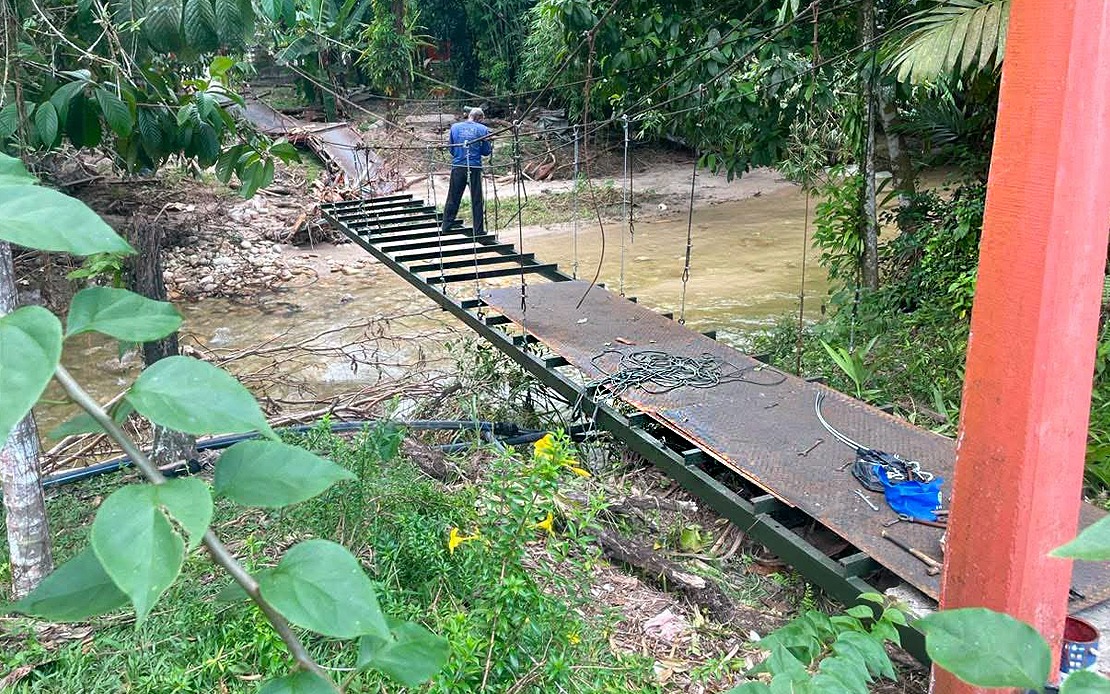
The Perak state government has committed RM500,000 toward constructing a concrete bridge to replace the crucial crossing in Kampung Ulu Geruntum, Gopeng, which was destroyed when a sudden water surge swept through the village on June 19. The allocation signals the administration's intention to provide a lasting solution to the infrastructure failure that left the remote settlement isolated and its residents unable to access essential services. State Housing and Local Government Committee chairman Sandrea Ng Shy Ching announced the decision, emphasizing that reconstruction efforts would begin once temporary remedial work is finished.
The bridge's collapse during the June water surge forced more than 50 villagers to abandon their homes and seek shelter at the Gopeng Town Hall temporary relief centre. The loss of the main crossing severed the only practical route connecting the settlement to the outside world, creating an immediate humanitarian situation that required emergency intervention by multiple government agencies and relief workers. Local residents found themselves unable to access markets, medical facilities, schools, and other vital infrastructure, making the restoration of connectivity a matter of significant urgency for the isolated community.
Recognizing the severity of the situation, Sandrea Ng, who represents the Teja state assembly seat, mobilized additional resources from her constituency allocation. She approved RM45,000 from her personal assemblyman fund specifically to repair water pipes that were damaged by the surge and to restore the supply network that had been disrupted by the disaster. This supplementary allocation demonstrates the multi-layered approach taken by state representatives to address not only the bridge reconstruction but also the rehabilitation of critical utilities that affect daily life in the village.
In the immediate term, the state government has authorized an emergency fund of RM150,000 for the construction of a temporary suspension bridge. This interim structure is already under construction and is projected to be completed by mid-July, providing residents with a functional crossing well before the permanent concrete bridge is ready. The staggered approach—combining emergency temporary infrastructure with longer-term permanent solutions—reflects pragmatic crisis management and ensures that the villagers are not left stranded for an extended period during the reconstruction phase.
Sandrea Ng's public statement, released through Facebook, conveyed gratitude to the various government agencies and field personnel who had been engaged in continuous recovery operations at the site. Her message emphasized the administration's commitment to expediting all relief efforts so that residents could resume their normal routines as quickly as possible. The acknowledgment of frontline workers' contributions also served to highlight the coordinated response that multiple government entities had mobilized since the initial emergency.
The disaster that struck Kampung Ulu Geruntum reflects the vulnerability of rural infrastructure in Malaysia's more remote areas, where isolated communities often depend on single access routes and aging structures that may be inadequately designed to withstand extreme weather events. The June water surge, while described as a natural disaster, underscores the importance of infrastructure resilience and the need for preventive maintenance and periodic upgrades in areas prone to flooding or seasonal water level fluctuations. The incident has prompted authorities to invest not only in replacement infrastructure but also to consider broader village development priorities.
For residents of Kampung Ulu Geruntum, the financial commitment represents a turning point in their immediate prospects. The temporary suspension bridge will restore basic connectivity within weeks, while the permanent concrete structure will provide the kind of durability and safety standards expected of modern infrastructure. The total investment—combining the RM500,000 main allocation, RM150,000 for the interim bridge, and RM45,000 for utilities—demonstrates a comprehensive commitment to village rehabilitation that extends beyond a single replacement project.
The restoration work also carries broader implications for rural development policy in Perak and potentially across Malaysia. When disasters strike remote settlements, the speed and scale of government response often determines whether communities can sustain themselves or face long-term economic and social decline. By committing substantial resources to infrastructure repair rather than merely providing temporary relief aid, the state government signals its intention to prevent the kind of prolonged displacement that can fragment village communities and drive permanent out-migration to urban centers.
The timeline for project completion remains important for planning and expectations management. With the temporary bridge expected by mid-July and the permanent structure to follow in subsequent months, residents have visibility of when their connectivity will be restored and when they can consider the crisis truly resolved. This phased approach also allows engineers to assess whether the June incident revealed systemic vulnerabilities in the waterway or drainage patterns that might influence the design specifications for the permanent concrete bridge, potentially making it more resilient to similar events in the future.
As work progresses, the Kampung Ulu Geruntum reconstruction effort will serve as a test case for how state governments coordinate disaster response, infrastructure restoration, and community support in the aftermath of natural disasters. The multi-agency involvement and the allocation of funds from both emergency budgets and constituency-level resources reflect the kind of distributed decision-making that characterizes Malaysian governance. Success in restoring this village's normal functioning could provide a model for managing similar crises in other vulnerable rural areas across the country.

