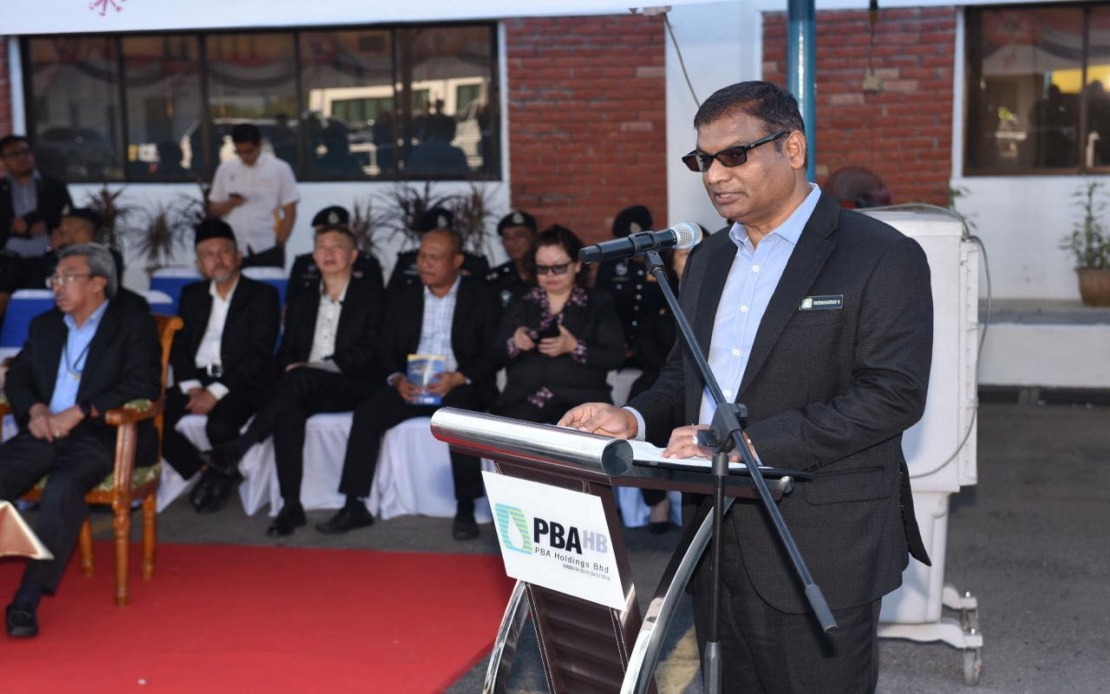
Penang's water authority has unveiled an ambitious infrastructure programme to strengthen supply across Seberang Perai Selatan, with a new 80 million litres-per-day treatment facility expected to commence operations in 2027. Penang Water Supply Corporation (PBAPP) is developing the plant under a Build-Operate-Transfer arrangement, drawing raw water from Sungai Kerian to serve the southern district's rapidly expanding needs.
The decision reflects mounting pressure on water resources across the district. Seberang Perai Selatan currently serves 87,611 registered users consuming an average of 116.8 MLD in 2025, accounting for approximately 13.5 per cent of Penang's total consumption. This represents a significant footprint for a single district, underscoring the scale of infrastructure required to sustain further growth. According to Datuk K. Pathmanathan, PBAPP's chief executive, the 2027 plant represents a critical medium-term intervention designed to bridge supply gaps during a period of substantial economic expansion.
The industrial sector is driving much of this demand surge. The RM2.2 billion Batu Kawan Industrial Park 3 project alone spans 165 hectares and is projected to require around 220 MLD during the 2030s—nearly double the entire district's current consumption. This concentration of industrial water demand in a single development underscores how rapid economic transformation can outpace infrastructure planning. Beyond BKIP3, developments including SkyWorld Cassia and the proposed Siliconware Precision semiconductor manufacturing facility will layer additional pressure on the system, creating a compounding demand trajectory that linear expansion cannot adequately address.
PBAPP has already moved to address immediate shortfalls through interim measures. A RM8.1 million compact treatment facility has operated in Seberang Perai Selatan since March of last year, producing 6.4 MLD and currently supplying approximately 4,000 users. This smaller plant serves as a temporary stopgap designed to manage demand across a three-year window, demonstrating PBAPP's willingness to deploy rapid-response infrastructure whilst longer-term projects develop. However, interim solutions cannot substitute for permanent capacity, particularly given the velocity of industrial expansion in the region.
The 2027 plant forms part of a sequenced development strategy that extends through the early 2030s. A second facility, the Sungai Kerian LRA with 114 MLD capacity, is scheduled to begin operations by 2030 under the Water Contingency Plan 2030, further reinforcing supply stability in the district. This phased approach reflects realistic assessment of construction timelines and financing constraints, whilst acknowledging that demand will continue escalating throughout the period. The staggered commissioning dates allow PBAPP to calibrate expansion against actual demand trends rather than speculative projections.
Most significantly, the Perak-Penang Water Project is anticipated to commence supplying between 300 and 500 MLD of treated water from Perak to Seberang Perai Selatan by 2031, with additional volumes supporting Seberang Perai Tengah. This inter-state water transfer scheme represents a fundamental shift in Penang's supply model, transcending the state's historical reliance on local catchment areas. The project introduces both opportunity and vulnerability—substantial new capacity will enable continued economic growth, yet dependency on interstate supplies introduces new variables including inter-governmental coordination, pricing mechanisms, and climate-related risks across the Perak-Penang corridor.
The infrastructure programme sits within Chief Minister Chow Kon Yeow's broader strategic framework emphasising sustainable and resilient water systems capable of supporting the state's socio-economic development agenda through the 2030s. This articulation of water supply as foundational to economic policy recognises a harsh reality: industrial investment, population retention, and commercial expansion all hinge on reliable water availability. Conversely, inadequate supply becomes a ceiling on growth, constraining opportunities in semiconductors, advanced manufacturing, and related sectors where Penang aims to compete regionally.
Several factors complicate this expansion narrative. Sourcing raw water from Sungai Kerian across multiple new facilities assumes the river's yield remains adequate under varying climatic conditions. Monsoon variability and longer-term climate change patterns could impact river flows, potentially making even expanded treatment capacity insufficient during dry periods. Additionally, the inter-state Perak-Penang project, whilst ambitious, requires sustained political alignment across state boundaries and raises questions about water pricing and cost allocation that may prove contentious as implementation approaches.
For Malaysian policymakers observing Penang's approach, several lessons emerge. First, infrastructure planning must anticipate demand from specific mega-projects rather than relying solely on generalised growth forecasts; BKIP3's projected 220 MLD demand illustrates how single developments can restructure regional requirements. Second, phased capacity additions spreading investment across multiple years reduce financial strain whilst allowing adjustments based on actual growth patterns. Third, inter-state water cooperation, whilst politically challenging, becomes unavoidable when intra-state resources prove insufficient—a scenario increasingly relevant across the region as industrial clusters expand beyond traditional water-rich areas.
The 2027 plant commissioning will represent a watershed moment for Seberang Perai Selatan's industrial trajectory. Adequate water supply removes a primary constraint on attracting and retaining manufacturing investment in semiconductors, petrochemicals, and related sectors. However, success depends on maintaining the infrastructure expansion timeline whilst managing the political and environmental complexities of both intra-state and inter-state projects. As Penang pursues this ambitious agenda, performance will influence how other Malaysian states approach water infrastructure planning for industrial zones competing for capital investment in an increasingly water-constrained region.

