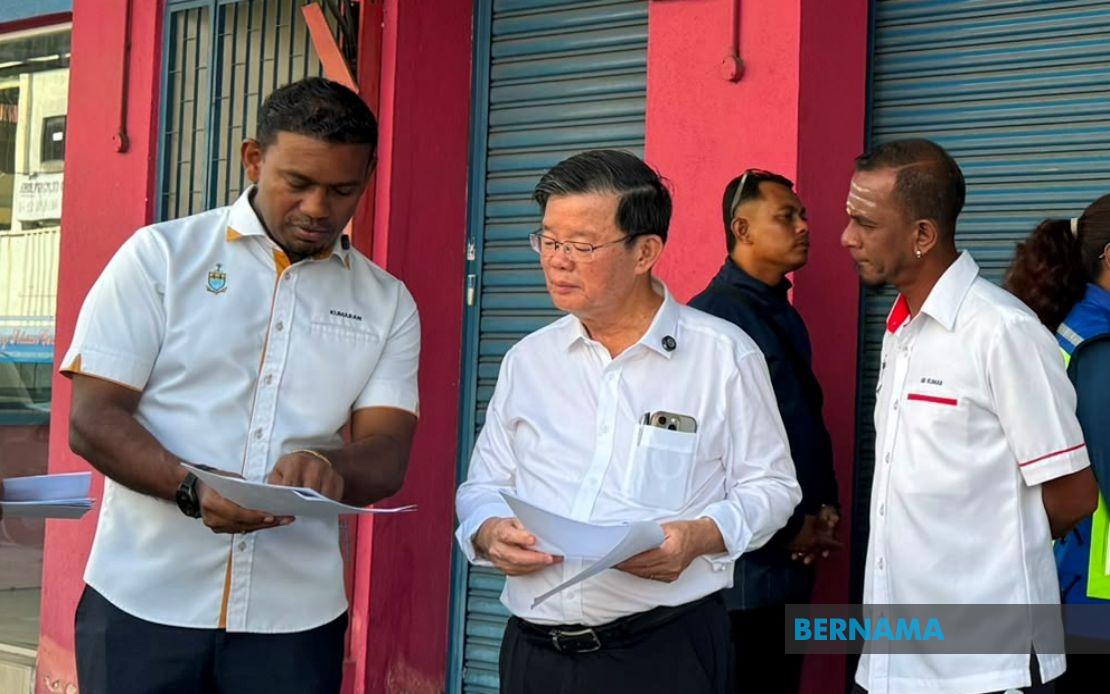
Penang will proceed without further delay on the newly implemented water tariff that commenced on July 1, Chief Minister Chow Kon Yeow announced on Wednesday, brushing aside requests from opposition figures to shelve the increase. The state has already deferred the measure from its originally prescribed date by nearly twelve months, prioritising public adjustment despite federal directives setting the original implementation date for July 30, 2025. Chow's confirmation signals the government's determination to move forward with revenue collection despite mounting political pressure.
The tariff adjustment represents a measured approach to funding the state's long-term water security requirements. Officials project the additional revenue at approximately RM20 million yearly, which Penang Water Supply Corporation executives contend is indispensable for bankrolling essential infrastructure projects that underpin the state's water sustainability. This funding mechanism comes at a time when water scarcity remains a persistent challenge across Malaysia, with northern states including Penang facing increasing demand pressures from industrial expansion and population growth. The decision reflects broader regional struggles to balance affordability with necessary capital investment in ageing utilities.
The Penang Water Supply Corporation faces an estimated RM2 billion capital requirement for water security initiatives alone, exclusive of additional investments required for an incoming water supply scheme sourced from Perak. These expenditures underscore the substantial infrastructure needs confronting the state as it seeks to guarantee reliable supply across its growing urban and industrial base. Without adequate revenue mechanisms, utility providers across Southeast Asia frequently struggle to upgrade treatment facilities, expand distribution networks, and build storage capacity. Penang's expansion plans include constructing new treatment plants at Mengkuang Dam and Sungai Perai, alongside land acquisition and upgrading work at the Sungai Dua facility and preparations for the Sungai Muda installation.
The tariff-setting framework operates under oversight of the National Water Services Commission, which establishes the structure applied uniformly across Malaysian states. All water operators possess the formal right to petition for tariff reviews every three years, contingent upon demonstrating cost pressures or capital development imperatives. This regulatory architecture aims to balance transparency with operational viability, though it frequently encounters resistance from consumer advocates and elected representatives concerned about affordability impacts. Penang's application of this mechanism demonstrates how state governments navigate the tension between maintaining service quality and managing public sentiment regarding utility costs.
Domestic consumers in Penang remain substantially shielded from the true cost of water delivery through cross-subsidisation mechanisms funded by commercial and industrial users. The actual expense of producing and distributing water now exceeds RM1 per cubic metre, yet residential customers paying the new tariff remit approximately 65 sen per cubic metre. This disparity illustrates a deliberate policy choice prioritising household affordability while shifting cost burdens to business consumers, a approach common throughout Malaysian states seeking to insulate lower-income households from price shocks. Industrial and commercial users consequently shoulder disproportionate financial responsibility for maintaining system-wide affordability.
Household impact calculations released by the water authority reveal that approximately 82 per cent of Penang households consuming 35 cubic metres or less monthly will experience a maximum daily increase of RM0.08, translating to approximately RM2.55 per month. For business consumers utilising 500 cubic metres monthly, the additional cost amounts to RM2.59 daily or RM77.70 monthly. These figures suggest that residential consumers absorb relatively modest per-unit increases despite the aggregate revenue generation, reflecting the cross-subsidy framework's cushioning effect on household finances. The announcement provides specific cost projections designed to demonstrate that the burden remains manageable for typical household budgets.
The Water Contingency Plan 2030 represents Penang's strategic framework for addressing foreseeable supply challenges over the next six years. Officials maintain that postponing tariff implementation would obstruct funding for this comprehensive roadmap, potentially compromising the state's capacity to execute time-sensitive infrastructure upgrades. The initiative encompasses multiple treatment facility enhancements, pipeline replacement programmes, and the Macallum-Bukit Dumbar pipeline construction, all components of a broader resilience strategy. Delaying revenue collection translates directly into deferred project timelines, creating cascading effects on water supply reliability.
Opposition figures including Bagan Member of Parliament Lim Guan Eng petitioned the state government through public channels to postpone the 20 sen per cubic metre increase for an additional year. Such appeals reflect common political responses to utility rate adjustments, though they frequently lack comprehensive discussion of funding alternatives or infrastructure consequences. Political resistance to tariff increases spans Malaysia's ideological spectrum, with opposition parties frequently leveraging public concern about cost-of-living pressures. Chow's decisive rejection of deferral signals that the administration prioritises infrastructure advancement over electoral sensitivity regarding this issue.
The Penang decision carries implications for water security discourse throughout Southeast Asia, where ageing infrastructure and climate variability increasingly pressure utility operators to seek adequate revenue. Malaysia's experience navigating the tension between affordability and investment mirrors challenges confronting regional peers in Thailand, Indonesia, and Vietnam. Authorities across the region struggle to communicate that tariff increases often reflect necessary operating cost adjustments rather than profit maximisation, particularly as treatment requirements intensify due to water quality degradation. Penang's transparent articulation of the cost-subsidy relationship attempts to demystify utility economics for consumers accustomed to viewing water as a minimally-priced commodity.
The implementation follows extended deliberation within government circles regarding optimal timing. By deferring the federally mandated tariff nearly a year beyond its originally scheduled date, Penang demonstrated willingness to absorb short-term revenue losses in exchange for extended adjustment periods. However, Chow's statements suggest that further deferral threatens operational capacity and project execution timelines. This positioning reflects a pragmatic acceptance that indefinite delays prove untenable given infrastructure imperatives and regulatory frameworks that mandate periodic reassessment. The state has consequently calibrated its approach to balance political considerations against utility viability.
Water security emerges as a defining governance challenge for Malaysian authorities confronting simultaneous pressures from population expansion, industrial growth, and climate variability. Penang's experience demonstrates how states must navigate competing demands for affordability, service quality, and fiscal responsibility. The tariff increase exemplifies the difficult choices utility managers face when existing revenue structures cannot fund necessary infrastructure. Whether this approach successfully funds the Water Contingency Plan 2030 while maintaining public acceptance remains uncertain, though the government's firm stance suggests commitment to seeing implementation through despite political headwinds.

