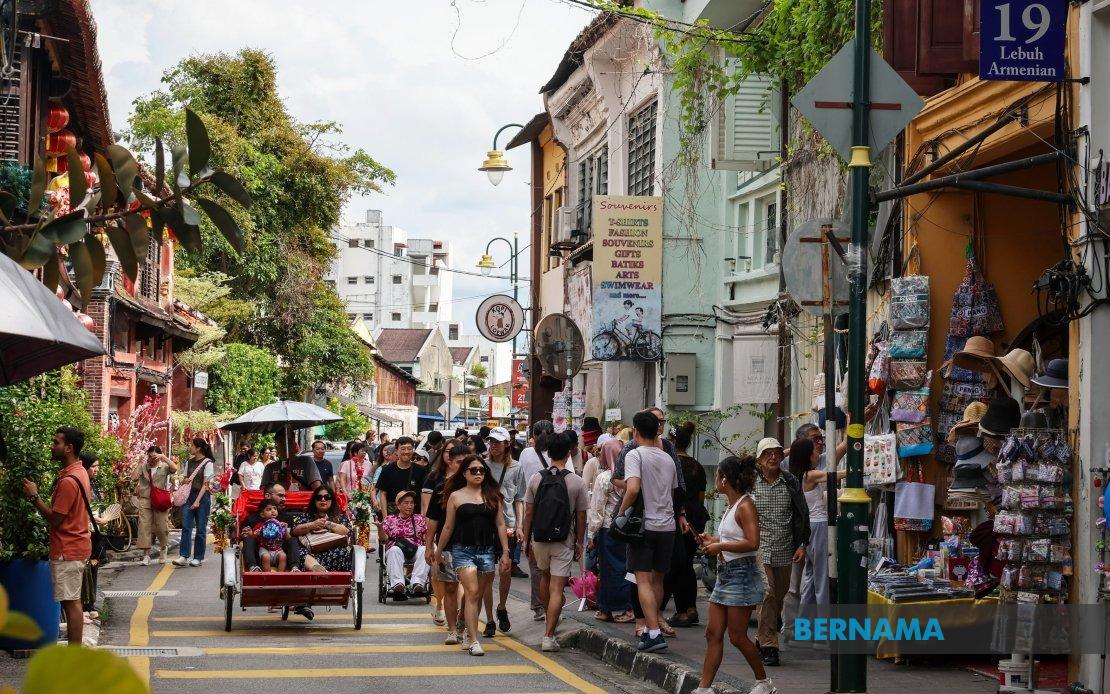
The Penang state government has moved to evaluate the structural integrity of heritage buildings across the state following an accident in which falling debris from a heritage shophouse along Armenian Street in George Town left two tourists injured. The incident has prompted officials to reassess how the state manages its stock of aging heritage properties, particularly in the UNESCO World Heritage-listed city centre where tourism and conservation priorities must coexist.
The collapse occurred when a wooden beam and concrete debris detached from the heritage shophouse, striking two Sri Lankan visitors identified as Mohamad Ammtar, 66, and Fatimah, 55. Both received emergency treatment at the scene before being transported to Penang Hospital for further care. Preliminary investigations attributed the structural failure to termite damage within the wooden elements of the building, a common problem affecting older timber-framed structures in Malaysia's tropical climate. The male victim was subsequently discharged after treatment, while his wife remained hospitalised undergoing further diagnostic imaging to determine the full extent of her injuries.
Jason H'ng Mooi Lye, chairman of Penang's Local Government and Town and Country Planning Committee, disclosed that the state government intends to engage an independent structural engineer to conduct a systematic survey of heritage buildings throughout Penang. This assessment will identify properties that present safety risks or require urgent restoration. The state plans to collaborate with the National Heritage Department in appointing a qualified engineer to lead the study, ensuring that evaluations meet national standards and heritage conservation principles.
Once the comprehensive assessment is finalised, the Penang Island City Council (MBPP) will have the mechanism to issue formal notices to building owners whose properties are identified as requiring remedial work. These notices would compel proprietors to undertake necessary restoration and safety improvements. The approach balances regulatory oversight with property owner responsibility, establishing a clear framework for addressing deteriorating conditions before incidents occur.
The incident underscores the tension that heritage-rich cities face in preserving historical character while meeting contemporary safety standards. H'ng articulated the principle that heritage conservation cannot come at the expense of public safety, a concern that resonates particularly in George Town, where thousands of tourists navigate narrow streets lined with centuries-old structures daily. The challenge is especially acute in developing nations like Malaysia, where budgets for heritage maintenance are often constrained and responsibility for upkeep falls partly on individual property owners who may lack resources for expensive restoration work.
H'ng acknowledged that authentic conservation requires retaining original architectural features and traditional construction methods. However, he suggested that where original materials—particularly wood in tropical environments—have degraded beyond safe functionality, engineers should consider adopting more durable alternative materials that preserve the visual and historical character of buildings while enhancing structural reliability. This pragmatic approach reflects international heritage conservation practice, which increasingly recognises that some material substitution is necessary to ensure long-term preservation and public safety.
Wong Hon Wai, chairman of the State Tourism and Creative Economy Committee, emphasised that George Town World Heritage Incorporated (GTWHI) and MBPP have issued directives to heritage building owners across the state to heighten awareness regarding structural maintenance. He stressed that the incident highlights the critical importance of ensuring that older and heritage buildings meet acceptable safety standards, preventing similar accidents that could deter tourism and undermine confidence in George Town's heritage district.
The response demonstrates a comprehensive, multi-agency approach involving heritage specialists, local government, and tourism authorities. The collaboration recognises that heritage preservation in urban centres is not merely a conservation issue but also affects public safety, tourism confidence, and economic vitality. George Town's status as a UNESCO World Heritage Site carries both prestige and responsibility, attracting international visitors who expect adequate safety standards alongside authentic historical experiences.
For Malaysian tourism and heritage management more broadly, the Penang incident provides a cautionary lesson about deferred maintenance in aging structures. Other heritage-rich cities in Malaysia—including Melaka, Ipoh, and Penang's own smaller heritage zones—may benefit from undertaking similar systematic safety audits before crises occur. The cost of proactive assessment and targeted repairs typically proves far lower than responding to accidents, managing legal liability, and repairing reputational damage to heritage tourism destinations.
The broader implication extends to property owner education and financing mechanisms. Many heritage building owners in Malaysia are individual entrepreneurs or small business operators who cannot easily absorb the costs of specialised restoration work. Penang's decision to conduct state-level assessment represents an opportunity to identify buildings requiring urgent intervention and potentially develop grant schemes or low-interest financing to help owners comply with safety requirements without abandoning the buildings or compromising heritage authenticity.
Looking forward, the success of Penang's structural assessment initiative will depend on thorough implementation, adequate resourcing of MBPP's enforcement capacity, and realistic timelines for building owners to complete remedial work. The process should also incorporate community engagement, informing tourists and residents about the measures being undertaken. This transparency reinforces confidence that heritage preservation and public safety are being managed responsibly, essential for maintaining George Town's appeal as a living heritage destination rather than a museum district.

