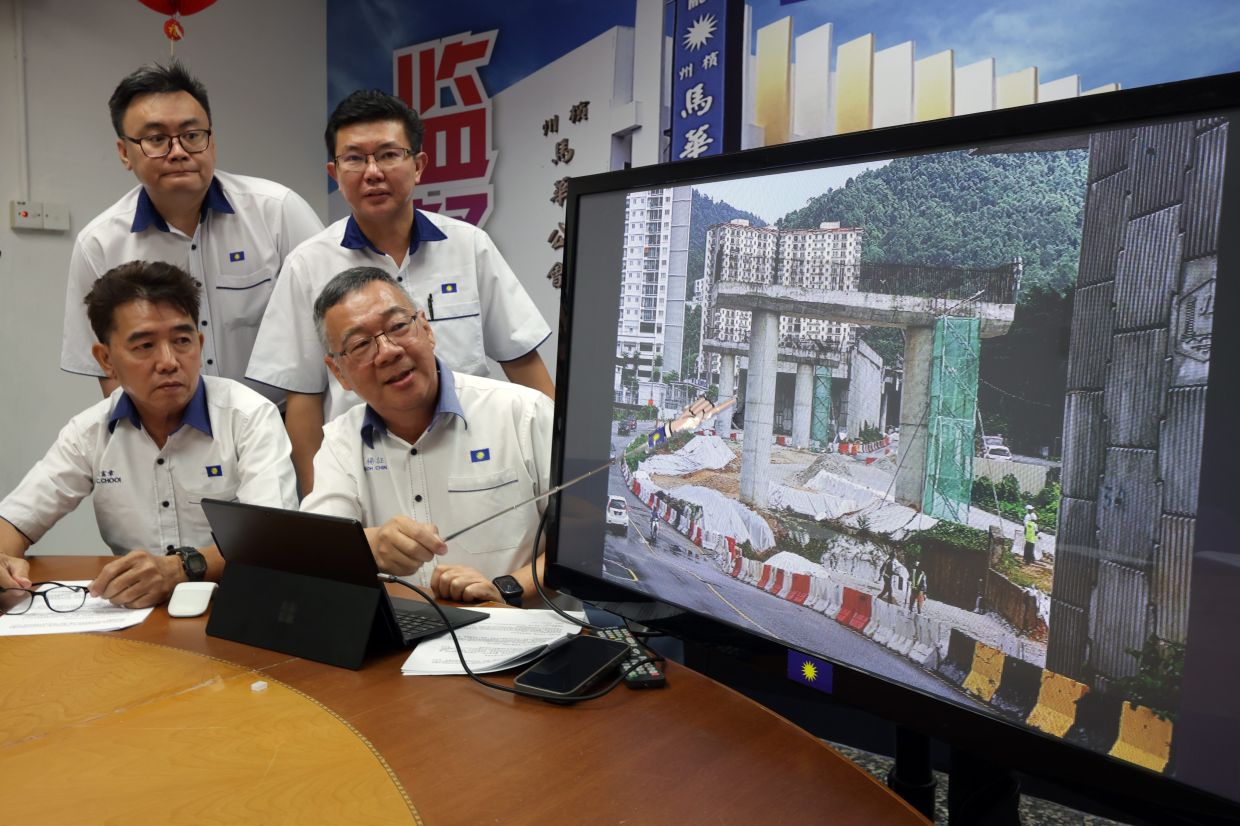
The Penang branch of the Malaysian Chinese Association has escalated pressure on the state government over the Air Itam-Tun Dr Lim Chong Eu Expressway bypass project, demanding immediate disclosure of financial records and technical assessments to verify claims of steady progress. The party's secretary, Yeoh Chin Kah, framed the issue not as a matter of construction delays but as a fundamental question of governance and public trust, emphasising that Penang residents deserve clarity on how taxpayer funds are being spent and whether work is genuinely advancing as reported.
The dispute centres on competing accounts of the project's status. State officials have described the 6-kilometre toll-free bypass as entering its final stages, with progress climbing from 80 percent in May to 89 percent by December of the previous year. However, Yeoh's inspection team found a markedly different reality during a site visit on July 1. They documented major sections—including Valley Road, Changkat Tembaga, and Jalan Thean Teik—that appeared nowhere near completion, with structural elements incomplete and finishing works barely begun across multiple segments.
Yeoh's observations reveal the substantial gap between statistical claims and physical reality. While contractor reports reference bridge piers in place, the team found no bridge beams, deck sections, or road surfaces in numerous areas. Critical elements including guardrails, noise barriers, mechanical and electrical systems, and connecting roads remain absent or unfinished in many zones. This pattern suggests either that percentage-based progress calculations are using questionable methodologies or that actual advancement lags far behind official narratives. Such discrepancies are particularly concerning given the project's already troubled history.
The bypass, forming the second package of the broader Penang undersea tunnel and paired roads initiative, was originally scheduled for completion in 2024. The contractor has since received two extensions, pushing the deadline to April 12, 2027—a delay that has frustrated residents in Air Itam, Bandar Baru Air Itam, and Paya Terubong who depend on this infrastructure to reduce congestion. An estimated 300,000 people stand to benefit once the elevated viaducts, tunnels, and ground-level segments finally open, yet the repeated postponements have understandably eroded confidence in official timelines.
Yeoh's ultimatum demands that the state government produce payment records, consultant certification reports, and comprehensive project assessments within seven days. The specific request for consultant certifications is significant, as these independent verifications are meant to validate contractor claims and protect the public interest. The absence of transparent documentation suggests either administrative negligence or deliberate opacity—neither scenario reflects well on governance. If the government fails to comply, Penang MCA has pledged to escalate the matter to the National Audit Department and the Malaysian Anti-Corruption Commission, signalling that the party views this as potentially involving misuse of public resources.
Beyond immediate accountability, Penang MCA intends to establish a dedicated monitoring committee tasked with tracking the project's reported advancement and verifying payment compliance. This institutional approach acknowledges that a one-time disclosure may not suffice; ongoing scrutiny may be necessary to ensure that official figures align with actual construction work. The party's willingness to invest resources in this oversight reflects broader frustration within civil society about infrastructure governance in Malaysia, where cost overruns, delays, and accountability gaps have become depressingly routine.
State government representatives have pushed back against the criticism. Paya Terubong assemblyman Wong Hon Wai countered that the project has actually reached 91 percent completion and remains on schedule for the April 2027 finish date. He cited a late June meeting with the construction team and provided technical details: twelve bridge beams on the Gelugor side are scheduled for installation between July and August, with the remaining six beams planned for the fourth quarter. Wong's account differs substantially from Yeoh's, though both may be describing the same reality from different vantage points or time periods.
Wong also noted that bridge beams on the Bandar Baru Air Itam side have already been installed, but indicated that road opening will not be immediate upon construction completion. Additional phases including deck slab work, parapet installation, road safety audits by government agencies, and Public Works Department clearance will follow. This sequential process, while technically sound, effectively means that the April 2027 date may represent construction completion rather than public access—a distinction that deserves clarification in all official communications.
The disagreement between Penang MCA and state officials reflects a broader pattern in Malaysian infrastructure projects where communication gaps, ambiguous progress metrics, and lack of public transparency breed distrust. Neither side appears to be acting in bad faith; rather, they are operating from different information sources and different interpretations of what constitutes meaningful completion. The MCA's demand for documentary evidence is reasonable and consistent with international best practices for megaprojects, where third-party verification provides stakeholders with reliable information.
For Penang residents, this standoff has tangible implications. The bypass is critical infrastructure designed to alleviate one of the state's most persistent traffic problems. Continued uncertainty about timelines and progress makes it difficult for residents, businesses, and planners to arrange their lives accordingly. Schools, hospitals, and commercial enterprises in the affected corridors need reliable information to coordinate expansion, staffing, and service delivery. The longer the transparency deficit persists, the greater the reputational cost to state governance more broadly.
The coming weeks will test whether the Penang government prioritises openness or defensiveness. A thorough release of the demanded documents would not necessarily vindicate either party; rather, it would provide an objective basis for assessing whether the project is genuinely progressing and whether funds are being used appropriately. Conversely, further stonewalling would reinforce impressions that officials have something to hide, further eroding public confidence in state-level infrastructure management. In a competitive political environment, such perceptions carry electoral consequences.

