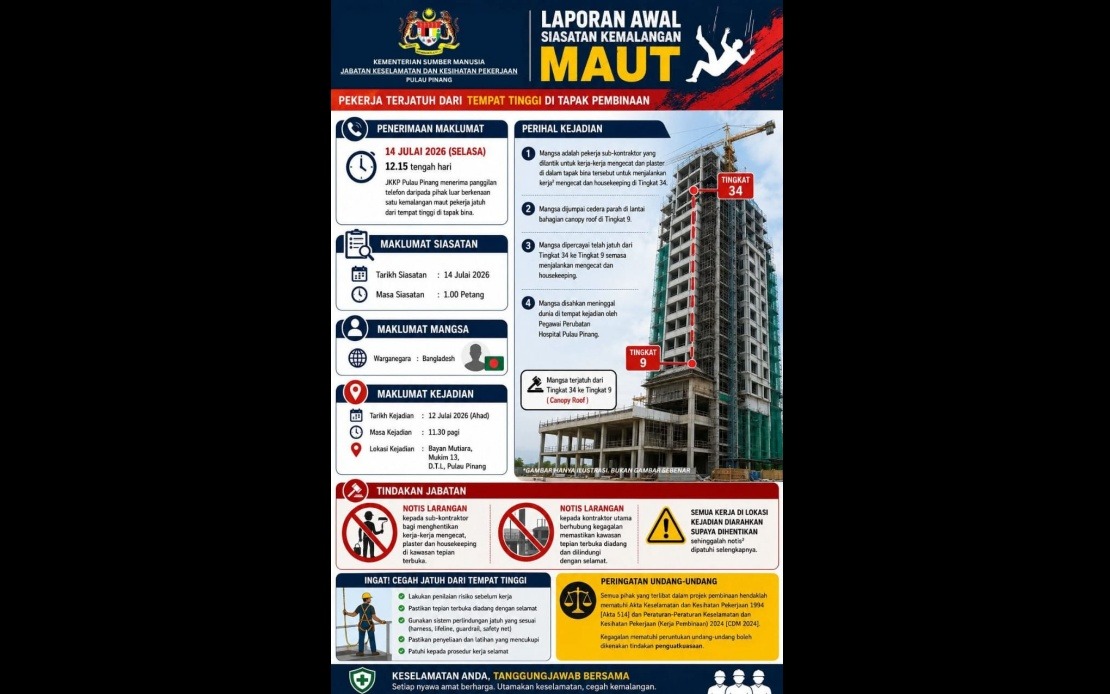
Penang's Department of Occupational Safety and Health (DOSH) has opened a formal investigation into the death of a Bangladeshi construction worker who fell from a building under development in the Bayan Mutiara area of George Town. The incident, which occurred on July 15, has prompted immediate regulatory action and raised fresh concerns about workplace safety protocols at high-rise construction projects across the state.
DOSH director Hairozie Asri revealed that the department was alerted to the tragedy at 12.15 pm by an external party, leading to swift deployment of investigating officers to the site. The preliminary findings paint a sobering picture of the circumstances surrounding the worker's death. The victim, who was employed by a subcontractor engaged in painting, plastering and housekeeping operations, was believed to be carrying out duties on the 34th floor when the accident occurred. He was subsequently discovered in critical condition on a canopy roof structure at Level 9, having fallen multiple storeys through what appears to have been an unprotected or inadequately secured area.
Medical personnel from Penang Hospital attended the scene and confirmed the worker's death on arrival. The significant vertical distance between the point of incident and where the victim was eventually found suggests the severity of the fall and the potential lack of safety barriers or fall-protection systems in place at the work location. Such incidents underscore the vulnerability of migrant workers on Malaysian construction sites, particularly those employed through subcontracting arrangements where oversight may be fragmented across multiple layers of responsibility.
In immediate response, DOSH took decisive enforcement action against both the subcontractor and main contractor. A prohibition notice was issued to the subcontractor specifically barring all painting, plastering and housekeeping activities in open-edge areas, indicating that the department views the use of such unprotected spaces as a critical safety breach. A separate prohibition notice was similarly issued to the main contractor overseeing the entire project. These measures reflect regulatory determination to prevent recurrence of similar incidents at this location.
Crucially, all construction activities at the affected site have been suspended with immediate effect, with the halt remaining in place until both contractors fully satisfy the requirements stipulated in the prohibition notices. This is a significant escalation that will impact project timelines and contractor operations. The suspension demonstrates DOSH's willingness to leverage its enforcement powers to compel compliance with occupational safety standards, rather than simply issuing warnings or fines that might otherwise allow work to continue amid inadequate safety measures.
The incident reflects ongoing challenges in Malaysia's construction sector regarding the protection of migrant workers. Bangladesh has become a significant source of construction labour for Malaysia, with thousands employed across major projects. However, these workers often face language barriers, limited familiarity with local safety regulations, and vulnerability arising from their dependent immigration status, which can discourage them from raising safety concerns or demanding protective equipment.
Subcontracting arrangements, which were evident in this case, create particular hazards. When primary contractors delegate work to subcontractors, responsibility for safety can become unclear, with each party potentially assuming the other is responsible for enforcement of protective measures. Workers in such arrangements may find themselves operating with minimal direct oversight from the main contractor, whose safety protocols may not effectively cascade down to the subcontractor level.
The focus on open-edge areas in the prohibition notice suggests that the worker may not have been equipped with or adequately secured by fall-protection equipment such as harnesses, safety nets or barriers. Fall protection remains among the most critical safety requirements for high-altitude construction work, yet enforcement remains inconsistent across Malaysian project sites. The 34th floor represents significant height, and a fall from such elevation demonstrates the fatal consequences of lapses in this fundamental safety requirement.
This incident will likely intensify scrutiny of safety practices across Penang's active construction sector, particularly on high-rise residential and commercial projects where such hazards are most prevalent. DOSH's visible enforcement action sends a message that violations will result in operational suspension, a powerful deterrent in an industry where project delays translate directly to financial losses. However, such incidents also point to the need for strengthened preventive measures, including enhanced safety training for migrant workers, clearer lines of responsibility in subcontracting chains, and more rigorous pre-work safety inspections.
The investigation into the circumstances surrounding the fall will likely examine multiple factors including whether the worker received adequate safety induction, whether fall-protection equipment was available and functional, whether the site supervisor conducted regular safety checks, and whether the worker understood the risks of the assigned task. These findings will inform recommendations that extend beyond the two contractors involved to influence broader industry practice.
For Malaysia's migrant worker population, this tragedy underscores the risks inherent in construction employment and the critical importance of workplace advocacy and safety consciousness. While the construction industry remains essential to Malaysia's infrastructure development, the human cost of safety violations demands continued vigilance from regulatory authorities, industry operators and worker advocates. The prompt action by DOSH in this instance demonstrates that enforcement capacity exists; the challenge lies in sustaining such vigilance across the hundreds of active construction sites throughout the country where similar hazards persist.

