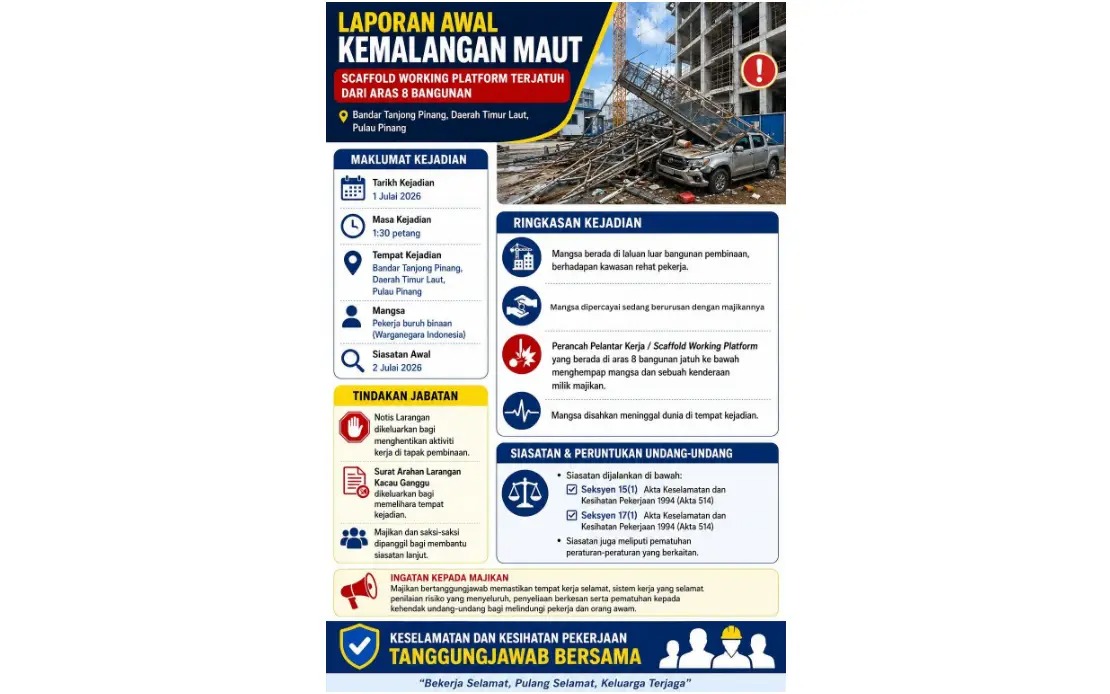
The Department of Occupational Safety and Health in Penang has imposed an immediate work stoppage at a construction project in Bandar Tanjong Pinang after a deadly accident on July 1 claimed the life of an Indonesian worker. The prohibition notice, issued in the weeks following the incident, represents a significant regulatory response to what authorities are treating as a serious breach of workplace safety standards. The fatality has placed intense scrutiny on construction safety practices across the state and raised broader questions about oversight mechanisms on major building projects throughout the region.
According to initial accounts of the incident, the fatal accident occurred at approximately 1.30 pm when a scaffolding working platform detached from the eighth floor of the building under construction. The structure fell directly onto the victim, who was positioned on an external walkway at ground level near the workers' rest area. At the moment of impact, the worker was engaged in discussion with his employer, making the timing particularly tragic. The falling platform subsequently struck a vehicle owned by the employer, compounding the scale of the incident and the damage caused by the sudden structural failure.
The circumstances surrounding the collapse point to potential deficiencies in the planning and execution of safety protocols at the site. Penang DOSH officials have launched a comprehensive investigation that extends beyond the immediate cause of the scaffolding failure to encompass broader compliance questions regarding employer responsibilities. The regulatory body is examining whether those responsible for the project met their obligations under Sections 15(1) and 17(1) of the Occupational Safety and Health Act 1994, which establish foundational duties for workplace safety management and the prevention of hazardous conditions.
In addition to the prohibition order halting all construction activities, authorities have implemented a non-disturbance directive to preserve the accident scene exactly as it was discovered. This forensic approach allows investigators to document evidence and reconstruct the sequence of events with precision. The preservation order remains in effect until the inquiry reaches completion, which may take several weeks depending on the complexity of the technical analysis required to determine how and why the scaffolding platform failed catastrophically.
The investigation process has commenced with testimony from employers involved in the project and witnesses who were present during the incident. Investigators are examining records related to the installation, inspection, and maintenance of the scaffolding system, as well as documentation concerning worker training and safety briefings. The focus extends to whether risk assessments were conducted prior to the work being undertaken and whether appropriate protective measures were in place to prevent falls and falling objects.
Penang DOSH has made clear that enforcement action will follow if the inquiry uncovers violations of workplace safety legislation. This warning carries weight given the seriousness of the outcome and the apparent negligence that may have contributed to the tragedy. Potential violations could result in substantial penalties, prosecution of responsible parties, and mandatory remedial measures across other projects managed by the same contractors or developers.
The incident underscores a persistent challenge in Malaysia's construction sector, where safety standards vary significantly across projects and enforcement capacity remains stretched. Foreign workers comprise a substantial portion of Malaysia's construction labour force, and language barriers, limited familiarity with local regulations, and sometimes precarious employment relationships can create additional vulnerabilities. The death of an Indonesian worker highlights how migrant labourers often occupy the most hazardous positions on building sites, exposed to risks that domestic workers might resist or have greater capacity to mitigate.
Penang DOSH's response reflects growing pressure on regulatory authorities to demonstrate effectiveness in preventing workplace deaths. State and federal governments have faced criticism over inadequate inspection regimes and lenient penalties that fail to deter unsafe practices. This incident may catalyse broader policy reviews and potentially stricter oversight of scaffolding systems used throughout Malaysian construction projects. Industry bodies and contractors' associations are likely to receive guidance on enhanced safety measures and documentation requirements.
The construction industry across Southeast Asia continues to grapple with safety challenges as rapid urbanisation drives demand for new projects. Malaysia's experience mirrors patterns observed in neighbouring countries where economic growth and infrastructure investment have occasionally outpaced the development of robust safety cultures. The Bandar Tanjong Pinang incident serves as a stark reminder that preventable deaths continue to occur when proper planning, training, and supervision are inadequate.
Moving forward, Penang DOSH has appealed to all employers, developers, main contractors, and subcontractors operating across the state to prioritise safety in project planning and execution. The regulatory message emphasises that every work activity must be carefully planned, potential hazards identified, and control measures implemented before operations commence. The agency has stressed that the loss of life in workplace accidents represents not merely a regulatory failure but a tragedy affecting families and communities that could have been prevented through diligent application of safety principles and standards.
The prohibition notice will remain in effect until investigators complete their analysis and authorities are satisfied that all safety deficiencies have been remedied. Once the hold is lifted, the construction site will likely require comprehensive safety audits before resuming operations. This case will serve as a benchmark for how Malaysia's occupational safety framework addresses major construction incidents and demonstrates the commitment of regulatory bodies to protecting workers regardless of their nationality or employment status.

