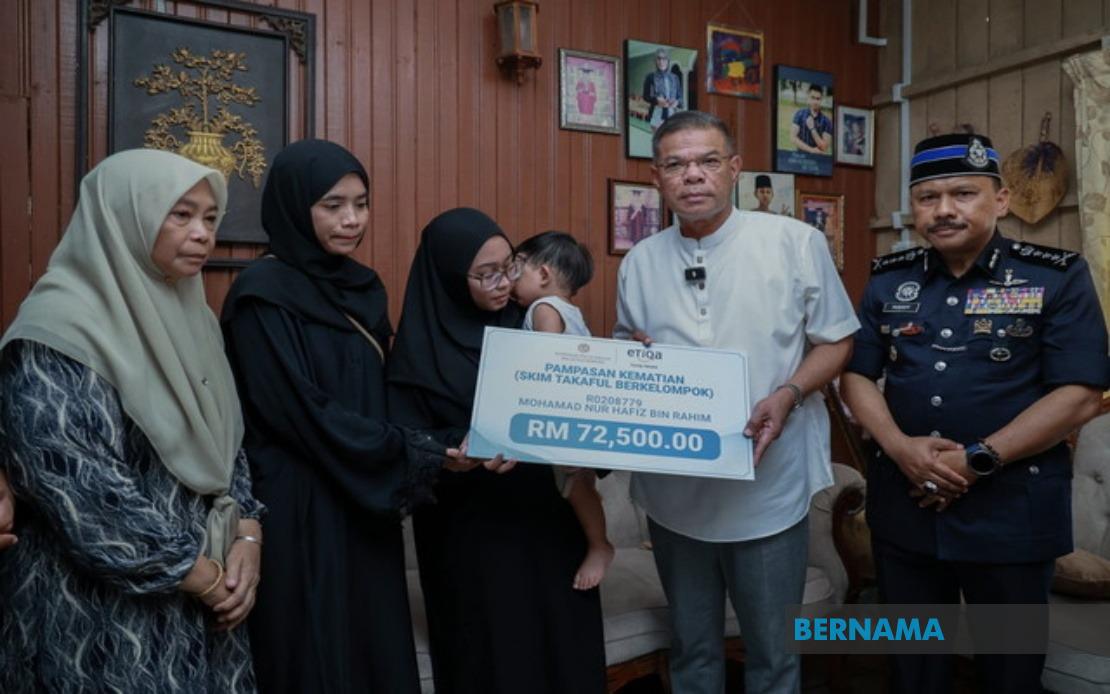
Home Minister Datuk Seri Saifuddin Nasution Ismail has committed to expediting welfare benefits and financial assistance for the family of Corporal Mohamad Nur Hafiz Rahim, 29, following the officer's death from electrocution at Beaufort police station in Sabah. The announcement came during a compassionate visit to the deceased's residence in Kampung Hutan Pasir, Ketereh, Kota Bharu, where Saifuddin Nasution met with the victim's widow and offered formal condolences on behalf of the Royal Malaysia Police (PDRM).
The tragic incident claimed the lives of three officers on the evening of August 9. Corporal Mohamad Nur Hafiz, Corporal Chiu Teck Siong, 40, and Constable Muhammad Raimi Ismarubee, 26, sustained fatal electric shocks while repositioning a metal pole near Weston Police Station. The circumstances surrounding the accident have raised questions about workplace safety protocols at police facilities, particularly regarding electrical hazards during routine maintenance tasks.
Accompanying the Home Minister on his visit were Bukit Aman Management director Datuk Seri Abdul Aziz Abdul Majid, Kelantan police chief Datuk Mohd Yusoff Mamat, and Sabah deputy police commissioner Datuk Mohd Azhar Hamin. Their collective presence underscored institutional solidarity and the seriousness with which the government views the matter. Saifuddin Nasution characterised the visit as a gesture of sympathy and support, acknowledging that the loss of any police officer, regardless of rank, represents a significant loss to the entire force.
Financial relief has already begun flowing to the bereaved family. Contributions from both the Sabah and Kelantan Police Contingents, combined with takaful payments derived from the deceased's own contributions as a member of the Police Cooperative, have exceeded RM200,000. This immediate injection of funds addresses the immediate financial vulnerability of Corporal Mohamad Nur Hafiz's wife, Fatimah Shahira, who faces the considerable responsibility of raising their two-year-old son independently.
Beyond the immediate financial package, the Home Minister has arranged for structural long-term security through the deceased's pension arrangements. Fatimah Shahira has been designated as the primary beneficiary of her late husband's monthly pension payments, while his mother has also been named as a recipient. These recurring payments provide a sustainable income stream that will support the family's living expenses over the coming years, reducing dependence on sporadic welfare interventions.
Crucially, Saifuddin Nasution has issued a direct instruction to circumvent standard bureaucratic procedures that would normally govern the disbursement of additional benefits. By ordering the Bukit Aman Management director to expedite remaining payments without subjecting them to conventional red tape, the Home Minister has effectively created a fast-track mechanism for the widow's relief. He personally assured Fatimah Shahira that processing delays would be minimised and that exceptional arrangements would be put in place to facilitate swift access to all funds and services to which she is entitled.
The widow has been informed that she may approach the Kelantan Police Contingent directly should she require further assistance regarding her child's welfare or family needs. This open-door policy creates an accessible support network and demonstrates institutional commitment extending beyond one-time financial transfers. The availability of direct police contact points reflects recognition that families of deceased officers often face multifaceted challenges—childcare, medical expenses, educational costs—that require tailored solutions beyond standard benefit schedules.
This incident and the government's response underscore broader questions about workplace safety within law enforcement. Three trained officers died performing routine duties, raising concerns about electrical safety standards, hazard identification procedures, and protective equipment availability at police facilities throughout Malaysia. While the immediate focus remains on family support, the incident should prompt systematic reviews of occupational health and safety practices across police stations.
For Malaysian readers, the case illustrates how government agencies respond to officer casualties and the mechanisms available to support bereaved families. The RM200,000-plus package and expedited pension arrangements represent standard government protocol, though the Home Minister's personal involvement suggests acknowledgment of this particular tragedy's severity. The fast-track procedure may also signal potential policy changes regarding how swiftly benefits reach families of uniformed personnel killed in service.
The incident also carries implications for police morale and workplace culture. Officers entering dangerous occupations expect their families will receive adequate support if they are killed in the line of duty. Saifuddin Nasution's visible commitment to this principle, demonstrated through high-level visitation and bypassing administrative procedures, communicates to the broader police force that institutional loyalty extends to bereaved families.

