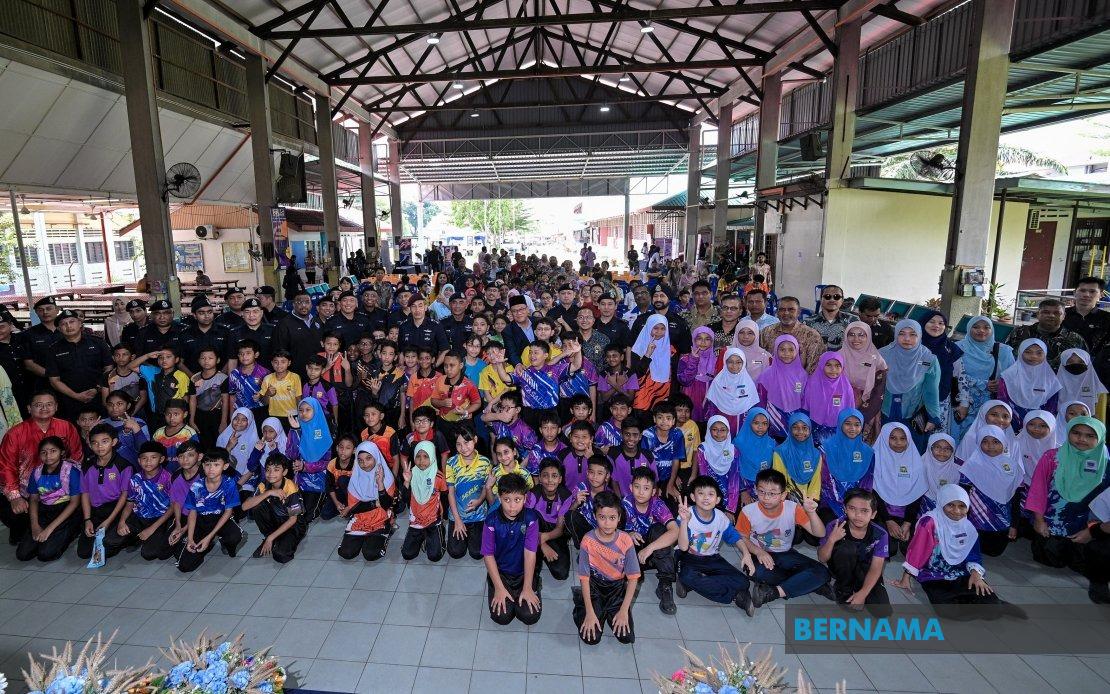
The Royal Malaysia Police has broadened the reach of its character-building and discipline initiative to encompass primary schools across Kuala Lumpur, marking a significant shift in the preventative approach to youth development. The expansion signals confidence in a collaborative model that has demonstrated tangible benefits in secondary schools, where the police and educational authorities have worked together to foster stronger moral foundations among students during their formative years.
Megat Affandi Datuk Ismail, director of the Federal Territory of Kuala Lumpur Education Department (JPNWPKL), disclosed that the programme was previously confined to secondary institutions. He explained that extending the initiative to younger cohorts responds to a strategic rationale: intervention at the primary level allows educators and law enforcement to establish disciplinary habits and ethical frameworks before students face the pressures and temptations of adolescence. This preventative approach aims to inoculate pupils against involvement in social ills from an early age.
The decision to scale up the programme rests on measurable success achieved through sustained partnership between Kuala Lumpur police and JPNWPKL. Over recent years, this collaboration has produced a demonstrable decline in both disciplinary incidents and criminal cases involving secondary school students—outcomes that justified investing in broader implementation. The impact extends beyond crime reduction: school attendance has improved noticeably, suggesting that a disciplined school environment encourages regular participation and engagement.
Bullying, a persistent concern in Malaysian educational settings, has also declined due to active police involvement in school communities. Regular visits to student hostels by officers have contributed to safer dormitory environments, signalling that visible law enforcement presence and close institutional oversight together create conditions in which peer-to-peer violence diminishes. This multi-layered engagement model—combining formal discipline structures with human oversight—has proven more effective than administrative measures alone.
Academic performance gains provide additional evidence of the programme's broader impact on school culture. Kuala Lumpur achieved its strongest Sijil Pelajaran Malaysia (SPM) results in a decade, while concurrent examination bodies—the Sijil Tinggi Persekolahan Malaysia (STPM) and Sijil Tinggi Agama Malaysia (STAM)—likewise recorded their best performances in ten years. These achievements underscore an often-overlooked reality: reducing discipline problems and fostering character simultaneously creates conditions favourable to academic progress. Students unburdened by fear or distraction focus better on learning; schools freed from managing frequent misconduct dedicate more resources to instruction.
Megat Affandi emphasised that educational success demands collaboration extending beyond schools themselves. Police, parents, community organisations, and government agencies must collectively support young people's development. This reframing challenges the traditional expectation that schools bear sole responsibility for student outcomes. For Malaysian families, the message carries practical weight: success requires parental vigilance as well as institutional commitment. He specifically urged guardians to monitor behavioural shifts during adolescence—a period when peer influence peaks and risk-taking intensifies—and to engage school counsellors when concerns arise.
The vaping challenge represents a contemporary concern testing collaborative capacity. JPNWPKL has committed to conducting unannounced compliance checks alongside police and other relevant agencies, while engaging Kuala Lumpur City Hall (DBKL) to strengthen enforcement of regulations governing nicotine product sales to minors. This multi-agency approach recognises that supply-side control requires coordination across education, law enforcement, and municipal authorities. The problem particularly affects Malaysian youth, given easy access to vaping devices and insufficient public awareness of health risks.
JPNWPKL oversees more than 200 schools across Kuala Lumpur, creating substantial logistical challenges for uniform implementation. The department has deployed school liaison officers to high-risk areas identified through analysis of socioeconomic factors and population density. This targeted deployment strategy acknowledges that discipline challenges correlate with poverty, overcrowding, and limited access to community resources. Rather than applying a uniform approach, authorities concentrate human and financial resources where need is greatest—a pragmatic allocation reflecting Malaysia's urban disparities.
The programme's expansion to primary schools represents a policy shift with implications for other Malaysian states. As one of the most developed federal territories, Kuala Lumpur often serves as a testing ground for national initiatives. If this police-education partnership continues yielding positive results at the primary level over the coming years, other states may seek to adopt similar frameworks. However, implementation beyond Kuala Lumpur faces obstacles, including varying police capacity, differing state education systems, and uneven resource availability across Malaysian jurisdictions.
For Malaysian policymakers and school administrators, the Kuala Lumpur experience offers a replicable model emphasising early intervention, sustained institutional collaboration, and measurable outcomes. The data—reduced crime, improved attendance, enhanced academic results—provide evidence-based justification for investing in police-education partnerships. Yet success ultimately depends on consistent commitment over years, not months, and on communities that understand character development as both a moral imperative and a practical foundation for personal achievement and social stability.

