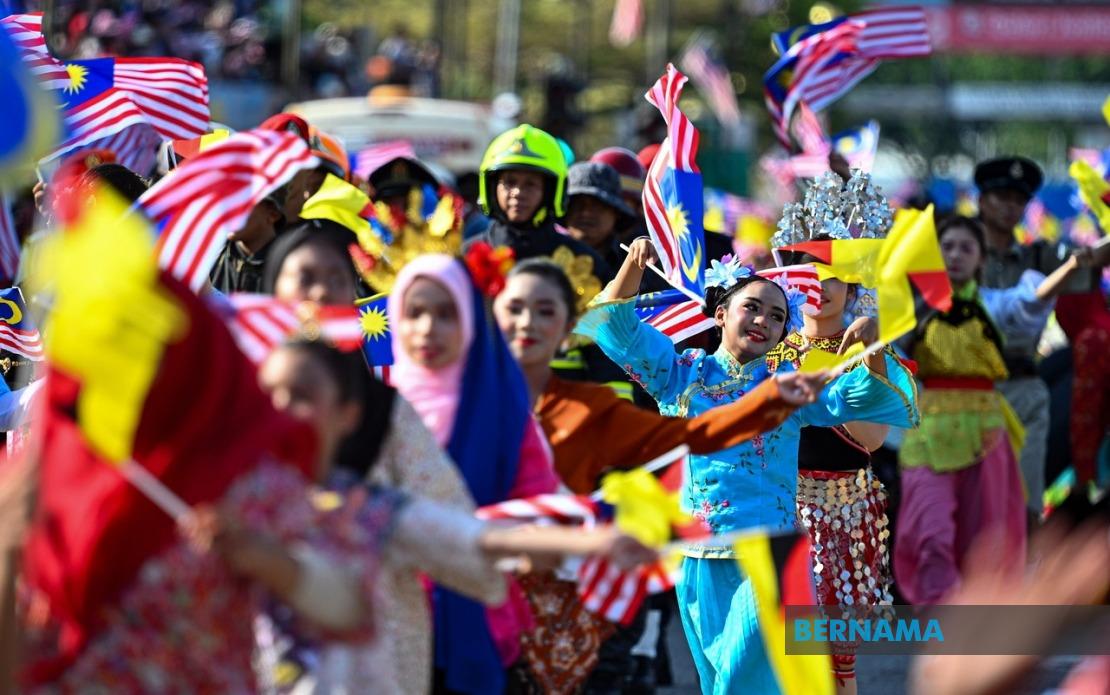
The state of Negeri Sembilan welcomed over 30,000 visitors to its official National Day celebration on 31 August, with crowds converging on Dataran Majlis Bandaraya Seremban from dawn to witness the full-day programme of ceremonial events, parades and entertainment. The impressive turnout, spanning multiple ethnic and religious communities, underscored both the enduring public appetite for structured national occasions and the organisational capacity of state-level authorities to stage major civic events that resonate across different demographic segments.
Menteri Besar Datuk Ismail Lasim attributed the substantial attendance to genuine enthusiasm for the independence milestone and a collective desire to mark the occasion with family and neighbours. Speaking to journalists immediately after the event concluded, he remarked that numerous attendees had spoken to him about arriving well before sunrise—some as early as 5.30 am—to secure vantage points, a pattern that he interpreted as evidence of deep-rooted attachment to national symbols and appreciation for the performances scheduled throughout the day.
The parade itself involved 82 distinct contingents representing more than 4,000 participants drawn from government ministries and agencies, public institutions, local council bodies, civil society organisations, educational establishments ranging from primary schools to universities, and various private-sector employers. This broad representational base reflected an effort to construct a snapshot of Negeri Sembilan's institutional landscape and to give visibility to diverse sectors within a single coordinated spectacle.
Central to ceremonial protocols was the Main Guard of Honour, comprising a standing party of three commissioned officers and 103 other ranks sourced from the 15th Battalion Royal Malay Regiment stationed in Senawang. Major Dr Muhammad Hazim Abdul Qhalib assumed command of this contingent, whilst Lieutenant Ahmad Izzudin Abdul Kadir carried the unit's colours and Warrant Officer 1 Darul Azhar Mohamed served in the senior non-commissioned officer role. These personnel were accompanied by a combined military band drawing musicians from the 24th Battalion Royal Malay Regiment and the Malaysian Army Basic Training Centre, operating under the baton of Drum Major Warrant Officer 2 Azwan Zakaria and performing a repertoire that included traditional military and patriotic selections.
Alongside these formal ceremonial elements, the parade showcased a curated collection of defence and security assets, including contemporary and vintage vehicles that generated sustained spectator interest throughout the proceedings. The display incorporated vehicles and equipment from the Malaysian Armed Forces, Royal Malaysia Police, Immigration Department, Fire and Rescue Department of Malaysia, Health Ministry, Malaysian Civil Defence Force and Seremban City Council, offering civilians rare opportunities to view operational and historical equipment.
Menteri Besar Ismail noted that organisers had deliberately constrained the scale of this year's parade compared to previous iterations, citing concerns about public exposure to hazardous atmospheric conditions caused by regional haze. Although weather conditions proved favourable on the day, the decision to reduce the number of contingents and assets reflected administrative prudence in planning for contingencies—a practical consideration that balances ceremonial ambition with public health safeguards, an increasingly relevant calculation for outdoor events across Southeast Asia.
The ceremonial programme achieved official legitimacy and elevated stature through the attendance of Tuanku Muhriz Tuanku Munawir, the Yang Dipertuan Besar of Negeri Sembilan, and Tunku Ampuan Besar Tuanku Aishah Rohani Tengku Besar Mahmud, who arrived approximately ninety minutes into the morning's activities and were formally received by the Menteri Besar. Their presence affirmed the occasion as a state-sanctioned ritual of national belonging, lending constitutional weight to what might otherwise be merely administrative assembly.
The public composition of attendees reflected conscious efforts by families to transmit nationalist values across generational lines. Housewife Siti Ruayiza Rebin, 42, explained that she had made it a practice over many years to bring her three children—now aged 19, 15 and 12—to every available National Day observance within reach, beginning when they were very young. She articulated a pedagogical rationale for this routine attendance, asserting that early exposure cultivates understanding of independence as a concept, fosters appreciation for sacrifices made by preceding generations, and creates habits of civil participation that would hopefully persist into adulthood.
Similarly, private-sector employee Mohd Khairul Azmi, 45, reported that his two young children, aged five and seven, displayed particular excitement at viewing military equipment and vintage vehicles that rarely appear in public spaces. The family had intentionally arrived by 6 am to claim a favourable position along the parade route, prioritising the children's opportunity for close observation and unobstructed viewing. Khairul Azmi articulated a conviction that such commemorative public events serve an educational function by embedding historical narratives and fostering awareness of institutional and governmental contributions to national development and security.
These individual testimonies reveal patterns of intentional family attendance and explicit intergenerational transmission of national consciousness through participation in structured ceremonial occasions. For Malaysian society more broadly, such events function as periodic reaffirmations of shared civic identity, creating spaces where the abstract concept of the nation becomes tangible, embodied in parades, uniforms, music and collective presence. The substantial turnout and diverse participation in Negeri Sembilan's celebration thus register both as attendance figures and as data points indicating sustained public investment in rituals of national belonging.
For Southeast Asian regional observers, Negeri Sembilan's successful execution of a large-scale public event offers lessons in crowd management, inter-agency coordination and the careful calibration of ceremonial scale to environmental and public health considerations. As climate change and transboundary pollution continue to complicate outdoor public gatherings across the region, the Malaysian state's willingness to adapt parade parameters based on haze forecasts exemplifies adaptive institutional practice. Simultaneously, the voluntary and enthusiastic civilian participation documented through early arrivals and family attendance demonstrates that ceremonial nationalism retains significant mobilisational capacity, at least when framed around historical commemoration and inclusive institutional representation rather than explicitly partisan or ideological messaging.

