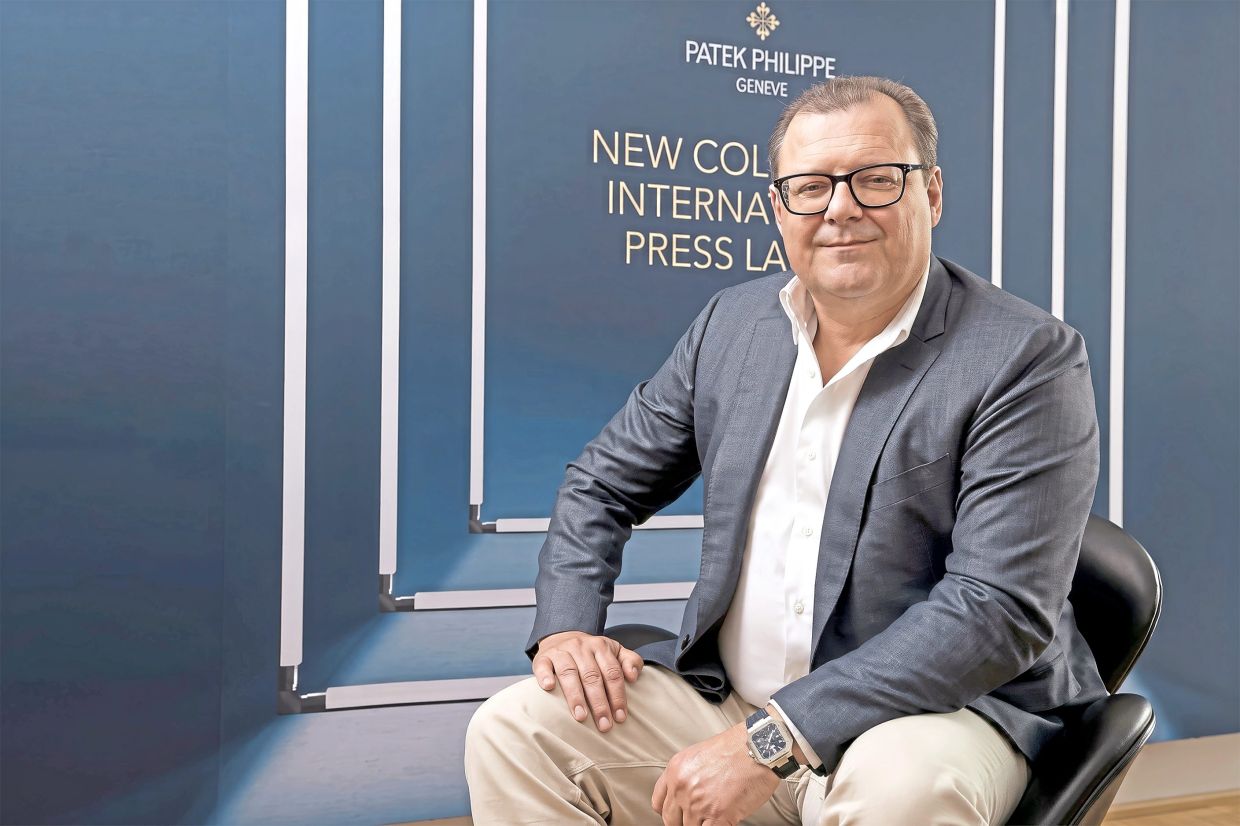
Thierry Stern carries himself less like the scion of Swiss watchmaking royalty and more like a collector who stumbled into the boardroom. The 55-year-old president of Patek Philippe, now leading the brand through its most significant anniversary celebration in decades, speaks with the earnest intensity of someone genuinely captivated by mechanical precision and design heritage rather than quarterly earnings. It is a deliberate positioning that reflects his conviction about what it takes to lead one of the world's most exclusive luxury houses.
During conversations at Watches and Wonders 2026 in Geneva, Stern articulates a philosophy that borders on the uncompromising: enthusiasm for watchmaking is not a career asset or a useful credential—it is a fundamental prerequisite. Without it, he argues, no amount of intelligence or business acumen can compensate. The discerning clientele that Patek Philippe attracts, he maintains, possess sufficient knowledge of horology to detect inauthenticity instantly. A leader who merely administers the brand rather than inhabits its passion creates a void that no marketing campaign can fill. This perspective reveals something deeper about how family-controlled Swiss luxury houses maintain their mystique and relevance across generations.
The brand's current focus is the golden anniversary of its most recognizable creation: the Nautilus, the revolutionary sports watch that debuted in 1976 and fundamentally challenged what Patek Philippe represented. Gerald Genta's design—with its distinctive porthole-inspired octagonal case and integrated bracelet—shocked the traditionalist establishment that had come to define the brand's identity. Competitors and purists alike dismissed it as too modern, too industrial, impossibly incongruous with Patek Philippe's archival aesthetic. That the design now occupies an almost mythological position in the watch world, commanding waiting lists stretching across years and auction results that frequently stagger financial logic, demonstrates how thoroughly taste can shift when a design resonates with something genuine in the collector's consciousness.
Stern's own relationship with the Nautilus carries an element of temporal irony. He was merely six years old when the watch launched and the industry's establishment erupted in protest. Those original critics—conservative voices who championed conventional horology—have largely departed the scene, leaving behind a legacy of misjudgment. Stern speaks of this transition with quiet amusement, understanding that his role is partly custodian of a vindicated vision and partly architect of new directions that future generations may initially resist.
To commemorate this anniversary, Patek Philippe has introduced three limited-edition Nautilus references, including variants in white gold and platinum, alongside a distinctive desk clock that echoes the watch's most iconic visual elements. The restraint evident in these releases distinguishes them from previous landmark commemorations, where horological complexity often took precedence over conceptual coherence. Stern deliberately rejected the instinct to showcase elaborate movements like tourbillons or other mechanical spectacles, instead doubling down on the Nautilus's essential identity as a pure hour-and-minute instrument. This decision reflects a maturity about brand stewardship—the recognition that not every milestone demands innovation in movement or function, that sometimes consolidation and celebration of core identity serves the brand's long-term interests better than technical ambition.
The new models themselves represent a study in ergonomic refinement. Housed in ultra-thin 6.9-millimetre cases and powered by the company's historic Calibre 240 with its distinctive micro-rotor, they prioritize wearability and proportional harmony over horological novelty. The development of the case and bracelet consumed several years of iterative refinement, evidence of the meticulous attention to tactile and visual balance that distinguishes Patek Philippe from manufacturers pursuing volume. For consumers accustomed to annual product cycles and rapid technological obsolescence, such extended development periods signal a fundamentally different value proposition—one rooted in permanence rather than perpetual renewal.
Stern's perspective on leadership was substantially shaped by the mentorship of his father Philippe Stern, who previously led the manufacture. The elder Stern impressed upon his successor a singular principle: understanding the client demands constant travel, genuine listening, and direct exposure to retail environments and end-user needs. This counsel transcended typical management platitudes; it advocated for empirical engagement rather than abstracted decision-making from executive offices. For a brand positioned at the apex of luxury watches—competing primarily with Rolex, Cartier, Audemars Piguet, and Omega—such grounded perspective becomes crucial when navigating the tension between heritage preservation and market evolution.
In Stern's view, stagnation masquerades as tradition in luxury industries where complacency can feel like reverence. He articulates clearly that without calculated risk-taking, Patek Philippe cannot sustain its relative standing across decades of changing consumer preferences, economic cycles, and technological disruption. Yet he distinguishes sharply between measured exploration and reckless experimentation. The Aquanaut, launched during the late 1990s as a younger, sportier counterpoint to the Nautilus, exemplifies this philosophy—a distinct product family that expanded the brand's appeal without fragmenting its identity or diluting its exclusivity.
This approach to stewardship reveals the particular challenges facing fourth-generation family enterprises in luxury sectors. The pressure to honor ancestral vision while remaining relevant to contemporary audiences creates constant tension. Stern navigates this by framing passion as the ultimate arbiter of decision-making. When leadership is driven by genuine engagement with the product itself rather than financial targets or market trends, it becomes easier to distinguish between innovations that serve the brand's evolution and those that merely chase momentary opportunities. A president who struggles to articulate why a particular design decision matters, who cannot connect technical specifications to the emotional response they evoke, lacks the internal compass necessary for sound judgment at this rarified level.
As Patek Philippe moves through this anniversary celebration, the broader luxury watch industry observes how the brand positions itself at a potential crossroads. Stern's insistence that passion remains non-negotiable—that technical expertise and business acumen cannot substitute for genuine love of mechanical watchmaking—offers a philosophical answer to questions about sustainable luxury leadership. Whether this approach can sustain profitability while maintaining exclusivity in an era of digital alternatives and changing wealth demographics remains an open question, but it reflects a conviction that some things, properly stewarded, remain timeless.

