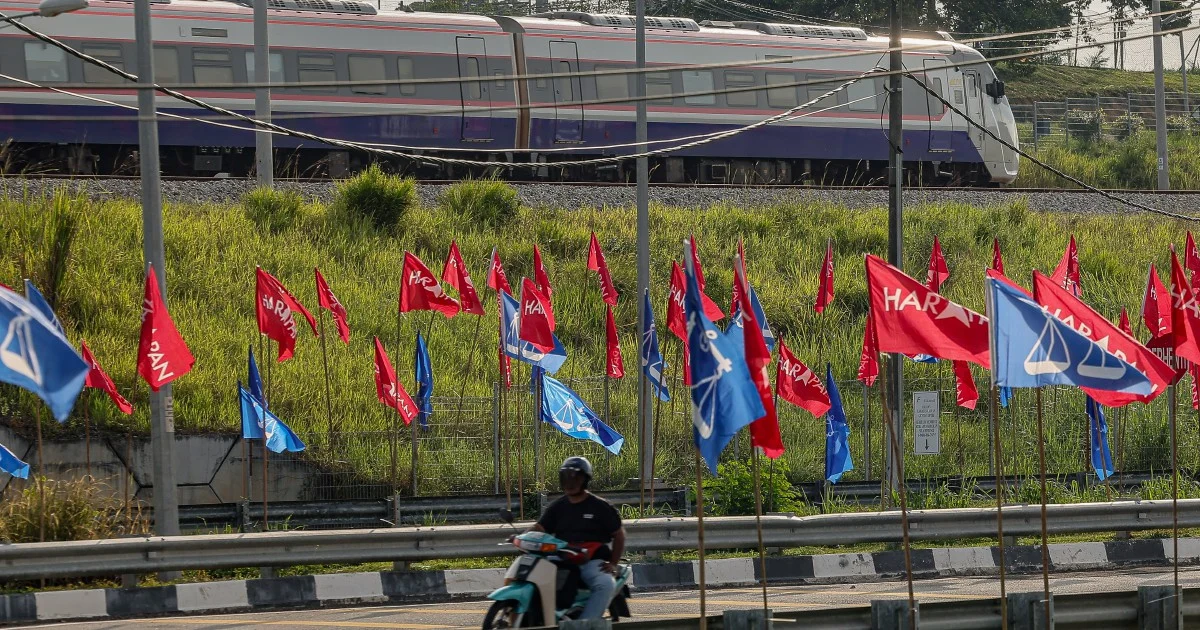
Malaysia's political landscape continues to shift as PAS Youth has clarified that the party's willingness to endorse Barisan Nasional candidates in constituencies where Perikatan Nasional abstains from competing represents a deliberate approach to limiting Pakatan Harapan's electoral advantage. The statement, made in Johor Baru, underscores the intricate web of cross-party alliances that have become increasingly common in recent Malaysian electoral cycles, where strategic partnerships between ostensibly rival coalitions have emerged as a tactical response to changing voter preferences and the fragmentation of the political middle ground.
The decision by PAS Youth to throw its organisational weight behind BN in carefully selected constituencies reflects broader tensions within Malaysia's three-coalition system. Rather than viewing this arrangement as a betrayal of traditional alliance patterns, party officials have characterised it as a calculated manoeuvre to prevent PH from consolidating power in marginal seats where a split opposition vote could prove decisive. This framing reveals how Malaysian political actors increasingly operate across traditional factional boundaries when they perceive a common strategic interest, a development that challenges conventional assumptions about coalition loyalty.
The move carries particular significance for Johor, a state where BN traditionally maintains considerable organisational infrastructure and voter support. By leveraging PAS Youth's grassroots networks in constituencies where PN has chosen not to field candidates, the arrangement theoretically amplifies BN's reach into communities where the coalition has struggled to maintain momentum. This coordination suggests that despite public rhetoric about maintaining distinct political identities, pragmatic calculations about electoral mathematics now dominate decision-making at the operational level.
For PAS, the arrangement presents a delicate balancing act. The party must maintain its standing within the Perikatan Nasional framework while simultaneously engaging in tactical cooperation with BN, a coalition from which PN itself broke away during the tumultuous post-2020 period. The party's youth wing appears to be signalling that this flexibility is not an abandonment of PN but rather a recognition that electoral competition demands opportunism. Whether this distinction resonates with ordinary party members and sympathisers remains uncertain, particularly given the historical animosity between PAS and some BN components.
The targeting of Pakatan Harapan reflects the perception among PN and BN strategists that PH represents the primary electoral threat requiring coordinated containment. Rather than competing directly against each other in every constituency, the two coalitions appear willing to deploy their respective strengths asymmetrically—allowing one coalition to contest where the other has opted out. This strategy assumes that voter behaviour remains relatively predictable along existing factional lines, with supporters of both PN and BN more willing to vote across coalition lines than to support PH candidates.
Regional implications of this arrangement extend beyond Johor. Should the PAS Youth's approach prove effective in translating organisational support into electoral gains for BN, similar coordination might emerge in other states where PN maintains significant presence but has strategic reasons to avoid contesting particular seats. Selangor, Kedah, and Terengganu—states where PN or its predecessors have contested—could potentially see similar patterns emerge in future elections. The precedent established in Johor may therefore reshape how Malaysian coalitions approach electoral strategy more broadly.
The move also reflects deeper structural challenges within the Malaysian political system. The existence of three major coalitions has created a winner-take-most environment where arithmetic matters more than ideology. When BN and PN calculate that sacrificing seats to each other while jointly limiting PH offers better overall outcomes than direct competition, they are effectively admitting that their differences on policy and governance are secondary to the shared objective of preventing PH dominance. This calculus underscores how contemporary Malaysian politics increasingly prioritises power allocation over programmatic differences.
For voters in contested constituencies, this arrangement creates novel dilemmas. Constituents who prefer neither BN nor PN but wish to prevent PH dominance now face clear voting incentives aligned with coalition strategy. Conversely, voters who support PH may feel increasingly marginalised in constituencies designated for BN or PN cooperation. The arrangement thus introduces an element of predetermined outcomes in constituencies where such cooperation exists, potentially dampening electoral competition and limiting genuine choice.
PAS Youth's public clarification appears designed to preempt criticism from within PN that the party is abandoning its coalition partners. By explicitly framing the BN cooperation as tactical and anti-PH rather than as a shift toward realignment, party officials seek to maintain their standing within Perikatan while simultaneously pursuing what they clearly view as an advantageous electoral arrangement. Whether this explanation satisfies PN's other component parties, particularly those with their own electoral ambitions, remains to be seen.
The statement also carries implications for how Malaysian voters understand their political options. In an increasingly fluid electoral environment where traditional coalition boundaries blur, voters must navigate competing narratives about party loyalty, strategic necessity, and principle. PAS Youth's position suggests that from the party's perspective, preventing PH's advance constitutes a sufficient justification for setting aside conventional alliance frameworks, reflecting the polarised nature of contemporary Malaysian politics where binary competition between broad blocs has superseded the more nuanced three-way competition that defined earlier electoral cycles.

