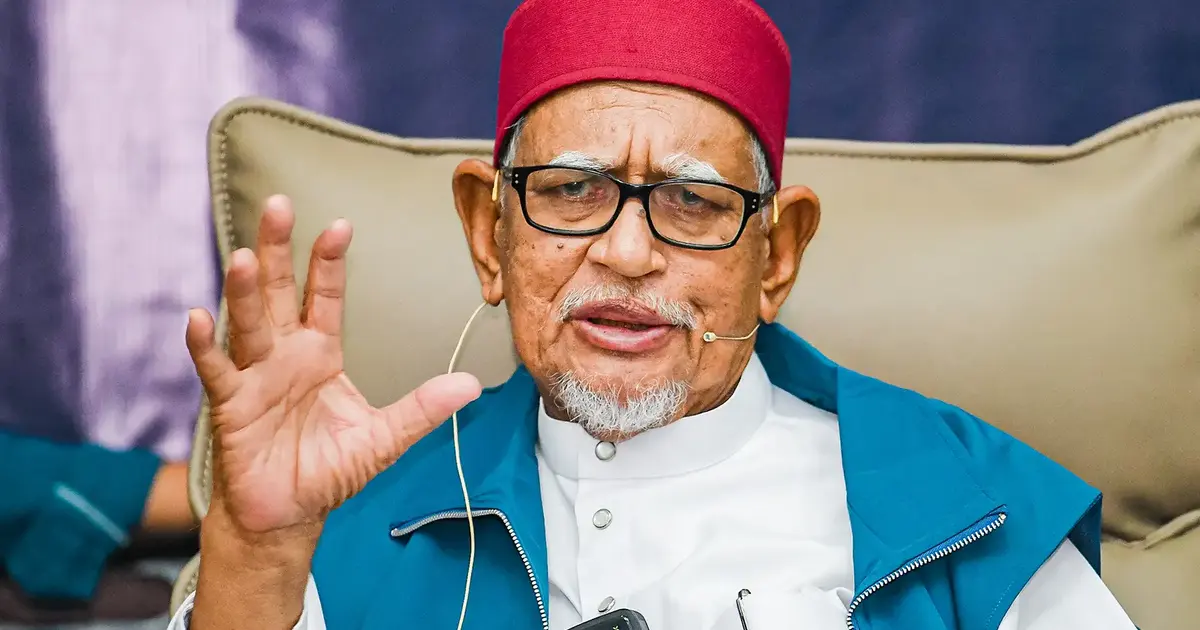
PAS president Hadi Awang has declared that Bersatu has effectively withdrawn from Perikatan Nasional, asserting that the party's announced strategy to establish a fresh political coalition after the Negeri Sembilan election constitutes an automatic exit from the alliance. The statement marks an escalation in tensions within the increasingly fractious opposition coalition that has struggled to maintain unity since its formation in 2020.
The assertion reflects deepening divisions among coalition members over the direction and future of their partnership. Bersatu, formerly led by former Prime Minister Mahathir Mohamad and now helmed by Tan Sri Muhyiddin Yassin, has been signalling its intention to pursue an alternative political structure, a move Hadi interprets as incompatible with continued membership in Perikatan Nasional. This interpretation suggests that the PAS leadership views any attempt to forge parallel alliances or coalitions as a fundamental breach of coalition loyalty and commitment.
The timing of Hadi's remarks is particularly significant given the scheduled Negeri Sembilan state election, which has become a potential flashpoint for inter-coalition disputes. Regional elections in Malaysian states often serve as testing grounds for larger political realignments, and this particular contest appears to have triggered discussions about the viability and structure of Perikatan Nasional itself. Rather than functioning as an opportunity for the coalition to demonstrate unified strength, the Negeri Sembilan election has instead become a catalyst for examining whether the partnership can survive internal pressures and divergent strategic interests.
For Malaysian political observers, this development underscores the fragility of opposition coalitions in the country's competitive political environment. Perikatan Nasional was originally established as a counter-alliance to the Pakatan Harapan government, positioning itself as an alternative governing option. However, the coalition has consistently grappled with reconciling the different ideological foundations and political ambitions of its constituent parties. PAS brings an Islamic-oriented voter base and institutional strength in particular states, while Bersatu represents urban-oriented, reform-minded supporters with historical connections to Mahathir's political legacy.
Bersatu's reported inclination to construct a new coalition suggests the party may be attempting to position itself more flexibly within Malaysia's multi-coalition political landscape. This manoeuvre could reflect calculations that new power-sharing arrangements offer better prospects for electoral success or political influence than remaining tethered to Perikatan Nasional's current configuration. The party's leadership may believe that establishing independent coalition options enhances their bargaining position in future negotiations over government formation or cabinet allocation.
Hadi's unilateral declaration that Bersatu has automatically exited the coalition, without apparent consultation with other alliance partners, itself demonstrates the governance challenges within Perikatan Nasional. Coalitions typically operate through consensus-based decision-making structures that allow member parties to negotiate disputes and clarify their respective commitments. The fact that the PAS president feels empowered to make such consequential pronouncements independently suggests either that established coalition protocols have broken down or that Hadi believes PAS wields sufficient influence to shape coalition membership unilaterally.
The implications for Malaysian politics are substantial. The opposition has repeatedly suffered from fragmentation and competing coalitions, which historically has benefited ruling administrations by splitting the anti-government vote. If Perikatan Nasional fractures further, with Bersatu pursuing independent coalition arrangements, the fragmentation could undermine the opposition's capacity to present a unified alternative government. Electoral mathematics in Malaysia's first-past-the-post system heavily penalise divided opposition votes, as demonstrated in previous general elections where multiple opposition coalitions contested the same constituencies.
Furthermore, the deterioration of Perikatan Nasional has broader ramifications for Southeast Asian politics, as Malaysia's coalition structures attract regional interest given the country's strategic importance and influence within ASEAN. A fragmented Malaysian opposition weakens the country's political stability and predictability, factors that international observers and neighbouring governments monitor closely. Coalition instability can also create uncertainty for investors and policy continuity in critical sectors like trade and regional security cooperation.
The Negeri Sembilan election thus becomes more than a routine state-level contest. It represents a potential inflection point where fundamental decisions about opposition coalition structures may crystallise. How Perikatan Nasional members campaign in the state, whether they enforce unified positions, and how the coalition manages the Bersatu question will provide crucial signals about whether the alliance can reform and stabilise or whether it has entered terminal decline. The election results themselves may either vindicate individual party strategies or demonstrate the electoral cost of coalition disunity.
Longer-term consequences could reshape Malaysia's political architecture significantly. Should Bersatu successfully establish an alternative coalition while maintaining electoral viability, Malaysia could transition toward a more multipolar opposition landscape with three or four distinct coalitions competing alongside the ruling administration. Alternatively, the fracturing could accelerate realignments where parties recalculate their political partnerships entirely, potentially leading to unexpected alliances that bridge traditional ideological divides. Either scenario would represent a substantial departure from recent Malaysian political patterns and would require voters, analysts, and policymakers to reassess fundamental assumptions about the country's political future.

