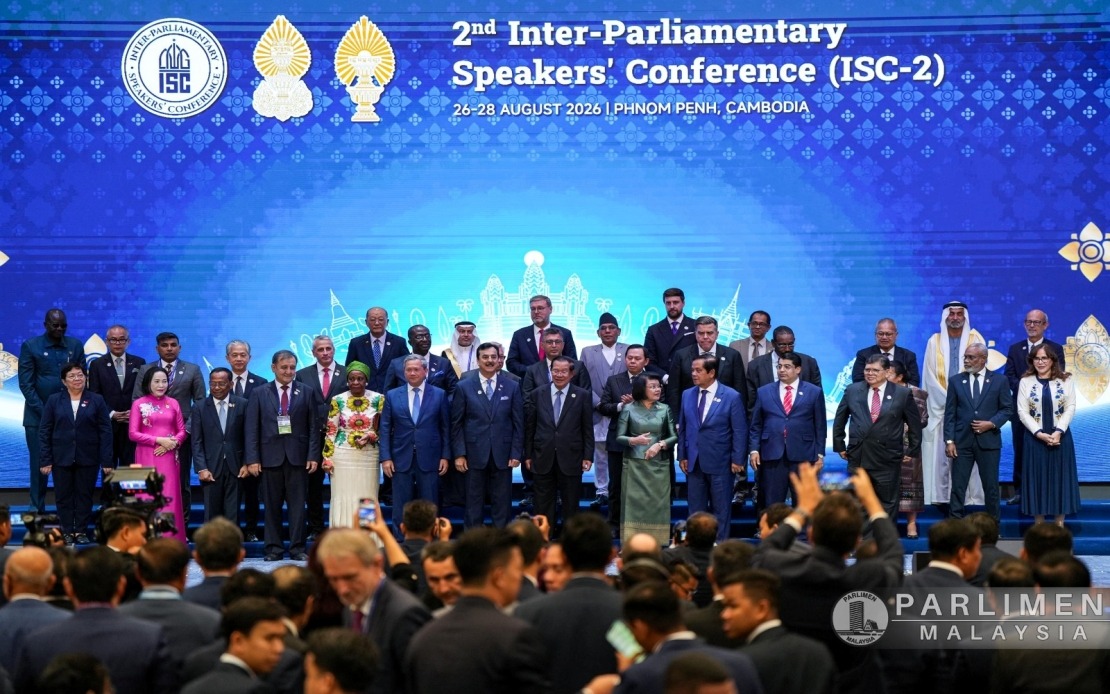
Addressing delegates at the Second Inter-Parliamentary Speakers' Conference in Phnom Penh, Dewan Rakyat Speaker Tan Sri Dr Johari Abdul has called for legislatures worldwide to take on expanded responsibilities in resolving international conflicts and managing geopolitical tensions. Speaking on Friday at the conference held jointly by Cambodia's National Assembly and Senate from August 26 to 28, Johari contended that peace, solidarity, international law and conflict resolution cannot remain the exclusive domain of governments, emphasizing instead that representative bodies must work hand in hand with executive branches to fashion comprehensive responses to the world's most pressing challenges.
The conference, convened under the theme "Solidarity for Peace and Shared Prosperity: Strengthening International Law and Resolving Conflicts Peacefully," provided a platform for Johari to articulate Malaysia's perspective on the evolving architecture of international engagement. He underscored that where geopolitical tensions and climate-related crises are destabilizing communities and displacing populations, the Inter-Parliamentary Speakers' Conference offers legislators a crucial venue for direct dialogue and collaborative problem-solving, circumventing the sometimes rigid protocols that govern diplomatic relations between states.
Johari's remarks reflect a growing recognition among regional policymakers that the traditional bifurcation between executive foreign policy and legislative oversight has become inadequate for addressing transnational crises. By bringing together speakers and senior parliamentary figures from multiple nations, such conferences create opportunities for relationship-building and trust formation that transcend official government channels. This informal diplomacy can prove invaluable when conventional state-to-state negotiations become deadlocked or when political sensitivities make direct governmental engagement difficult.
The speaker highlighted the distinctive analytical capabilities that legislative bodies bring to complex international disputes. While executive branches tend to view global challenges primarily through a political lens shaped by immediate diplomatic considerations, parliamentarians often possess deeper understanding of how conflicts and geopolitical shifts affect ordinary citizens and communities. This distinction matters significantly in crafting durable solutions that address root causes rather than merely managing symptoms. When both branches contribute their respective insights, the result tends to be policy frameworks that are both politically feasible and substantively responsive to public concerns.
Central to Johari's argument is the notion that parliamentary diplomacy maintains channels of communication when official relations between governments deteriorate. During periods of heightened tension, when formal diplomatic protocols become strained or when political rhetoric dominates official discourse, parliamentarians can continue quiet conversations across national and ideological divides. These exchanges preserve the possibility of reconciliation and provide forums where representatives can remind each other that political disagreement need not inevitably escalate to confrontation or conflict. Such back-channel engagement has historically prevented misunderstandings from metastasizing into serious international incidents.
Malaysia's approach, as articulated by Johari, centers on core principles of sovereignty, territorial integrity, adherence to international law and the peaceful settlement of disputes—commitments that carry particular resonance within Southeast Asia. ASEAN's founding premise, rooted in dialogue and consultation rather than coercive mechanisms, demonstrates that the region has long understood the value of negotiated solutions to interstate differences. The association's track record, while imperfect, shows that sustained commitment to multilateral engagement can contain tensions that might otherwise destabilize entire subregions.
Johari's remarks acquire special significance given Malaysia's position as a significant maritime and trading nation embedded within a complex regional security environment. Southeast Asia faces overlapping challenges: unresolved maritime boundary disputes, competing economic interests, and external powers with divergent strategic objectives. In this context, the ability of parliaments to build understanding among peoples and encourage solutions grounded in international law becomes particularly valuable. Legislative delegations can address constituencies directly, explaining the rationale behind peaceful settlement frameworks and building public support for approaches that might initially appear to sacrifice perceived national advantage but actually serve longer-term stability and prosperity.
The speaker's emphasis on parliamentary engagement also speaks to broader questions about democratic legitimacy in international affairs. When parliaments remain marginal to conflict resolution efforts, the resulting agreements may lack domestic support and prove vulnerable to reversal when political circumstances shift. Conversely, when legislatures are genuinely invested in diplomatic outcomes, their members become ambassadors for those agreements within their own constituencies, helping sustain public commitment to peace processes that often require years or decades to yield tangible results.
Looking ahead, Indonesia's commitment to hosting the third Inter-Parliamentary Speakers' Conference in 2025 signals sustained momentum toward institutionalizing legislative engagement in global affairs. This progression from Pakistan's inaugural conference through Cambodia's second gathering to Indonesia's forthcoming hosting demonstrates that Asian parliaments view such forums as essential infrastructure for managing international relations. The geographic spread of hosting responsibilities across South Asia and Southeast Asia also reflects determination to embed parliamentary diplomacy within the region's broader architecture of cooperation.
For Malaysian policymakers and observers, Johari's advocacy carries practical implications. As ASEAN navigates increasingly complex regional dynamics and as Malaysia balances relationships with multiple great powers, enhanced parliamentary coordination can serve valuable conflict-prevention and confidence-building functions. Greater legislative involvement need not undermine executive prerogatives but rather complement government efforts by providing additional channels for dialogue, trust-building and the cultivation of cross-national relationships grounded in personal connections and mutual understanding between representatives.
The broader significance of Johari's intervention lies in his implicit challenge to assumptions that have long dominated international relations theory and practice. The notion that foreign policy and conflict resolution belong primarily to executive branches reflects historical patterns rooted in monarchical systems and Cold War realpolitik. Contemporary challenges—from climate displacement to pandemics to asymmetric security threats—increasingly demand responses that engage societies more broadly. By emphasizing parliament's role, Johari articulates a vision of international governance that is more inclusive, more transparent and potentially more resilient to the complexities and scale of twenty-first century crises.

