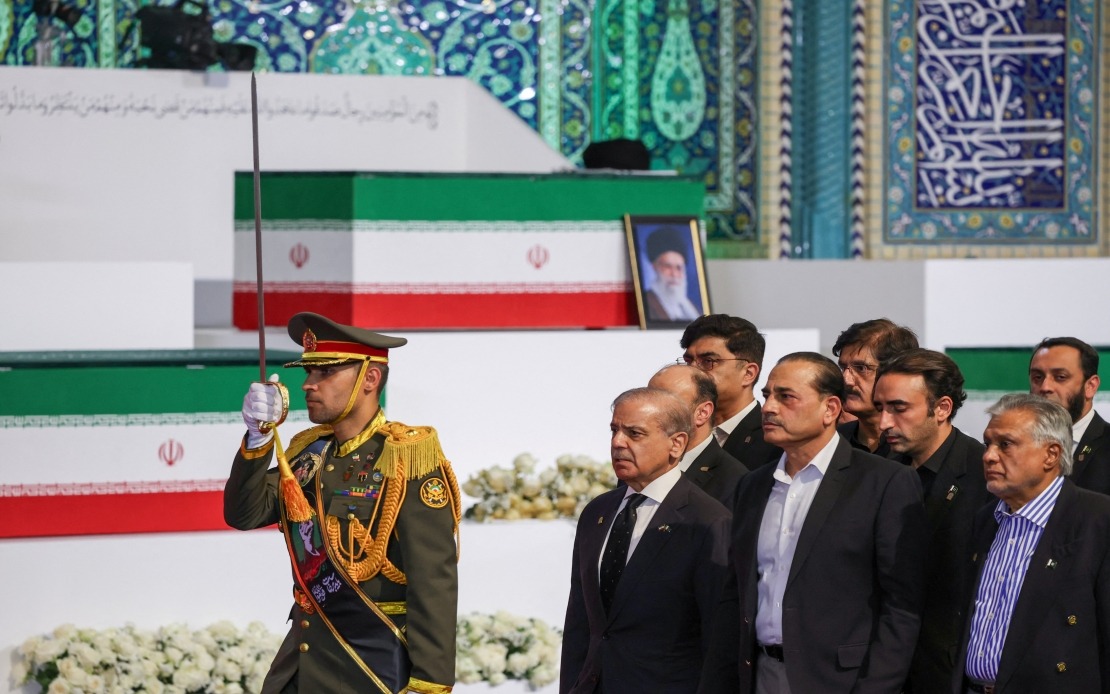
Pakistan deployed its most senior political and military leadership to the funeral of Iran's Supreme Leader Ayatollah Ali Khamenei in Tehran on Friday, a gesture Iran's diplomatic corps hailed as testament to the depth of bilateral relations between the two neighbouring Islamic nations. The unprecedented scale and composition of the Pakistani contingent underscored Islamabad's commitment to cementing ties with Tehran at a moment of significant transition for the Islamic Republic, whose Supreme Leader died on February 28 along with family members in what Iranian officials characterised as a United States and Israeli attack on his compound in the capital.
Prime Minister Shehbaz Sharif personally led the Pakistani delegation, an exceptionally rare occurrence for such ceremonies and a clear signal of the country's desire to strengthen bonds with Tehran. Accompanying the premier were figures representing the full spectrum of Pakistan's power structure: Deputy Prime Minister and Foreign Minister Ishaq Dar, Military Chief of Army Staff Field Marshal Syed Asim Munir, political opposition leader and Pakistan People's Party chairman Bilawal Bhutto Zardari, National Assembly Speaker Sardar Ayaz Sadiq, Interior Minister Mohsin Naqvi and Information Minister Attaullah Tarar. The roster reflected both executive confidence and rare cross-party consensus on regional diplomacy.
Iran's Ambassador to Pakistan, Reza Amiri Moghadam, publicly acknowledged Pakistan's participation in notably effusive terms, describing the delegation as both the numerically largest and diplomatically highest-ranking among delegations from approximately one hundred nations present in Tehran. His statements on the X platform emphasised that the Pakistani show of respect extended beyond ceremonial obligation, characterising it instead as a meaningful historical gesture rooted in genuine civilisational bonds. The ambassador's language—invoking "enduring friendship and brotherhood"—reflected Tehran's evident satisfaction with how Islamabad managed a sensitive moment in Iranian national affairs.
The funeral brought together an extraordinary gathering of global dignitaries spanning the geopolitical spectrum. Malaysia, Bangladesh, Saudi Arabia, Turkey, Qatar, Oman, Egypt, Russia, Iraq, China and India all dispatched representatives, indicating Khamenei's significance not merely as Iran's religious leader but as a pivotal regional figure whose passing warranted attention from powers across ideological divides. This diversity of attendance itself carried diplomatic weight, suggesting broad international recognition of Iran's role in Middle Eastern affairs despite ongoing tensions with Western nations.
Khamenei's tenure as Supreme Leader stretched from 1989 until his death at age 86, encompassing three decades of Iranian domestic and foreign policy during which he consolidated religious and political authority while navigating regional conflicts, international sanctions and nuclear negotiations. His death at this juncture leaves Iran managing succession during a period of heightened regional volatility and raises questions about continuity in Tehran's strategic orientation, particularly regarding its posture toward neighbouring states and global powers.
Pakistan's diplomatic outreach carries particular significance for Malaysian and broader Southeast Asian interests given the interconnected nature of regional security dynamics. Pakistan's robust engagement with Iran reflects efforts to maintain balanced relations with neighbouring Muslim-majority nations while managing complex dynamics involving energy security, counterterrorism cooperation and Shia-Sunni relations. For Islamabad, demonstrating solidarity with Tehran represents an assertion of Pakistani agency in regional affairs independent of pressure from Western capitals, particularly given longstanding Pakistani relationships with Gulf Arab states that maintain more fraught ties with Iran.
The funeral ceremonies, which commenced publicly on Saturday with internment scheduled for July 9 in Mashhad, Khamenei's birthplace, marked an extended period of national mourning for Iran. Pakistan's decision to send its highest civilian and military leadership rather than merely diplomatic functionaries conveyed respect for this solemn occasion whilst simultaneously projecting influence during a moment when Iran's decision-making structures would be momentarily fluid. Such timing allowed Islamabad to reaffirm commitments to Tehran at potentially consequential junctures in bilateral relations.
Prime Minister Sharif's own remarks at the ceremony acknowledged Khamenei's "wisdom, leadership and profound influence on Iran and the wider region," language that extended respect beyond mere diplomatic courtesy to recognition of substantive influence over regional geopolitics. This formulation allowed Pakistan to honour Khamenei's legacy whilst implicitly acknowledging Iran's gravitational pull across Middle Eastern and South Asian security concerns. For Malaysian observers, Pakistan's calculated demonstration of bilateral closeness with Iran illustrates how Islamic republics navigate complex relationships involving religious affinity, strategic interests and great power competition.
Iran's ambassador's emphasis on the "historic ties and shared values" binding the two nations invoked deeper connections than formal state relations, touching on civilisational narratives important to both countries' domestic audiences. This rhetoric, whilst diplomatically conventional, carries genuine substance: Pakistan and Iran share border regions, Shia populations, historical trade routes, and mutual security concerns regarding Afghan stability and militant movements. Ambassador Moghadam's public articulation of appreciation for Pakistan's gesture suggested Tehran wished to cement these ties during a leadership transition that could reshape Iranian foreign policy priorities.
The composition and scale of Pakistan's funeral delegation reflects broader patterns in South Asian and Islamic world diplomacy wherein high-level attendance at state funerals serves as barometer of bilateral relations and regional alignment. For Pakistan, the decision to elevate the mission beyond standard diplomatic protocol signalled confidence in the longevity of Pakistan-Iran cooperation whilst potentially signalling to other regional actors—particularly Saudi Arabia and the Gulf states—that Islamabad maintains independent relationships unmediated by Riyadh's strategic preferences. This balancing act has grown more intricate as regional tensions have escalated.
Looking forward, Pakistan's emphatic engagement with Iran's mourning period may establish diplomatic capital useful for managing cross-border security challenges, water-sharing disputes and mutual concerns regarding terrorist organisations operating across their shared frontier. The funeral represented a rare moment of unified international focus on Iran, and Pakistan's prominent participation positioned Islamabad advantageously for subsequent negotiations or cooperation initiatives. For regional observers including Malaysia, Pakistan's diplomatic performance illuminates how middle-power nations maintain strategic autonomy whilst respecting great power interests and honouring civilisational bonds that transcend state borders.

