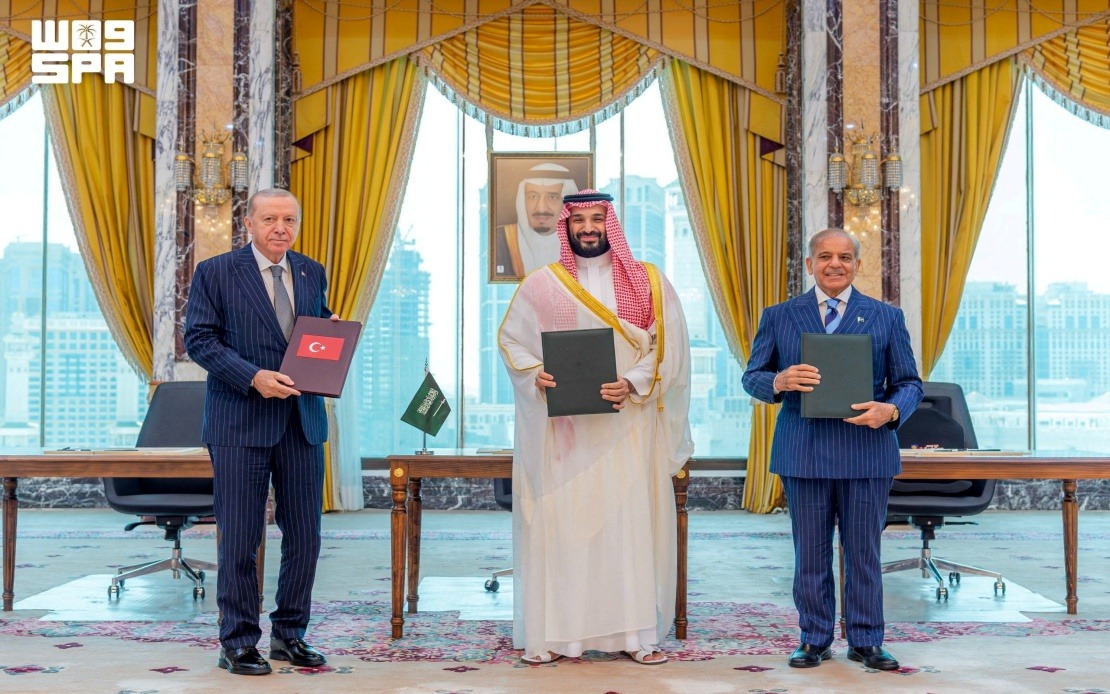
Pakistan, Saudi Arabia and Türkiye have formalised a landmark trilateral defence agreement, signalling a deepening commitment to collective security in one of the world's most geopolitically significant regions. The accord, signed on Friday at Al Safa Palace in Makkah, brings together three influential Muslim-majority nations with substantial military and economic weight to create a unified deterrent framework. Saudi Crown Prince Mohammed bin Salman bin Abdulaziz Al Saud, Pakistan Prime Minister Shehbaz Sharif and Turkish President Recep Tayyip Erdogan each affixed their signatures to what officials describe as a watershed moment in regional cooperation.
The Joint Defence Agreement establishes a critical principle: any armed aggression directed at one signatory shall be treated as aggression against all three nations. This mutual defence clause represents the pact's central pillar, creating a binding commitment that extends beyond diplomatic rhetoric to encompass concrete security obligations. The framework explicitly endorses the enhancement of defence cooperation across all dimensions—military training, joint exercises, intelligence sharing and technological collaboration. By pooling their defensive capabilities, the three countries aim to project a unified posture that discourages hostile action from external actors.
For Malaysia and broader Southeast Asia, this development carries substantial implications. The pact reinforces a trend toward regional blocs and multilateral security arrangements that reshape the global balance of power. Pakistan's position as a nuclear-armed state adds considerable weight to the agreement, while Saudi Arabia's economic influence and Türkiye's strategic geography spanning Europe and Asia create a potent combination. The emergence of such frameworks outside traditional Western-led alliances demonstrates how middle powers increasingly pursue independent security architectures tailored to their specific regional contexts and threat perceptions.
Saudi Arabia's deputy public diplomacy minister, Rayed Krimly, characterised the agreement as defensive in nature, emphasising that it neither threatens neighbouring countries nor represents an escalation of regional tensions. Instead, officials present the pact as a stabilising mechanism designed to deter aggression and manage shared security challenges. Krimly highlighted that the arrangement enables the three states to develop integrated defence capabilities, strengthen strategic deterrence, and enhance collective readiness against potential threats. This framing attempts to position the agreement as consistent with international law and existing regional norms, rather than as a provocative shift in the security landscape.
The partnership builds upon existing bilateral relationships that have matured over decades. Pakistan and Saudi Arabia inked their own bilateral defence agreement in September of the previous year, establishing reciprocal obligations to provide military assistance during external attacks. That foundational accord laid groundwork for the more ambitious trilateral structure now formalised in Makkah. Türkiye's inclusion extends the framework geographically and strategically, linking South Asia with the Middle East and Mediterranean through a coherent security arrangement. The expansion from bilateral to trilateral cooperation suggests confidence among the parties that their interests align sufficiently to warrant deeper integration.
Historically, Pakistan has cultivated robust defence ties with both Türkiye and Saudi Arabia, making this formalisation a natural evolution rather than a dramatic departure. The three nations share certain geopolitical concerns, including counterterrorism operations, maritime security in crucial waterways, and management of regional conflicts. Pakistan's experience combating militant organisations, Saudi Arabia's leadership role in the Arabian Peninsula and beyond, and Türkiye's NATO membership and regional activism create a complementary set of capabilities and perspectives. When these strengths combine through institutional mechanisms, they produce tangible deterrent effects that ripple throughout the broader region.
The joint statement issued following the Makkah summit emphasised the three leaders' commitment to strengthening collective security while simultaneously promoting peace, stability and prosperity. This dual emphasis—deterrence paired with development—reflects a sophisticated understanding that security arrangements succeed only when embedded within broader frameworks promoting economic cooperation and conflict resolution. The agreement thus represents not merely a military compact but a comprehensive commitment to regional wellbeing, acknowledging that lasting security emerges from addressing underlying grievances and creating mutual prosperity.
From a Southeast Asian perspective, Pakistan's integration into such high-level security arrangements merits close attention. As a major regional power with substantial military capabilities and significant involvement in regional conflicts, Pakistan's strategic choices influence flows of arms, extremist movements and great power competition. The agreement potentially signals Pakistan's intention to anchor itself more firmly within Middle Eastern security structures, potentially diverting attention and resources from South Asian concerns. Conversely, it may enhance Pakistan's capacity to manage security challenges more effectively, potentially reducing destabilising behaviour that reverberates across the Indian Ocean and into Southeast Asian waters.
The absence of explicit provisions naming specific adversaries or threat vectors underscores the agreement's deliberately ambiguous framing. Rather than targeting particular countries or militant organisations, the pact presents itself as a general deterrent against unspecified aggression. This approach grants flexibility in application while avoiding inflammatory language that might provoke international backlash. However, regional observers recognise that such agreements carry implicit messages about threat perceptions and strategic alignments, even when couched in defensive terminology. The positioning of the pact as exclusively defensive—neither threatening other regional states nor escalating existing tensions—attempts to preempt criticism from countries potentially uncomfortable with the strengthened Pakistan-Saudi Arabia-Türkiye nexus.
Moving forward, the operational success of this trilateral arrangement will depend upon regular engagement, concrete institutional mechanisms and demonstrated will to coordinate on actual security challenges. Defence agreements function effectively only when supported by standing committees, joint planning processes and periodic exercises that translate written commitments into operational readiness. The agreement's durability will be tested when member states face genuine crises requiring activation of mutual defence clauses or when divergent national interests collide. How the three signatories navigate such challenges will determine whether this pact represents a genuinely transformative shift in regional security architecture or a largely symbolic affirmation of existing partnerships.

