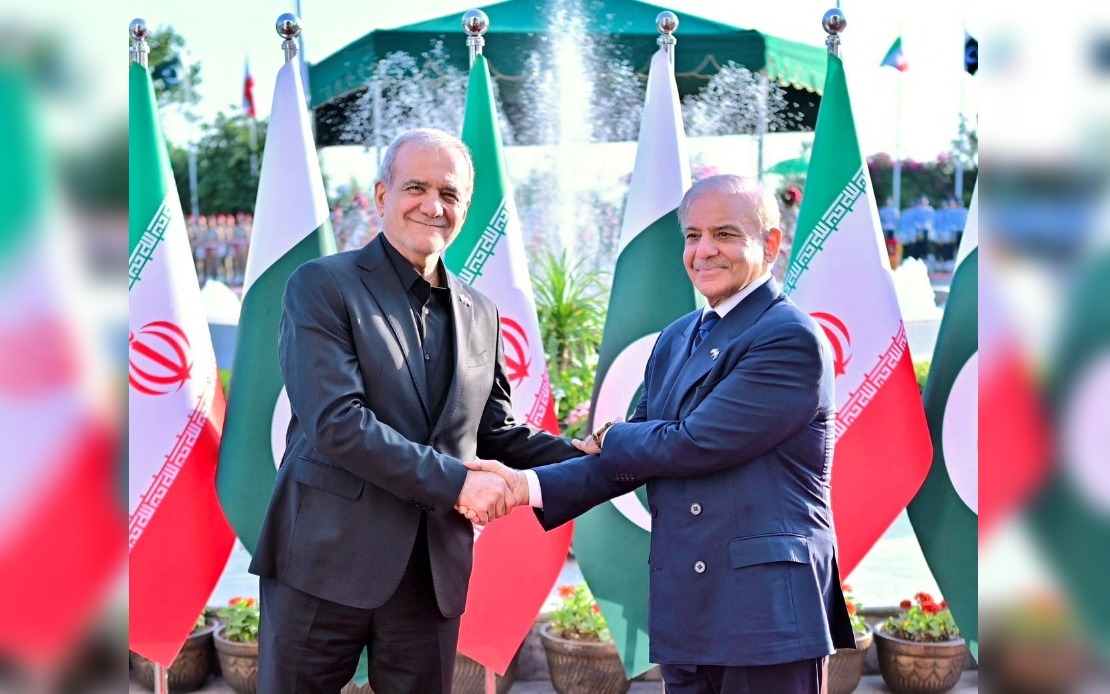
Pakistan's Prime Minister Shehbaz Sharif has thrown his weight behind Iran's ballistic missile capabilities, declaring that Tehran should not face discriminatory restrictions that other nations escape. The remarks came during talks with visiting Iranian President Masoud Pezeshkian and his delegation in Islamabad on Tuesday, underscoring Islamabad's continued alignment with Tehran at a critical juncture in Middle Eastern geopolitics.
Sharif emphasised that the ballistic missile issue was conspicuously absent from the memorandum of understanding signed between Iran and the United States on June 17, which Pakistan had helped facilitate. He stressed that Iran had never sought to place missiles on the negotiating table and should not now face pressure to do so. The statement carries particular weight given Pakistan's central role in brokering multiple rounds of engagement between Washington and Tehran in recent months, including an interim ceasefire arrangement in April.
The Pakistani premier framed Iran's defensive capabilities as non-negotiable, rejecting what he characterised as a double standard in international relations. By allowing some nations to maintain extensive missile arsenals whilst demanding that others disarm, Sharif suggested, the global community perpetuates an unjust and destabilising hierarchy. His position aligns closely with the broader regional anxiety about security threats, particularly following attacks by Israel and the United States against Iranian territory in February, which Tehran views as justifying its emphasis on military deterrence.
Sharif expressed gratitude for Iran's confidence in Pakistan's mediation role, noting the instrumental contributions of Deputy Prime Minister and Foreign Minister Ishaq Dar and Field Marshal Syed Asim Munir, the Chief of Army Staff. In assuming the mantle of honest broker between adversaries, Pakistan has positioned itself as an indispensable player in West Asian diplomacy. However, the prime minister cautioned that external actors continue to work against stabilisation efforts in the region, warning of "spoilers all over the world" determined to derail the emerging understanding.
Iranian President Pezeshkian responded by declaring that his nation's defensive arsenal represents a fundamental and inviolable aspect of national sovereignty. He invoked a stark hypothetical, suggesting that without Iran's missile capabilities, Israel and the United States would reduce his country to the devastation witnessed in Gaza, with no regard for civilian lives. This framing reflects Tehran's conviction that military strength, rather than diplomatic accommodation, provides the ultimate security guarantee against external aggression.
The timing of Pezeshkian's visit carries geopolitical significance for Southeast Asia and the broader developing world. As great powers contest influence across the Indo-Pacific and Middle East, smaller nations like Pakistan and others in the region must navigate complex alignments without sacrificing their interests. Pakistan's vocal backing of Iran's military prerogatives demonstrates how regional powers are calibrating their positions amid shifting US policy under the Trump administration, which has signalled greater tolerance for Iranian missile development than previous American governments.
Trump's recent concession that Iran possesses a legitimate claim to ballistic missiles—if other countries retain such capabilities—represents a notable rhetorical shift from conventional American positions. The former and future president told reporters in Paris that restricting Iranian missiles whilst permitting comparable arsenals elsewhere constitutes unfairness. This evolving American stance has emboldened Iran's allies, including Pakistan, to articulate their support more openly, knowing that domestic American opposition to the measures may constrain any aggressive enforcement efforts.
The pageantry surrounding Pezeshkian's arrival in Islamabad underscored the ceremonial importance Pakistan attaches to the relationship. Six Pakistani Air Force fighter jets escorted the Iranian presidential aircraft, while President Asif Ali Zardari and Prime Minister Sharif received their guest with formal honours, including a 21-gun salute. Such displays serve both symbolic and practical purposes: they demonstrate solidarity to domestic audiences, signal to international observers the depth of bilateral partnership, and provide reassurance to Iran that Pakistan remains committed despite regional pressures.
For Malaysia and other Southeast Asian nations, these developments offer instructive lessons about the interplay between regional security architecture and great power competition. As countries across the region increasingly engage with Middle Eastern actors in security and economic domains, the outcome of the Iran-US engagement will reverberate across trade routes, energy supplies, and investment flows. Pakistan's mediation role also exemplifies how non-permanent Security Council members can amplify their influence through strategic positioning during crises.
The exclusion of ballistic missiles from the Iran-US memorandum suggests that both parties, despite mutual suspicion, recognised that progress on some issues could proceed without addressing every contentious matter simultaneously. This incremental approach may offer a model for other intractable disputes, though it also risks creating ambiguity about whether future negotiations will revisit excluded topics. Iran and the United States remain fundamentally at odds over numerous strategic questions, and the current thaw could prove temporary if either side perceives the other is gaining undue advantage.
Pakistan's diplomatic investment in mediating between Iran and America reflects its own strategic interests. As a nation bordering Iran with significant Shia Muslim populations and historical cultural ties, Pakistan cannot afford to alienate Tehran. Simultaneously, Pakistan maintains critical relationships with Western powers and faces pressure to counter Iranian influence in its own territory through groups designated as terrorist organisations. By positioning itself as a neutral facilitator, Sharif's government seeks to preserve these multiple relationships whilst enhancing its regional relevance.
The broader context of Middle Eastern instability, particularly the Israeli-Palestinian conflict and regional proxy competitions, suggests that even successful diplomatic agreements on discrete issues may not resolve deeper structural tensions. Pezeshkian's invocation of Gaza and implicit warning about potential Iranian vulnerability reflects genuine security anxieties within Tehran's leadership. These concerns will likely persist regardless of the current memorandum, keeping Iran focused on military capability development as an essential insurance policy.
As the region navigates the months ahead, Pakistan's public endorsement of Iran's missile rights indicates that Islamabad believes the emerging balance of power favours greater Iranian assertiveness and that accommodating this reality through frank acknowledgment serves Pakistan's interests better than joining calls for further Iranian constraints. Whether this calculation proves correct will depend partly on how the United States interprets and enforces the June 17 agreement, and whether Israel perceives the current diplomatic trajectory as strengthening or weakening its own security position in the region.