Pakatan Harapan's campaign momentum in the Johor state election is gaining traction through a methodical, constituency-level strategy that tailors messaging and resources to local political conditions, according to the coalition's secretary-general. Datuk Seri Saifuddin Nasution Ismail disclosed that PH has systematically categorized all 56 state seats under contention into priority tiers, reflecting varying degrees of electoral potential and distinct community demographics. This targeted approach represents a departure from broad-brush campaigning, instead directing concentrated effort toward constituencies where ground sentiment shows the strongest receptivity to the coalition's platform.
The granular nature of PH's strategy reflects an understanding that electoral success hinges on acknowledging the heterogeneity of Johor's political landscape. Saifuddin illustrated the diversity of constituencies by contrasting Puteri Wangsa with Johor Lama, and Larkin with Endau, emphasizing that each locality presents unique voter concerns and logistical challenges. By segmenting the electoral terrain into distinct clusters assigned differential priority rankings, PH aims to deploy campaign resources with surgical precision rather than spreading messaging uniformly across all seats. This methodology suggests the coalition has invested in granular voter research to identify which areas represent winnable territory, which require intensive persuasion efforts, and where resources might yield diminishing returns.
The coalition's confidence in mounting support appears bolstered partly by strategic missteps from competing political forces. Saifuddin highlighted PAS's decision to contest only 11 seats while directing its supporters to back Barisan Nasional in remaining constituencies, characterizing this tactical arrangement as inadvertently advantageous to PH's positioning. The move by PAS, historically a heavyweight in Johor politics, to effectively cede much of the contested terrain arguably reshapes the electoral battlefield in PH's favour by consolidating the opposition vote around Barisan Nasional rather than fragmenting it across multiple coalitions. In contrast, Saifuddin emphasized that PH has pursued transparency by announcing its own seat distribution unambiguously and offering voters a coherent, implementable manifesto, thereby projecting stability and organizational competence.
The contrast between coalition transparency and opposition fragmentation appears central to PH's messaging strategy. Rather than positioning itself merely as a viable alternative, PH is framing itself as the more professionally organized and predictable force capable of administering a state government. This rhetorical positioning addresses longstanding voter anxieties about coalition governance and party coordination in Malaysian politics. By presenting clear candidate lists and detailed policy commitments, PH signals that it has anticipated governance challenges and prepared concrete solutions, distinguishing itself from opposition actors seemingly engaged in seat-bargaining rather than principled political platform-building.
The presence of Datuk Dr Mohd Puad Zarkashi, a former UMNO Supreme Council member, at joint campaign events with Prime Minister Datuk Seri Anwar Ibrahim represents an additional symbolic asset for PH's Johor campaign. Saifuddin characterized Puad's participation in talks at Felda Ulu Tiram as adding momentum and credibility to the coalition's outreach efforts. The involvement of a historically significant UMNO figure at PH campaign events carries implicit messaging about political realignment and the viability of governing coalitions that transcend traditional party boundaries. For Johor voters, particularly rural constituencies dependent on FELDA schemes and traditional UMNO constituencies, the visual of established UMNO figures endorsing PH governance may signal that abandoning long-held political allegiances does not require embracing untested or radical alternatives.
PH's candidate slate reflects careful internal negotiation and seat allocation among its constituent parties. The coalition is fielding candidates across all 56 seats, with PKR contesting 20 seats, Amanah 19, and DAP 17. This distribution suggests an attempt to balance party interests while maintaining coalition cohesion ahead of state-level governance. The allocation does not rigidly follow proportional representation, instead reflecting assessments of which party possesses strongest ground organization and candidate appeal in specific constituencies. Such allocations become critical because electoral defeats sometimes trigger recriminations about vote-splitting and poor resource allocation, particularly when coalition partners perform unevenly across constituencies.
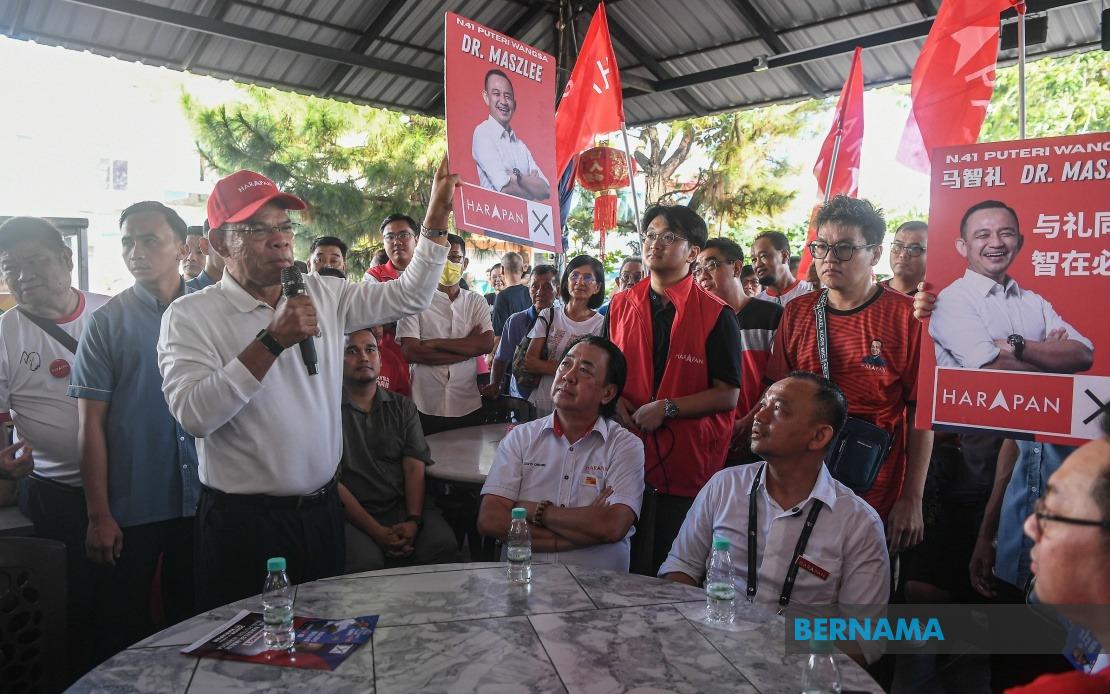
Puteri Wangsa, the constituency where Saifuddin held his community engagement breakfast, exemplifies PH's targeted approach. The candidate Dr Maszlee Malik was described as a qualified aspirant and strategic asset for the coalition if it wins the mandate to form Johor's state government. This emphasis on candidate quality and preparedness for governance reflects PH's apparent strategy of positioning the election not merely as a popularity contest but as a judgment about organizational capability and government-readiness. By highlighting candidate credentials and policy competence, PH attempts to elevate the electoral debate beyond personality-driven or emotion-driven campaigning.
The broader Johor electoral contest involves 172 candidates across competing political formations, with polling scheduled for July 11 and early voting on July 7. This represents a significant electoral exercise in Malaysia's most developed non-peninsula state and a potentially consequential test of national political trends at the state level. Johor's electoral outcome could influence perceptions of PH's electoral viability ahead of potential national contests and shape the trajectory of Malaysian coalition politics more broadly. The state's economic significance and geographic proximity to Singapore also ensure that Johor governance carries implications extending beyond state-level concerns.
For regional observers, the Johor election offers a barometer of political consolidation dynamics in Southeast Asia's largest established democracy. The emergence of coalition-based governance, sophisticated voter segmentation strategies, and the incorporation of cross-party figures into political movements reflect maturation of Malaysian electoral competition. These developments suggest that Malaysian politics is moving beyond zero-sum adversarial positioning toward more pragmatic coalition-building informed by granular voter data and strategic targeting. The success or failure of PH's approach in Johor will likely influence how Malaysian political coalitions structure campaigns and resource allocation in future electoral contests, potentially establishing templates that extend across the region's democracies.

