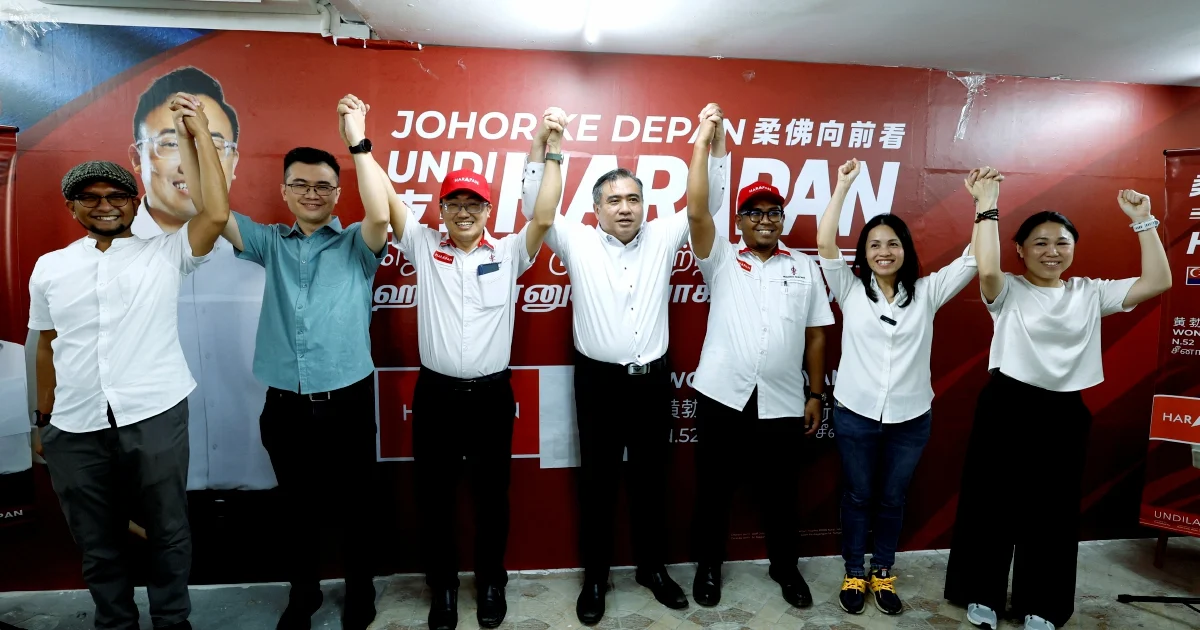
The opposition coalition Pakatan Harapan has signalled that identifying its candidate for Johor's top executive position remains contingent on first securing a winning mandate in the state election, marking a strategic approach that keeps internal deliberations shielded from public scrutiny during the campaign period. Rather than pre-empting the electoral outcome by naming a preferred menteri besar now, the coalition has opted for a post-victory framework where its senior decision-making body will determine the appointment based on circumstances that unfold following polling day.
This measured stance reflects a deliberate calculus common among opposition alliances seeking to project unity and focus messaging on governance platforms rather than internal power arrangements. By deferring the announcement, Pakatan Harapan avoids creating factional tensions or inviting scrutiny over leadership credentials before voters have rendered their verdict. The strategy allows candidate discussions and delegated discussions within the coalition to proceed without distraction, preventing rival factions from exploiting leadership disputes as campaign ammunition against the coalition's broader agenda.
For Malaysian political observers, this approach carries particular weight given the fractious history of power-sharing disputes within Pakatan Harapan since its 2018 federal election victory. The coalition has experienced periodic strains as member parties—notably PKR, DAP, and Amanah—have negotiated over ministerial posts and key positions in both federal and state governments. By ringfencing the Johor menteri besar decision until after victory is secured, party leaders evidently seek to prevent such negotiation pressures from undermining campaign cohesion.
The Johor state election represents a significant electoral contest in Malaysia's political calendar, given the state's economic importance, strategic geographic position bordering Singapore, and its historical association with Barisan Nasional dominance. A Pakatan Harapan victory would substantially reconfigure Malaysia's political landscape, as Johor has remained a critical stronghold for BN since independence. The state's voters have traditionally favoured UMNO and coalition partners, making any opposition breakthrough there consequential for the federation's broader power distribution.
Winning Johor would strengthen Pakatan Harapan's negotiating position at the federal level while simultaneously validating its governance model in a major state. Such a victory would likely accelerate discussions about which coalition member should lead the state administration, as the decision would carry implications for inter-party equilibrium across multiple electoral territories. The top leadership council responsible for naming the menteri besar will need to balance party contributions during the campaign, demographic and geographic representation, and administrative experience while maintaining coalition harmony.
The deferment strategy also permits Pakatan Harapan to evaluate ground realities as campaigning progresses, potentially identifying which candidate would prove most effective in managing stakeholder relationships post-election. Should the coalition secure a razor-thin majority, internal calculations about the most politically resilient candidate choice would differ markedly from scenarios involving commanding victories. The flexibility embedded in announcing the decision after results arrive allows leadership to calibrate their selection with fuller information about the state's political configuration and voter sentiment.
For Johor's electorate, the approach might generate uncertainty about which individual would assume menteri besar responsibilities should Pakatan Harapan prevail. However, the coalition's insistence on focusing voter attention on policy platforms—development priorities, economic diversification, fiscal management, and social programmes—suggests that leadership personalities remain secondary to programmatic offerings in its campaign messaging. This framing appeals to voters fatigued by personality-driven politics and craving competence-focused administration.
The timing of the menteri besar announcement will inevitably influence subsequent cabinet formation and the allocation of state-level resources. Pakatan Harapan's senior leaders will want sufficient time to evaluate candidate suitability and navigate any residual internal negotiations before public presentation occurs. Announcing too rapidly after victory risks appearing precipitous, while delaying excessively invites questions about leadership uncertainty. The coalition will likely target a window of several days to one or two weeks post-election, providing adequate consultation scope while demonstrating decisive governance intent.
International and regional business communities watching Malaysia's political developments may welcome this measured approach, as it suggests the coalition prioritises institutional stability over factional advantage-seeking. Investors tracking Malaysian politics frequently signal concern about leadership instability and internal coalition disputes, viewing such tensions as introducing uncertainty into policy implementation and regulatory consistency. By telegraphing orderly, collegial decision-making processes, Pakatan Harapan seeks to project administrative credibility regardless of which individual ultimately serves as menteri besar.
For ordinary Johor residents, the pending decision carries practical implications spanning infrastructure investment, agricultural support, manufacturing sector development, and urban planning priorities. The menteri besar's administrative style and policy preferences will significantly shape how state resources are deployed across these domains. Pakatan Harapan's current messaging emphasizes that the coalition's institutional framework ensures disciplined governance, with decisions made through deliberative processes involving experienced senior leaders rather than through concentrated individual authority.
The coalition's position also implicitly acknowledges that menteri besar selection involves considerations beyond simple seniority or party affiliation. Competence, public reputation, relationships with federal counterparts, capacity to manage diverse stakeholder interests, and alignment with Pakatan Harapan's policy vision all factor into the equation. By reserving this decision for post-election deliberation, the coalition's leadership preserves optionality while maintaining disciplined messaging during the critical campaign phase when voter engagement proves decisive.
%22%2F%3E%3C%2Fpattern%3E%3C%2Fdefs%3E%3Crect%20width%3D%22100%25%22%20height%3D%22100%25%22%20fill%3D%22url(%23ph9fncg)%22%2F%3E%3Crect%20width%3D%22100%25%22%20height%3D%22100%25%22%20fill%3D%22url(%23ph9fncp)%22%2F%3E%3Ctext%20x%3D%2250%25%22%20y%3D%2250%25%22%20text-anchor%3D%22middle%22%20dominant-baseline%3D%22central%22%20fill%3D%22rgba(255%2C255%2C255%2C0.95)%22%20font-family%3D%22Georgia%2C%20'Times%20New%20Roman'%2C%20serif%22%20font-weight%3D%22700%22%20font-size%3D%22320%22%20letter-spacing%3D%22-0.02em%22%3E402%3C%2Ftext%3E%3C%2Fsvg%3E)