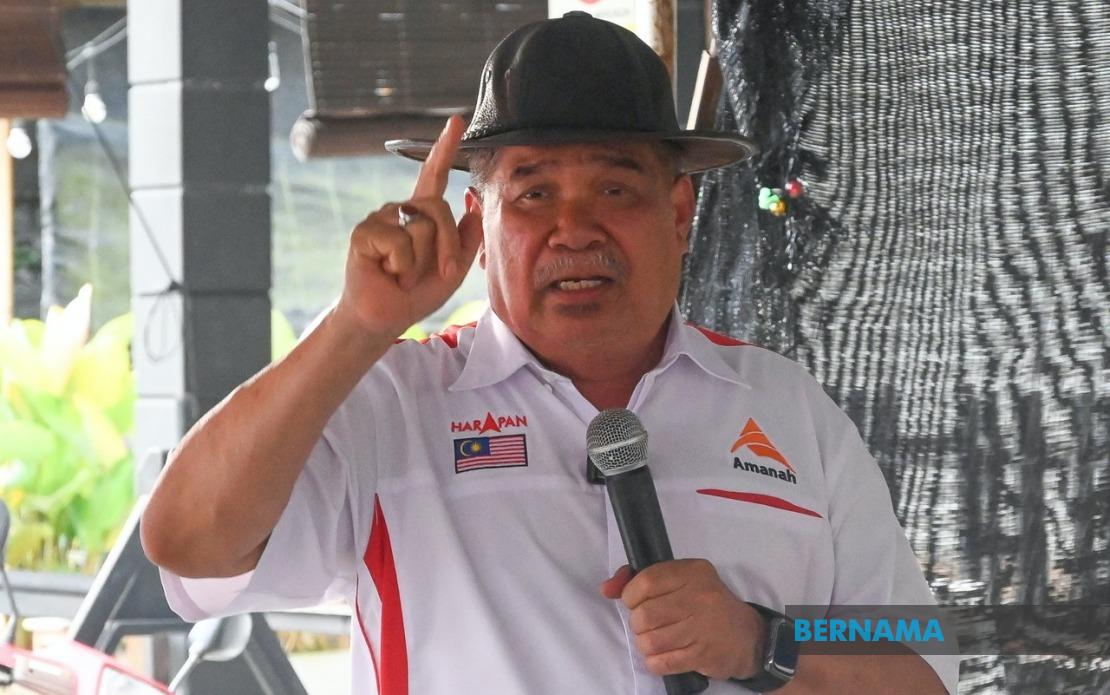
Pakatan Harapan will persist in placing the welfare of ordinary Malaysians ahead of narrow partisan calculations or individual political ambitions, according to Amanah President Datuk Seri Mohamad Sabu, who sought to reassure supporters that the coalition faces recent political realignments with composure rather than defensiveness. The Amanah leader's statement signals the ruling alliance's determination to maintain focus on governance and service delivery even as Barisan Nasional and Perikatan Nasional strengthen their cooperation, a development that has drawn scrutiny from political observers tracking shifts in Malaysia's coalition dynamics.
Mohamad, who also holds the portfolio of Minister of Agriculture and Food Security, contended that PH need not succumb to anxiety over the BN-PN arrangement, instead urging the coalition to respond with institutional maturity and sustained commitment to substantive policy work benefiting the electorate. His intervention reflects broader efforts within the PH leadership to project stability and forward momentum at a time when Malaysia's fractious political landscape continues to generate uncertainty about the durability of current governing arrangements. The statement carries particular weight given Amanah's role as a key PH constituent, making the party president's public confidence instrumental in maintaining coalition cohesion.
Central to Mohamad's messaging is the assertion that Prime Minister Datuk Seri Anwar Ibrahim remains steadfastly devoted to safeguarding Malay-Muslim interests through concrete governance initiatives rather than rhetorical mobilisation or appeals to anxiety. This framing challenges opposition narratives suggesting that the current administration has compromised on constitutional protections for Islam, the Malay language, Bumiputera privileges, or the institution of the Malay Rulers. By anchoring his argument in policy outcomes rather than symbolic gestures, Mohamad implicitly critiques what he views as irresponsible political messaging from rivals, positioning PH as the custodian of genuine constitutional safeguards through institutionalised programmes.
An instructive dimension of Mohamad's intervention concerns his direct challenge to what he terms the perpetuation of narratives depicting Malays as perpetually imperilled. He argues that governance built on instilling fear and a sense of vulnerability ultimately weakens rather than strengthens communities, undermining the development of self-reliance, educational attainment, and competitive capability. This philosophical position reflects a modernising impulse within sections of PH leadership, suggesting that authentic Malay advancement requires confidence, technological competence, and economic autonomy rather than dependency on state patronage or constant political reassurance.
The Minister's characterisation of a strong Malay identity emphasises intellectual development, personal integrity, economic independence, and willingness to engage in fair competition with other communities. This vision stands in tension with opposition messaging that frequently stresses zero-sum inter-communal dynamics and treats advancement for other groups as inherently threatening to Malay interests. By recasting Malay empowerment through the lens of individual capability and institutional strength rather than group grievance, Mohamad attempts to redirect political discourse toward substantive development metrics and away from sentiment-driven mobilisation.
Mohamad's confidence that the Malay electorate has matured beyond susceptibility to what he dismisses as enduring emotional appeals reflects a calculated gamble on voter sophistication. Whether this assessment proves accurate will substantially influence PH's electoral prospects in coming contests, as the coalition's ability to retain support among Malay-Muslim voters—traditionally BN's core constituency—remains essential to governing majority maintenance. His implicit critique of opposition tactics as manipulative rather than persuasive risks appearing condescending if the electorate responds poorly to PH's policy record or governance performance.
The statement's emphasis on building state confidence rather than exploiting state anxiety represents a departure from conventional Malaysian political practice, wherein major parties have historically competed by amplifying communal anxieties and promising protective action. Should this approach gain traction within PH's broader messaging strategy, it could potentially reshape the terms of Malaysian political competition, though opposition parties currently show little inclination to abandon more emotionally resonant framing. The success of Mohamad's confidence-centred approach will depend substantially on whether government policies deliver demonstrable improvements in Malay economic participation, educational outcomes, and living standards.
For Malaysian readers, Mohamad's intervention illuminates fundamental differences in how PH and opposition blocs conceptualise governance priorities and community development. The emphasis on constitutional protections implemented through policy frameworks rather than performative politics addresses legitimate concerns within Muslim-Malay constituencies about their position within Malaysia's plural system, whilst simultaneously attempting to move beyond the securitised, zero-sum framing that has characterised much post-2018 political contestation. Whether this reframing resonates or remains marginalised within broader electoral calculations will shape the trajectory of Malaysia's political economy over coming years.
The regional context adds additional weight to Mohamad's messaging, as Southeast Asian democracies increasingly grapple with questions about balancing protection of religious and ethnic identities with inclusive governance frameworks and economic integration. Malaysia's approach to these questions will influence how peer states navigate similar tensions between pluralism and communal protection. The PH leadership's gambit to move beyond fear-based politics whilst maintaining constitutional safeguards represents a distinct model that regional observers will monitor closely, particularly if it gains electoral validation.
Moving forward, the coherence and consistency of PH's people-first messaging across all coalition partners will prove crucial to its political sustainability. If different PH components send conflicting signals about constitutional commitments or economic priorities, the coalition risks appearing incoherent precisely when unified presentation becomes essential for countering BN-PN coordination. Mohamad's intervention thus functions not merely as a statement of coalition principles but as a test of whether PH can maintain internal discipline around a common strategic vision amid ongoing political pressures and competitive threats.

