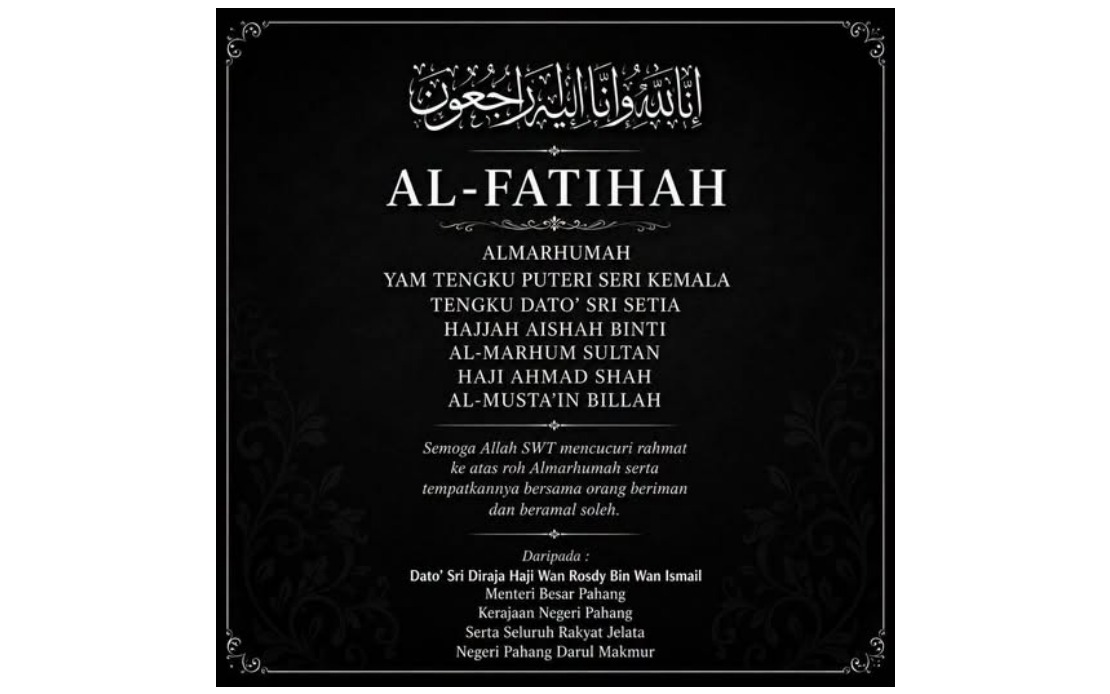
Pahang Menteri Besar Datuk Seri Wan Rosdy Wan Ismail has formally expressed condolences following the death of Tengku Puteri Seri Kemala Tengku Datuk Seri Aishah Almarhum Sultan Ahmad Shah, the elder sister of Sultan of Pahang Al-Sultan Abdullah Ri'ayatuddin Al-Mustafa Billah Shah. The royal family's loss represents a significant moment for the state, with the Menteri Besar acknowledging the profound impact on both the reigning Sultan and the broader Pahang Royal Family.
The Menteri Besar characterised the passing as a considerable loss to the royal household, particularly emphasising its significance to Al-Sultan Abdullah and Tengku Ampuan Pahang Tunku Azizah Aminah Maimunah Iskandariah. In his public statement, released through social media, Wan Rosdy underscored the gravity of the occasion by speaking on behalf of not only the state administration but also the wider Pahang populace.
Tengku Datuk Seri Aishah passed away at a Kuala Lumpur medical facility at 9.15 pm, marking the conclusion of her life away from her home state. Her remains were subsequently transferred for interment at the Pahang Royal Mausoleum in Pekan, the traditional resting place for members of the royal lineage. This arrangement reflects the protocol observed for senior members of the Pahang Royal Family, ensuring her final resting place honours her position within the royal hierarchy.
In his formal statement, the Menteri Besar invoked religious sentiments appropriate to the occasion, requesting divine mercy upon the deceased's soul and forgiveness for any transgressions. The expression of hope that she be counted among the believers and righteous reflects the Islamic customs observed within Malaysia's constitutional monarchy system, where religious observance forms an integral part of state ceremonies and official pronouncements.
The timing of this bereavement occurs within the broader context of Malaysia's federal structure, where state governments maintain close ceremonial and administrative ties with their respective royal families. For Pahang, one of the nation's oldest sultanates, the relationship between the state administration and the palace carries particular historical weight, with the Menteri Besar serving as a key liaison between government operations and royal protocol.
The passing of royal family members typically triggers coordinated responses across state institutions, with various agencies and officials expressing their respects according to established hierarchy and tradition. The Menteri Besar's intervention demonstrates how such occasions unite the political and ceremonial leadership of a state in collective mourning and support for the reigning monarch.
This event also highlights the role of state leaders in managing public expressions of grief and solidarity during moments of royal loss. By issuing a formal statement through widely-accessible social media channels, Wan Rosdy ensured that citizens across Pahang received official acknowledgement of the family's loss, reinforcing the connection between the populace and their royal institution.
The Pahang Royal Family occupies a position of considerable prominence within Malaysia's constitutional framework, with the Sultan serving as the state's chief authority alongside his role as a member of the Conference of Rulers. Any significant development affecting the royal household carries implications for state governance and public sentiment, making official acknowledgement and expressions of sympathy essential components of the political process.
For observers tracking developments within Pahang's governance structures, such moments provide insight into how the state's political leadership manages the delicate balance between administrative function and ceremonial responsibility. The Menteri Besar's measured and respectful approach reflects the sophisticated protocol that characterises Malaysia's plural society, where recognition of loss within royal families transcends ordinary political divisions.
The funeral arrangements proceeding according to established custom, with burial occurring within the state rather than federal territories, underscores Pahang's institutional autonomy and the distinct position enjoyed by Malaysia's sultanates. This reflects broader principles embedded within Malaysia's constitutional arrangement, where states retain jurisdiction over matters relating to their royal families and religious affairs.
Moving forward, the incident serves as a reminder of how political leadership in Malaysia necessarily intersects with ceremonial and religious dimensions of public life. The respectful manner in which state officials acknowledge royal losses contributes to maintaining the stability and legitimacy of both governmental structures and traditional institutions that continue to command considerable respect among Malaysia's diverse population.

