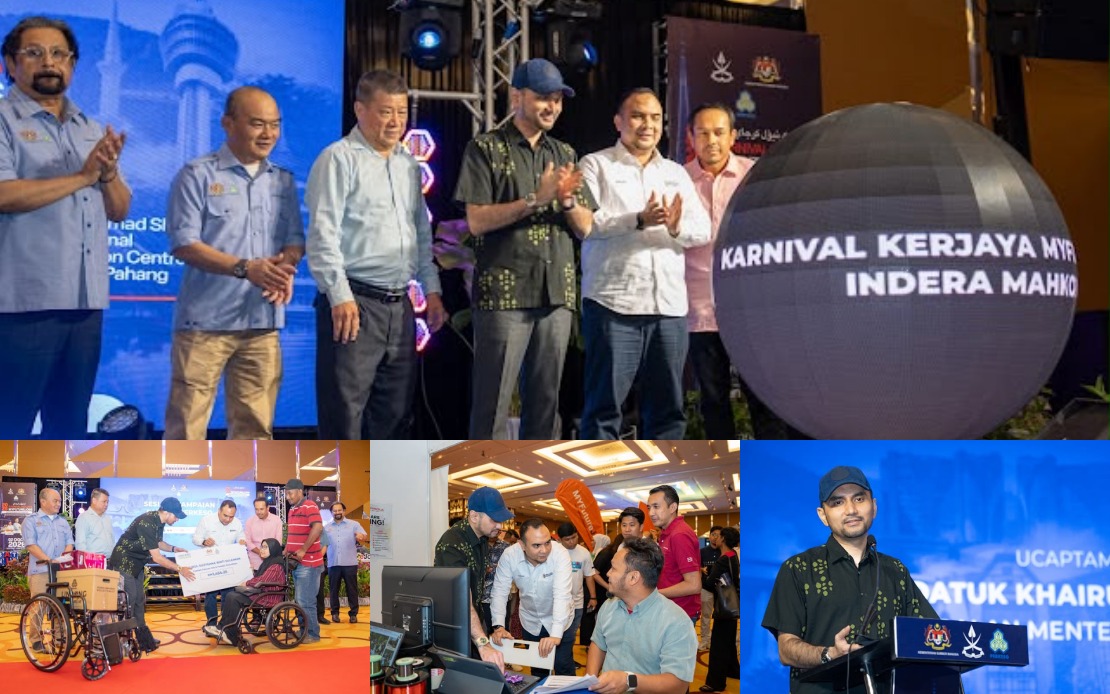
Pahang has emerged as the employment leader across Malaysia's east coast region, with labour force participation reaching 65.3 per cent during the first quarter of 2026. The state's unemployment rate remains exceptionally low at 1.9 per cent, reflecting the effectiveness of coordinated efforts to connect workers with available positions. These figures were announced during the opening of a major career fair in Kuantan, underscoring the state's continued momentum in the labour market despite broader economic uncertainties.
The Deputy Human Resources Minister, Datuk Khairul Firdaus Akbar Khan, attributed the strong employment indicators to a suite of government-backed programmes designed to streamline the job-seeking process for Malaysian workers across all demographics. He highlighted the MYFutureJobs initiative, administered by the Social Security Organisation (PERKESO), as central to this success story. The minister framed employment accessibility as an ongoing governmental priority, with particular emphasis on ensuring younger citizens can capitalise on emerging opportunities in the labour market.
The MYFutureJobs platform has demonstrated tangible impact within Pahang specifically. Since its inception through July 2026, the programme has facilitated employment for 26,877 job seekers across the state. This substantial figure reflects the scale at which PERKESO's matching services operate, moving beyond simple job listings to active placement support. The organisation has conducted 1,277 interview programmes and career carnivals throughout Pahang during this period, creating repeated touchpoints between employers and prospective employees. The expansion of accessible employment infrastructure represents a strategic response to demographic shifts and evolving labour market dynamics in Malaysia.
The Indera Mahkota MyFutureJobs Career Carnival 2026, held in Kuantan, exemplified the practical execution of these employment initiatives. The event brought together 30 employers representing diverse economic sectors to advertise 6,000 job vacancies directly to interested candidates. Such large-scale gatherings serve multiple functions: they reduce information asymmetries between employers and workers, enable face-to-face engagement that often accelerates hiring, and signal to the public that quality employment opportunities exist beyond traditional metropolitan centres. For East Coast residents, particularly those in smaller towns and rural areas, such initiatives offer rare direct access to major employers.
Registration data reveals growing awareness and utilisation of the MYFutureJobs platform among Pahang residents. By 2026, over 11,857 job seekers had registered on the portal, demonstrating expanding participation in structured employment services. The circulation of job advertisements through the platform exceeded 10,000 vacancies cumulatively, creating a substantial pool of opportunities for users to browse and apply. This digital infrastructure complements physical events like career carnivals, creating layered approaches to labour market matching that accommodate different preferences and technological access levels.
Beyond job placement, the Ministry of Human Resources is emphasising worker development and upskilling initiatives as complementary strategies. Datuk Khairul Firdaus stressed that government services extend beyond mere platform provision; comprehensive training programmes enable workers to develop competencies aligned with industry requirements. This approach acknowledges that labour market challenges often involve skills mismatches rather than pure job scarcity. By investing in training delivery alongside placement services, the government attempts to enhance worker adaptability and long-term employability, particularly crucial in sectors undergoing rapid technological transition.
The government has also launched the Sahabat MADANI initiative at the state level, representing an attempt to integrate employment and social services through volunteer mobilisation. Ahmad Farhan Fauzi, the Prime Minister's political secretary, inaugurated this component at the career carnival event. Sahabat MADANI functions simultaneously as a volunteer programme and community bridge, positioned as a mechanism for channelling grassroots input to government while mobilising young people for local development activities. The initiative emphasises principles including inclusivity, mutual respect, and humanitarian focus, suggesting a governance approach that intertwines employment services with broader community engagement.
Pahang's recruitment efforts for the Sahabat MADANI programme have already reached their initial target, with 2,000 volunteers enlisted across the state. However, Ahmad Farhan signalled that organisers intend to expand this volunteer cadre substantially, seeking to attract additional youth participation. The framing of volunteers as both community helpers and "eyes and ears" of the MADANI Government suggests these initiatives blend social mobilisation with information gathering functions. For rural and geographically isolated communities, volunteer networks can supplement formal government service delivery, extending employment information and other support services to areas where government offices may be distant or understaffed.
The convergence of employment facilitation and volunteerism within the broader MADANI framework reflects contemporary governance trends across Southeast Asia. Rather than viewing employment policy and community development as separate domains, Malaysian authorities are attempting integrated approaches where job-seekers become volunteer mobilisers and community members. This strategy potentially generates positive externalities: volunteers gain work experience and social connections through their service, making them more attractive to employers; communities receive additional support services; and government gains direct feedback about local needs and conditions.
For East Coast states like Pahang, sustained focus on labour force participation carries particular significance. The region has historically experienced lower economic diversification compared to western Malaysian centres, with rural populations and smaller urban agglomerations characterising the demographic landscape. High labour force participation rates suggest successful labour force activation, indicating that working-age residents remain engaged in economic activity rather than withdrawing from the labour market entirely. The 65.3 per cent figure represents progress, though it remains below some developed economy benchmarks, indicating room for continued policy evolution.
The low unemployment rate of 1.9 per cent warrants careful interpretation within the regional context. While superficially positive, such figures can mask underemployment, part-time work accepted as necessity rather than preference, or informal sector employment offering limited protections and benefits. The emphasis on training programmes and skills development suggests government recognition that employment quantity requires complementary attention to employment quality. Workers earning subsistence wages in precarious arrangements technically reduce unemployment statistics without necessarily improving living standards or economic security.
Looking forward, Pahang's employment momentum depends on sustained employer engagement and economic growth supporting job creation. The 6,000 vacancies advertised at a single event represent meaningful but finite opportunities. Sustaining this trajectory requires ongoing investment in labour market infrastructure, employer incentives for regional hiring, and economic policies that encourage business expansion across East Coast states. The integration of employment services with volunteerism and community development reflects recognition that employment challenges intertwine with broader development inequalities between Malaysia's regions.
The outcomes achieved in Pahang during the first half of 2026 demonstrate that coordinated employment initiatives can generate measurable results when backed by adequate resources and commitment. Whether these achievements prove sustainable, and whether similar outcomes can be replicated in neighbouring East Coast states with different economic structures, remains to be established. The Pahang experience offers both a template and a testing ground for employment policy approaches that prioritise accessibility, skills development, and integration with community mobilisation efforts.

