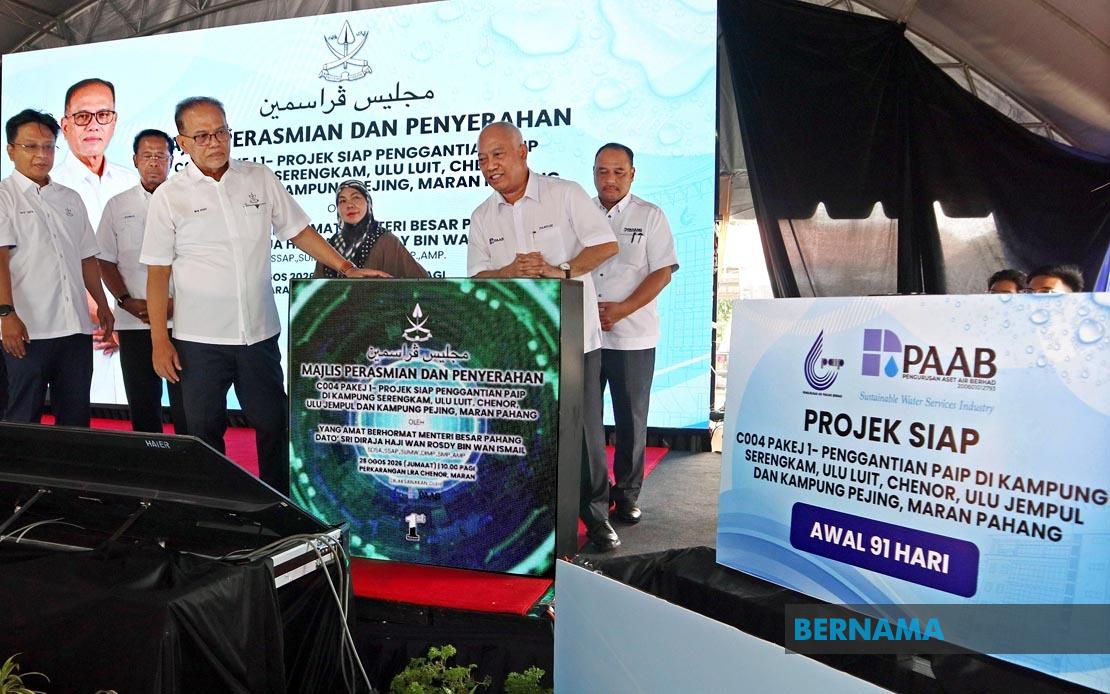
The Pahang government is committing to develop a comprehensive long-term strategy to resolve the persistent shallowing of Sungai Pahang, a waterway that has increasingly constrained economic and social activities in riverside settlements. The problem, which has manifested across multiple locations including Kampung Pesagi in Maran district, has prompted state authorities to move beyond temporary fixes toward sustainable solutions grounded in detailed environmental and hydrological analysis. Menteri Besar Datuk Seri Wan Rosdy Wan Ismail signalled this shift during remarks made at the Chenor Water Treatment Plant, where he was inaugurating the completion of a significant pipe replacement initiative in the district.
The state administration recognizes that addressing river shallowing requires substantially more rigor than conventional maintenance approaches. Rather than implementing ad-hoc interventions, Pahang is assembling detailed technical reports from relevant agencies to map the river's condition comprehensively. This foundational work will enable the state to distinguish between immediate stabilization measures, medium-duration interventions spanning several years, and permanent infrastructure modifications designed to restore optimal water flow and depth. Wan Rosdy indicated that once these assessments are finalized, the findings will be presented to the state executive council for deliberation, refinement, and authorization of a tiered action plan.
The economic and social dimensions of the shallow river problem underscore why state officials view this as a matter demanding serious attention. Communities along the Sungai Pahang depend on navigable waterways for transport, livelihoods, and resource extraction. When water levels drop significantly, residents face disruptions to fishing operations, agricultural irrigation, and mobility patterns that have sustained regional economies for generations. By grounding its response in comprehensive research, Pahang aims to identify interventions that genuinely resolve the underlying causes rather than merely postponing inevitable complications. This methodical approach reflects a broader understanding that infrastructure challenges in the state require solutions calibrated to local conditions and long-term viability.
Paralleling efforts to address the river shallowing, Pahang continues prioritizing water supply infrastructure modernization across multiple districts. The pipe replacement programme currently underway represents a crucial component of the state's broader push to upgrade aging water delivery systems that have historically struggled to serve growing populations reliably. Four districts have already achieved resolution rates surpassing 90 percent, demonstrating the programme's effectiveness in reducing water loss through leakage and improving service quality. Maran district, where the Chenor facility upgrade was completed, is anticipated to reach similar performance benchmarks in the coming months as final installations are concluded.
The state's strategic vision extends well beyond water management into energy infrastructure development, reflecting recognition that competitive regional economies require diversified and resilient systems spanning multiple utility sectors. Tenaga Nasional Berhad is proceeding with construction of a 500-kilovolt Transmission Main Intake Substation in Kampung Awah, representing a major investment in electrical transmission capacity for Pahang and the broader East Coast region. This project, allocated approximately RM350 million in funding, is scheduled for completion by 2030 and will establish critical connectivity between strategic locations across the peninsula's eastern flank. The transmission facility is engineered to accommodate substantial future power demand while enhancing stability and redundancy in an energy network increasingly dependent on distributed renewable sources and interconnected distribution patterns.
The TNB substation initiative holds implications that extend well beyond Pahang's borders, as it will anchor a more robust electrical backbone serving the entire East Coast corridor. By strengthening transmission infrastructure, the state creates conditions conducive to industrial investment and manufacturing expansion in regions historically less developed than the Klang Valley and Selangor. The project signals to domestic and foreign investors that Pahang is actively modernizing its foundational systems to support large-scale operations requiring substantial and reliable power supplies. This infrastructure positioning becomes increasingly consequential as regional economies diversify beyond traditional agriculture and primary processing toward higher-value manufacturing and technology-intensive sectors.
State leadership emphasizes that infrastructure advancement and consistent execution of investment projects form the essential foundation for economic acceleration and employment generation. The combination of water system upgrades, river management initiatives, and power infrastructure development represents an integrated approach recognizing that isolated improvements yield limited returns. Instead, Pahang's strategy attempts to create comprehensive conditions where basic services function efficiently, utilities operate reliably, and transportation networks function smoothly—prerequisites that attract business investment and enable existing enterprises to expand operations confidently. This holistic perspective acknowledges that competitive advantage in contemporary economics flows from the quality and comprehensiveness of public infrastructure networks rather than single isolated improvements.
The state's commitment to resolving the Sungai Pahang shallowing through data-driven planning reflects evolving governance practices in Malaysia, where major state governments are increasingly employing technical expertise and systematic analysis to inform policy decisions. Rather than responding reactively to constituent complaints, Pahang's approach demonstrates how environmental and infrastructure challenges can be addressed through structured investigation, stakeholder consultation, and phased implementation strategies. This represents a maturation of state-level governance, where technical competence and administrative rigor become competitive advantages distinguishing well-managed jurisdictions from those relying on improvisation and political considerations to drive decision-making.
The cumulative effect of Pahang's multi-sector infrastructure initiatives positions the state for sustained economic development over the coming decade. Water security, electrical reliability, and river navigability are foundational elements that influence location decisions for manufacturers, agricultural enterprises, and service providers evaluating where to establish or expand operations. By systematically addressing deficiencies across these utility domains, Pahang removes friction points that otherwise constrain growth and increase operational costs for businesses. The RM350 million TNB investment alone signals confidence in the region's economic trajectory while simultaneously enabling that trajectory by removing power supply constraints that have historically limited industrial development in East Coast jurisdictions.

