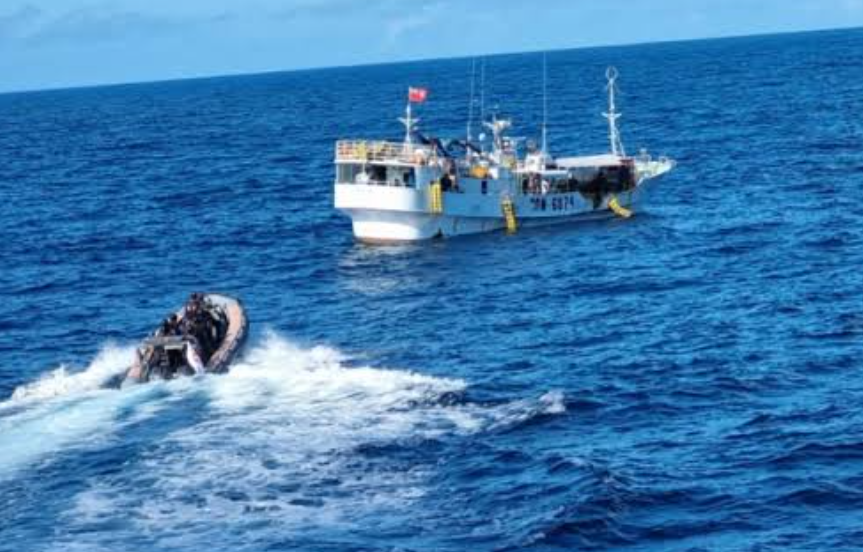
Pacific island authorities have arrested multiple foreign fishing vessels suspected of operating illegally in regional waters, marking an escalation in efforts to protect one of the world's most valuable fisheries. During a coordinated enforcement operation conducted this month, the Pacific Islands Forum Fisheries Agency confirmed that four vessels—originating from China and Indonesia—were detained or brought to port by authorities in Kiribati, Palau, and Papua New Guinea for either engaging in unlicensed fishing or violating the terms of their operating permits.
The crackdown formed part of Operation Island Chief, an unprecedented two-week surveillance initiative spanning 28 million square kilometres of ocean that concluded in mid-August. Eleven Pacific island nations participated in the operation, with their maritime authorities boarding and inspecting more than 100 vessels between August 3 and 14. The scale of the operation, supported by aerial reconnaissance from an Australian military aircraft and patrols by a United States Coast Guard vessel alongside regional maritime police units, demonstrates the determination of Pacific nations to assert control over their exclusive economic zones.
The significance of this enforcement drive lies in the economic stakes involved. The Pacific region accounts for approximately half of global tuna production, yet the financial benefits flowing to island nations remain disproportionately modest. While the tuna fisheries generate roughly US$500 million in annual licensing fees and US$1.2 billion in export revenues for Pacific island governments, only 15 per cent of the catch is actually processed or handled within the region itself. The remaining 85 per cent is managed by distant-water fishing fleets—predominantly from China, Taiwan, Japan, and South Korea—that operate under licence agreements negotiated with individual island nations. For many Pacific communities, fishing-related income supports the livelihoods of approximately one-third of all households, making the protection and maximisation of these revenues critically important for economic stability.
The operation also identified an additional 16 vessels classified as "of interest" by authorities, though the Pacific Islands Forum Fisheries Agency has declined to release identifying details about these suspect vessels. This cautious approach reflects the politically delicate nature of naming nations whose fleets operate in the region. China operates particularly large long-distance fishing operations and maintains fisheries joint ventures with several Pacific island states, making public accusations of illegal activity a diplomatically sensitive matter that could strain bilateral relationships and potentially jeopardise fishing access agreements.
A recent case in Tuvalu illustrates both the enforcement challenges and the diplomatic complexities involved in policing illegal fishing. Tuvalu's maritime authorities arrested a Chinese fishing vessel detected transmitting false location coordinates while conducting unlicensed fishing operations in Tuvaluan waters. The vessel was detained for 24 days before being released after payment of a fine, as confirmed by Peter Hammarstedt, captain of the conservation vessel Sea Shepherd, which assisted Tuvalu police during maritime patrols. Notably, Tuvalu maintains formal diplomatic recognition of Taiwan rather than the People's Republic of China, a distinction that may have enabled authorities there to take more assertive enforcement action without concerns about diplomatic retaliation.
Historical data underscores the scale of the enforcement challenge facing Pacific authorities. According to records maintained by the Western and Central Pacific Fisheries Commission, the largest regional fisheries regulatory body, Chinese vessels accumulated 278 penalty notices for violations between 2008 and 2026—the second-highest tally globally after Taiwan, which recorded 319 infringements over the same period. This suggests that illegal or unlicensed fishing represents an entrenched problem across multiple nations and fleets, requiring sustained and coordinated regulatory effort.
The timing of Operation Island Chief carries additional significance given broader discussions about fishing rights and revenue generation in the region. An annual summit of 18 Pacific island leaders scheduled to convene in Palau beginning August 30 is expected to address comprehensive strategies for strengthening fishing rights protection and increasing financial returns from tuna resources. These discussions will occur against a backdrop of climate change, which scientists warn poses an existential threat to Pacific fish stocks through warming ocean temperatures, changing migration patterns, and acidification of marine ecosystems. The convergence of enforcement challenges, economic pressures, and environmental threats has elevated fishing governance to a paramount concern for Pacific island policymakers.
For Southeast Asian readers, these developments carry particular relevance given the region's substantial involvement in Pacific fisheries. Indonesian vessels were among those detained during the operation, reflecting how fishing enforcement in the Pacific directly affects Southeast Asian maritime industries and economies. Furthermore, the governance challenges facing Pacific island authorities mirror similar enforcement difficulties that Southeast Asian nations confront in their own waters, where illegal, unreported, and unregulated fishing operations similarly drain resources and undermine the livelihoods of legitimate fishing communities.
The Pacific Islands Forum Fisheries Agency's role in coordinating the operation demonstrates how regional cooperation mechanisms can enhance enforcement capacity beyond what individual island nations could achieve alone. By pooling surveillance resources, sharing intelligence, and conducting simultaneous boarding operations across multiple jurisdictions, the participating nations maximised the enforcement impact and deterrent effect of their regulatory efforts. Such collaborative approaches may offer useful models for Southeast Asian nations seeking to strengthen their own maritime law enforcement capabilities and combat transnational fishing violations.
Authorities in Palau and Papua New Guinea declined to comment on specific aspects of the operation, while Kiribati's maritime police similarly provided no public statements about the enforcement actions. This reticence likely reflects the diplomatic sensitivity of publicly discussing enforcement actions against major fishing nations whose vessels generate vital government revenue through licensing agreements. Island governments must balance their obligations to protect marine resources and support legitimate fishing communities against their economic dependence on access fees paid by foreign fishing companies.
The coming weeks will reveal whether the heightened enforcement activity and political focus on fishing governance at the Palau summit translate into concrete policy changes. Pacific island leaders may seek to renegotiate licensing terms to increase revenue captures, implement stricter compliance monitoring systems, or expand joint surveillance initiatives similar to Operation Island Chief. Any such measures would require careful calibration to avoid alienating major fishing nations while demonstrating genuine commitment to protecting regional fish stocks and the economic interests of Pacific island populations.

