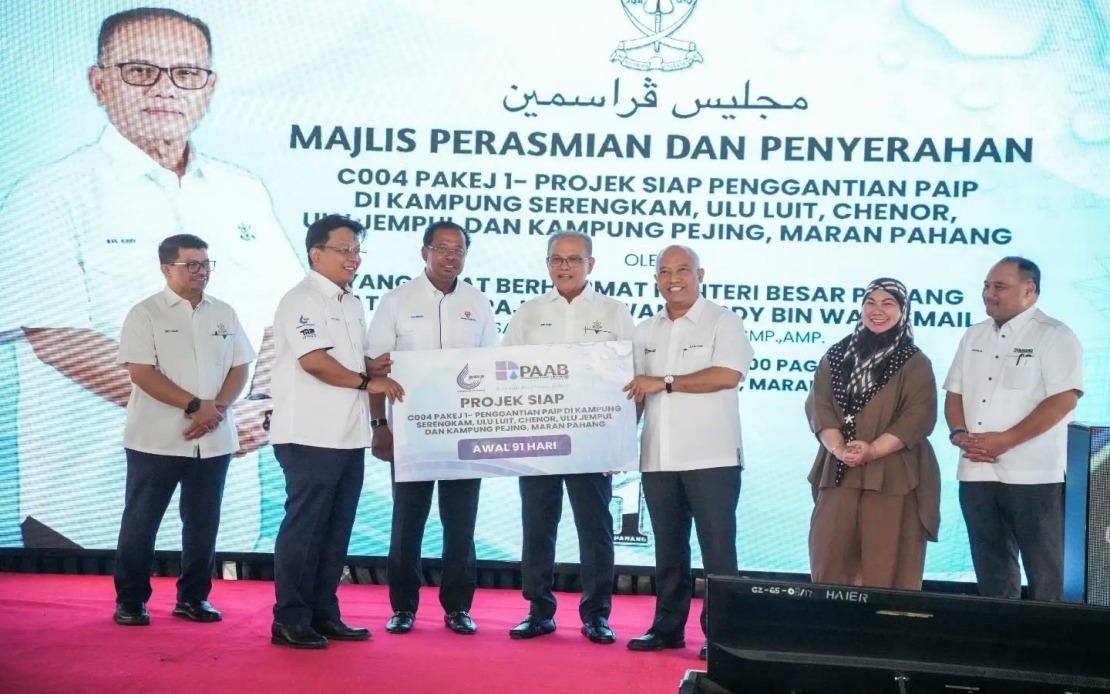
Pahang's long-standing battle with water supply unreliability has taken a significant step forward with the completion of Pengurusan Aset Air Berhad (PAAB)'s RM11.19 million infrastructure overhaul in Maran. The project, which was unveiled at the Chenor Water Treatment Plant ceremony today, represents a watershed moment for residents who have endured nearly two decades of recurring disruptions, particularly in the Chenor sub-district where supply failures have been most pronounced.
Delivered three months ahead of schedule, the initiative involved replacing 29.6 kilometres of aging and deteriorating water pipes across multiple communities, including Kampung Serengkam, Ulu Luit, Pejing, Ulu Jempul and Chenor itself. The scale of this undertaking reflects the severity of the infrastructure deficit that has constrained development and quality of life in the region. PAAB, which is wholly owned by Minister of Finance Incorporated and operates under the regulatory purview of the Ministry of Energy Transition and Water Transformation, funded the project entirely, demonstrating a strategic commitment to addressing systemic vulnerabilities in Pahang's water sector.
The crumbling pipe network had been responsible for a cascade of problems that extended far beyond mere inconvenience. Frequent burst pipes not only disrupted water delivery but also contributed to substantial non-revenue water losses—water that is produced but never reaches consumers due to leakage. Additionally, the aging infrastructure struggled to maintain adequate pressure during peak demand periods, particularly in the scorching dry season and during festive celebrations when consumption surges. These compounding issues had effectively constrained social and economic progress in Maran, limiting business development and creating public health concerns.
The completion of this phase directly benefits nearly 10,000 residents across Maran, though the implications extend beyond individual households. Reliable water supply forms the foundation for broader socioeconomic advancement, enabling schools and healthcare facilities to function effectively, supporting agricultural productivity, and creating conditions in which businesses can confidently invest. For a district that has struggled with infrastructure constraints, this project signals a turning point in the government's capacity to deliver tangible improvements to everyday life.
Pahang Menteri Besar Datuk Seri Wan Rosdy Wan Ismail presided over the handover ceremony, joined by Deputy Energy Transition and Water Transformation Minister Datuk Seri Abdul Rahman Mohamad and Deputy Economy Minister Datuk Mohd Shahar Abdullah. The high-level attendance underscores the political significance of addressing long-neglected infrastructure in a state that has historically faced chronic water management challenges. The participation of PAAB chief executive officer Zulkiflee Omar and Pengurusan Air Pahang Berhad (PAIP) chief executive officer Datuk Saiful Zaini Mohd Bokhari reflects the collaborative governance model through which such large-scale projects are now being executed.
Beyond Maran, PAAB has articulated an ambitious three-year roadmap for Pahang in partnership with PAIP, signalling that this project represents part of a coordinated strategy rather than an isolated intervention. Upcoming work includes upgrading electrical systems at the Jengka Utama Water Treatment Plant's pumping station, specifically targeting water supply disruptions affecting the Felda Jengka settlement. This demonstrates recognition that water infrastructure challenges in Pahang are geographically distributed and require tailored solutions across multiple nodes of the supply network.
A separate RM35.7 million initiative will replace 76.2 kilometres of deteriorated pipes in Jerantut and Lipis, areas connecting Pulau Tawar and Kuala Tahan. This substantial project addresses another region where aging infrastructure has constrained service reliability. Simultaneously, Felda Keratong in Rompin will see an RM13 million investment to replace 11 kilometres of water pipes, reflecting a systematic approach to modernizing the entire state's water distribution system. These projects collectively signal that Pahang is moving beyond piecemeal repairs toward comprehensive infrastructure renewal.
The financial scale of PAAB's commitment to Pahang is substantial. As of July this year, the organization had allocated RM1.17 billion for water supply infrastructure projects across the state. Of this amount, RM69.79 million had been deployed in completed projects, RM66.94 million was committed to projects currently under construction, and RM981.04 million was designated for future initiatives in planning and design phases. This allocation reflects a front-loaded investment strategy in which substantial groundwork is being laid for sustained improvements over the coming years.
PAAB itself operates within a governance framework established by the Water Services Industry Act 2006, having been created to assist federal implementation of the National Water Services Industry Restructuring Plan. Its regulatory oversight through the Ministry of Energy Transition and Water Transformation positions it at the intersection of national water policy objectives and on-the-ground delivery. The partnership between PAAB and PAIP—formalized through the Pahang State Water Supply Services Restructuring Agreement signed in 2020—represents a collaborative model in which asset management expertise is mobilized to address state-level challenges.
For Malaysian readers, the Maran project illustrates broader trends in how federal infrastructure agencies are addressing inherited deficits in water systems. Pahang, like several other states, has grappled with infrastructure that fails to meet growing demand and population needs. The shift toward dedicated investment vehicles like PAAB, combined with structured partnerships with state entities, suggests a conscious move away from ad-hoc maintenance toward predictable, long-term planning. This approach aligns with federal commitments to transform the water sector into a system that is simultaneously more resilient, efficient and sustainable—objectives that extend beyond individual states to shape regional water security across Southeast Asia.
The resolution of water supply disruptions in Maran is therefore more than a local achievement; it represents a demonstration of how systematic infrastructure investment can address entrenched problems. As Pahang moves forward with its expanded portfolio of water projects, the success of the Maran initiative will likely inform approaches to similar challenges in other Malaysian states facing comparable infrastructure aging and population pressures.

