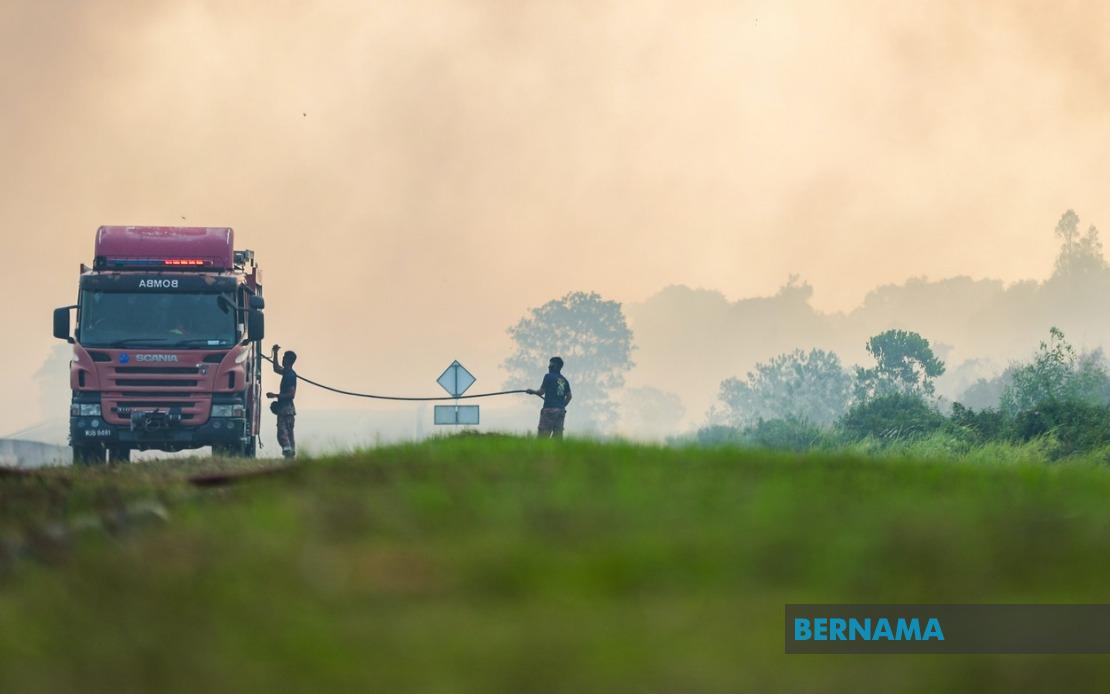
Firefighting teams working around the clock have brought more than half of a major peatland fire under control in Johor, with crews extinguishing approximately 29 hectares of the 51.4-hectare affected area by Monday afternoon. The fire, which began at Jalan Bypass Punggai-Sebana Cove in Pengerang near Kota Tinggi, has prompted a significant emergency response involving multiple agencies coordinating operations across two distinct sectors since the blaze first ignited.
Fire Superintendent II Baharuddin Idris, the operations commander at Sungai Rengit Fire and Rescue Station, confirmed that continuous monitoring and active firefighting work are proceeding without pause to suppress the flames, create firebreaks, and prevent further expansion of the burn area. The relentless 24-hour operational tempo reflects the urgency of containing what remains a substantial threat, particularly given the ecological sensitivity of peatland ecosystems in Malaysia's peninsula and Borneo regions.
The operational picture remains asymmetrical across the two active zones. Sector A still requires significant attention, with approximately 21 hectares remaining to be brought under control through ongoing firefighting and firebreak construction. In contrast, Sector B has been nearly completely extinguished, representing a meaningful success in the containment strategy and suggesting that tactical approaches developed in one sector have yielded positive results when applied to the other.
Airborne reinforcement arrived in the afternoon when an aircraft, deployed following approval from the Air Operations Control Centre, took flight at 2.30 pm to provide aerial firefighting support. This escalation indicates that ground-based resources alone faced capacity constraints, and the decision to deploy aircraft reflects official recognition that aerial bombardment of fire retardant and water drops can achieve suppression rates impossible for terrestrial teams operating in challenging peatland terrain.
The ground operation marshals considerable human resources across government, semi-government, and municipal entities. Fire and rescue personnel from the Sungai Rengit station form the backbone of firefighting operations, supported by 36 firefighters distributed across the zones. These uniformed responders work alongside nine Malaysian Civil Defence Force personnel, 14 staff from Ranhill SAJ—the water service operator serving Johor—two environmental specialists from the Department of Environment, and three representatives from the Pengerang Municipal Council.
This multi-agency composition reflects the interconnected nature of large-scale fire management in Malaysia. The Civil Defence Force brings disaster response expertise and logistics coordination; Ranhill SAJ contributes access to water infrastructure and pumping capacity potentially vital for ground-based suppression; environmental specialists provide critical ecological assessment to guide firefighting strategy and minimise collateral damage to protected zones; and municipal authorities coordinate local access and community safety measures. Such coordination becomes essential when managing incidents spanning 51 hectares of peatland terrain that may include challenging topography, water-logged sections, and underground burning in organic matter.
Peatland fires represent a particularly vexing challenge for Malaysian emergency services, distinct from conventional forest fires. Peat consists of accumulated partially decomposed organic material, often water-saturated and extending considerable depths underground. Surface flames may represent only a fraction of the actual fire, with smouldering fires burning deep within the peat matrix, invisible to aerial observation and resistant to conventional suppression techniques. These subsurface fires can reignite for weeks or months if not thoroughly extinguished, creating a long-term recovery and monitoring burden.
The Pengerang location adds regional significance beyond immediate fire suppression concerns. The area near Kota Tinggi represents environmentally sensitive terrain within Johor's landscape, and major peatland disturbances carry implications for water quality, greenhouse gas emissions, and restoration timelines extending years beyond the incident itself. For Malaysian policymakers and regional environmental observers, such incidents underscore the vulnerability of natural ecosystems to fire hazards, whether from anthropogenic causes or natural ignition sources.
The deployment of aircraft and the sustained operational commitment suggest that officials assess this fire as posing material risk, justifying the commitment of expensive resources and personnel hours. The fact that operations commenced on Monday but remained substantially active by midweek indicates that initial assessment of burn severity and containment difficulty prompted the escalation from ground-only response to incorporate aerial support. Achieving suppression of nearly 60 percent of the affected area within this timeframe represents tangible progress, though the remaining 22 hectares, concentrated in Sector A, will demand sustained effort to prevent regression or re-ignition of controlled areas.

