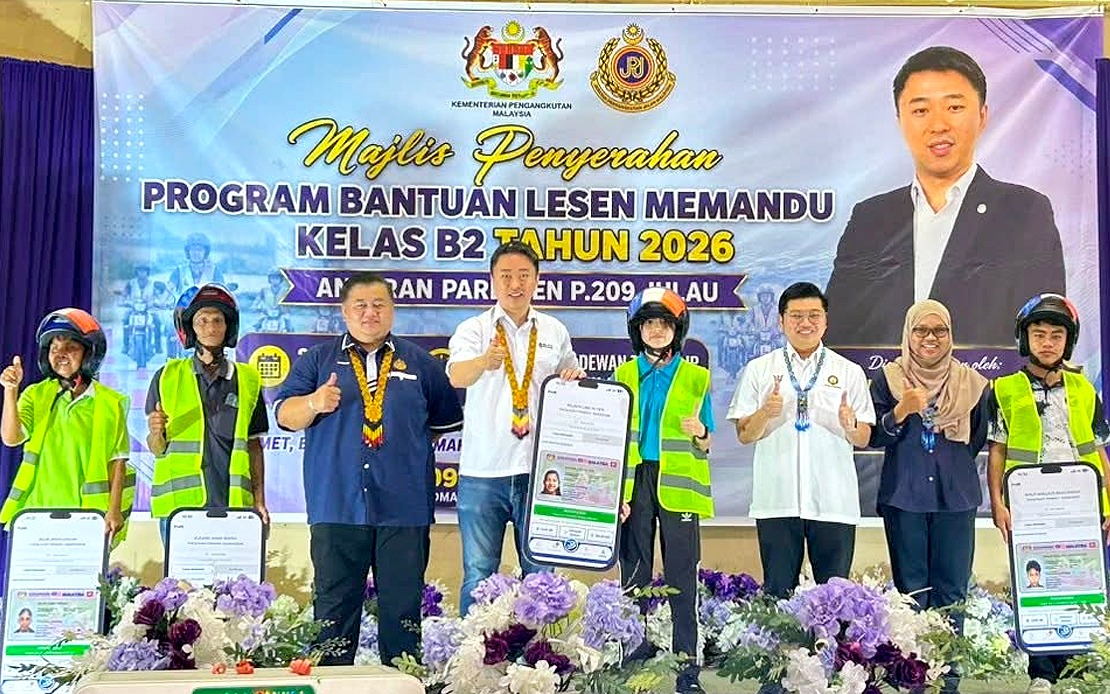
More than 885 participants from the rural districts of Julau have completed a government-backed driving licence assistance programme, marking a significant milestone for communities where access to formal licensing and fuel subsidies has historically been limited. The closing ceremony of the 2026 Class B2 Driving Licence Assistance Programme (BLM) took place at Julau Closed Stadium in Sarikei, with the initiative overseen by Julau Member of Parliament Datuk Larry Sng Wei Shien, who also chairs the Malaysian Timber Industry Board (MTIB). The Sarawak Road Transport Department director Norizan Jili attended the event, underscoring official commitment to bringing regulatory compliance and economic relief to remote constituencies.
For participants like Bajik Undum, a 57-year-old resident of Rumah Ajau in Ulu Kuntau, Pakan, the programme has addressed a long-standing financial hardship. Prior to obtaining her Class B2 Probationary Driving Licence, Bajik relied on her motorcycle to commute to her orchard and transport agricultural produce, yet lacked the legal authorization to access the fuel subsidy scheme. This forced her to purchase petrol at full market rates, a cost that accumulated significantly given the volatility of fuel prices in Malaysia. With her new licence now in hand, she can purchase subsidised petrol, materially reducing the daily operating expenses that have long squeezed smallholder farmers and rural workers throughout Sarawak.
The financial burden of fuel costs has become increasingly acute across Malaysia's rural regions, where motorcycles and small vehicles form the backbone of personal and commercial transport. Bajik's experience reflects a broader structural inequality wherein residents without formal driving credentials have been locked out of subsidy mechanisms designed to ease the transport costs of lower-income households. The BLM programme directly counters this exclusion by providing accessible pathways to licensure for populations who may face barriers to formal licensing channels, whether through distance, cost, or bureaucratic complexity. By removing these obstacles, the initiative creates tangible economic relief at a moment when petrol prices remain elevated relative to rural incomes.
Kudang Jenggi, the programme's oldest male participant at 64, articulated a further dimension of the licence's value beyond fuel savings. As a caretaker of a bird's nest house operation in Bayong, Sarikei, Kudang previously travelled with the persistent anxiety of encountering police roadblocks without proper documentation. His new Class B2 licence confers not only legal legitimacy to his motorcycle use but also dignity and freedom from the low-level harassment that often accompanies unlicensed riding in Malaysia. The psychological weight of operating outside regulatory frameworks, even in rural areas where enforcement may be sporadic, imposes a constant stress that the programme has now alleviated.
The programme has also provided measurable economic relief for those whose livelihoods depend directly on daily vehicle use. Daniel Padong, 45, from Rumah Pom in Ulu Amot, Pakan, depends on his motorcycle to reach his oil palm smallholding each working day. Like many smallholders across Sarawak, Daniel has absorbed escalating petrol costs into his operating budget, eroding already-thin profit margins on commodity crops subject to volatile global pricing. The subsidy access unlocked by his new licence directly reduces his daily transport expenses, allowing him to preserve capital for other production inputs and household needs. When multiplied across hundreds of smallholding operators in Julau, the aggregate economic impact of fuel subsidy access becomes substantial.
Sarawak's rural constituencies face distinctive transport challenges that distinguish them from peninsular Malaysia. Julau encompasses extensive interior regions where road networks remain underdeveloped and distances to commercial centers considerable. Motorcycles and motorcycles-based transport serve as the primary means of access to markets, government services, medical facilities, and employment for dispersed populations. Licensing barriers that restrict subsidy access therefore carry outsized consequences in these contexts, affecting not merely personal convenience but economic viability of rural livelihoods and access to essential services. The BLM programme recognition of these realities demonstrates policy sensitivity to regional particularities.
The government's subsidy framework for fuel, though occasionally politically contentious, serves a redistributive function that is particularly vital in rural areas where incomes remain substantially below urban averages and transport costs represent a larger proportion of household budgets. By coupling subsidy access with a streamlined licensing pathway, the BLM programme addresses a policy gap wherein formal regulatory requirements inadvertently excluded lower-income populations from the very benefits intended to ease their financial burdens. This integration of licensing assistance with subsidy access represents a more coherent approach to rural economic support than licensing requirements alone would provide.
The Julau programme's completion with 885 participants represents meaningful progress, though the figure also hints at the scale of the underlying need. Sarawak remains home to hundreds of thousands of rural residents, many of whom lack current driving licences. If similar proportions across other constituencies face comparable barriers to licensing and subsidy access, the total population affected could number in the hundreds of thousands across the state. Scaling the BLM model to additional constituencies and populations would therefore merit consideration as a cost-effective mechanism for delivering targeted economic support to rural communities.
Longer-term implications of expanded licensing programmes extend beyond immediate fuel subsidy access. Driving licences serve as foundational identity and qualification documents in Malaysia's regulatory framework, affecting not only fuel subsidies but also insurance eligibility, employment prospects in transport-related sectors, and broader civic participation. By systematizing pathways to licensing for populations who have historically faced barriers, the BLM programme indirectly supports rural economic diversification and human capital development. Young people in rural areas with valid licences gain expanded employment opportunities in transport, delivery, and mobility services that have expanded across Malaysia in recent years.

