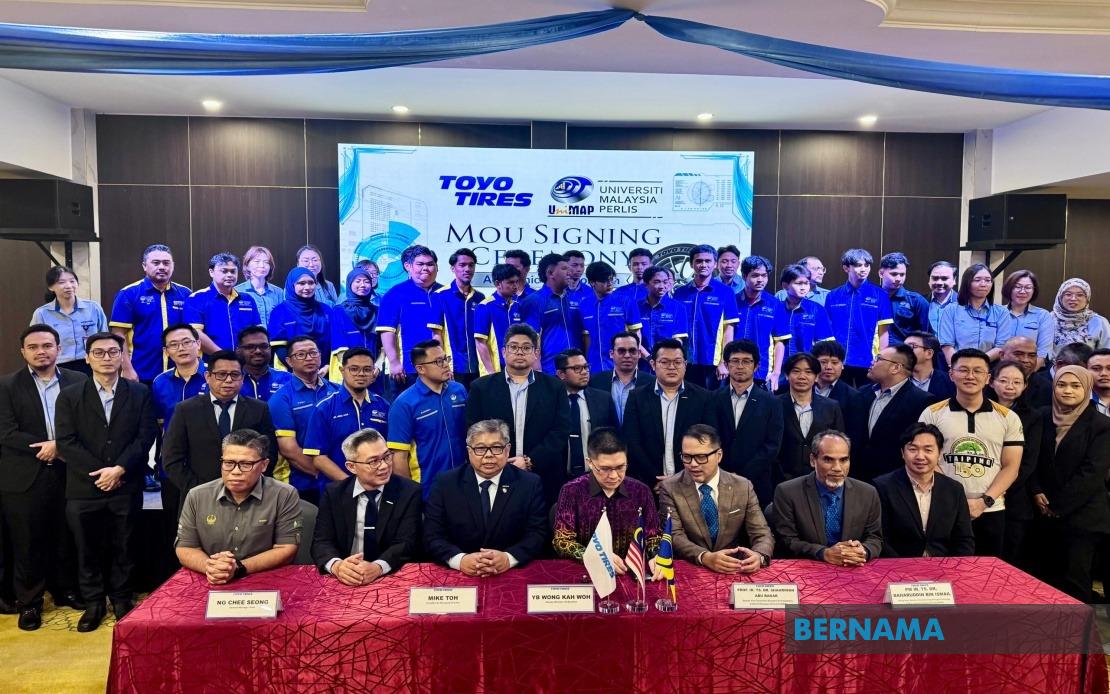
The Ministry of Education's Vocational Colleges have witnessed unprecedented demand, with applications climbing to 67,045 as the admission window neared closure, according to Deputy Education Minister Wong Kah Woh. This volume substantially exceeds the 19,567 available positions nationwide, indicating that demand continues to outpace capacity by a ratio of more than three to one. Wong, speaking at a signing ceremony in Taiping involving tyre manufacturer Toyo Tyre Malaysia Sdn Bhd and Universiti Malaysia Perlis (UniMAP), projected the total would surpass 68,000 once applications formally closed at midnight that evening.
The surge in applications represents a tangible vindication of the MADANI Government's strategic commitment to elevating the Technical and Vocational Education and Training (TVET) sector. Rather than treating vocational training as a residual pathway, policymakers have positioned skills-based education as a central pillar of workforce development. This reorientation reflects a deliberate shift in Malaysian education policy, moving away from a historical over-emphasis on academic credentials toward recognition that practical, marketable competencies command genuine economic value in the contemporary job market.
Central to understanding this surge is the employment trajectory of graduates. Wong emphasised that Vocational Colleges reported an employability rate of 99.95 per cent among 2023 graduates, with consistent results between 98 and 99 per cent recorded across recent years. These figures are remarkable by any standard and substantially outpace many university graduate employment statistics globally. The near-universal placement of vocational graduates into employment represents concrete proof that the curriculum and training align with immediate labour market needs.
The alignment between educational offerings and industry requirements does not occur by accident. Wong stressed that active collaboration between the Ministry of Education and private sector employers ensures that vocational colleges teach competencies that employers genuinely seek. This partnership model—where industry practitioners inform course design, instructors receive exposure to contemporary workplace practices, and students encounter equipment and methodologies reflecting current operations—creates an efficient pipeline from classroom to employment. The mechanism transforms theoretical training into immediately applicable expertise.
This industry-education nexus assumes particular significance for Malaysia's economic trajectory. The nation faces persistent challenges in developing a skilled workforce capable of supporting advanced manufacturing, digital transformation, and high-value service sectors. By anchoring TVET programmes within actual industry requirements, the system avoids the common pitfall of training students for jobs that no longer exist or training them in outdated techniques. The result is graduates who enter employment with capabilities their employers immediately need, reducing costly on-the-job training periods and accelerating productivity gains.
The demographic implications warrant consideration as well. Malaysia's education system has historically routed substantial student cohorts toward academic streams, often regardless of aptitude or inclination. The surge in vocational applications suggests that students, parents, and educators increasingly recognise that alternative pathways offer genuine economic advantages. For students whose strengths lie in practical problem-solving, hands-on learning, and technical application rather than abstract theory, vocational training provides a culturally validated route to respectable, well-compensated employment—a shift that promises to improve educational outcomes for a broader population spectrum.
Regional competitiveness forms another critical dimension. Southeast Asian economies compete intensely for foreign direct investment, particularly in manufacturing and technology sectors. Countries that produce graduates with current, practical technical skills attract investment. Conversely, nations perceived as lacking skilled workforces struggle to advance beyond basic manufacturing or lose investment to competitors. Malaysia's expanding vocational sector, evidenced by these application figures, strengthens the country's positioning in attracting and retaining high-value manufacturing operations that require substantial technical expertise at multiple levels.
The capacity constraints revealed by the data—with demand vastly exceeding available places—point toward necessary expansion. If applications consistently outpace admission by factors of three or more, the Ministry of Education faces legitimate pressure to increase Vocational Colleges' physical infrastructure, instructor recruitment, and operational capacity. Failure to meet demonstrated demand risks pushing students toward alternative pathways, whether international technical education, private vocational providers, or deferred entry. Strategic expansion of the vocational college network would represent a logical response to this market signal.
The Toyo Tyre Malaysia and UniMAP collaboration symbolises the institutional partnerships increasingly characterising Malaysia's TVET landscape. When multinational enterprises and universities formally collaborate on vocational education initiatives, they signal commitment to quality, inject resources, and facilitate knowledge transfer. Such partnerships amplify the reach and credibility of vocational pathways, encouraging broader social acceptance and participation. They also create channels for continuous curriculum updating, ensuring training remains contemporary.
Wong's remarks contextualise Malaysia's educational development within broader governance narratives. The MADANI framework explicitly emphasises inclusive prosperity and expanding opportunity across diverse populations. Strengthening TVET aligns with this positioning by democratising access to dignified, remunerative employment pathways for students across socioeconomic strata. Vocational education requires neither expensive private schooling nor family resources to pursue tertiary study abroad, making it particularly relevant for rural students and those from lower-income backgrounds.
Looking forward, sustaining this momentum requires maintaining quality while expanding access. The challenge lies in scaling without compromising the industry partnerships and instructor expertise that generate those extraordinary employability outcomes. Rapid expansion risks diluting programme quality if insufficient qualified instructors or industry collaboration accompanies growth. Strategic planning must balance enthusiasm for expansion with commitment to the educational standards that have made vocational pathways genuinely valuable for students and employers alike.

