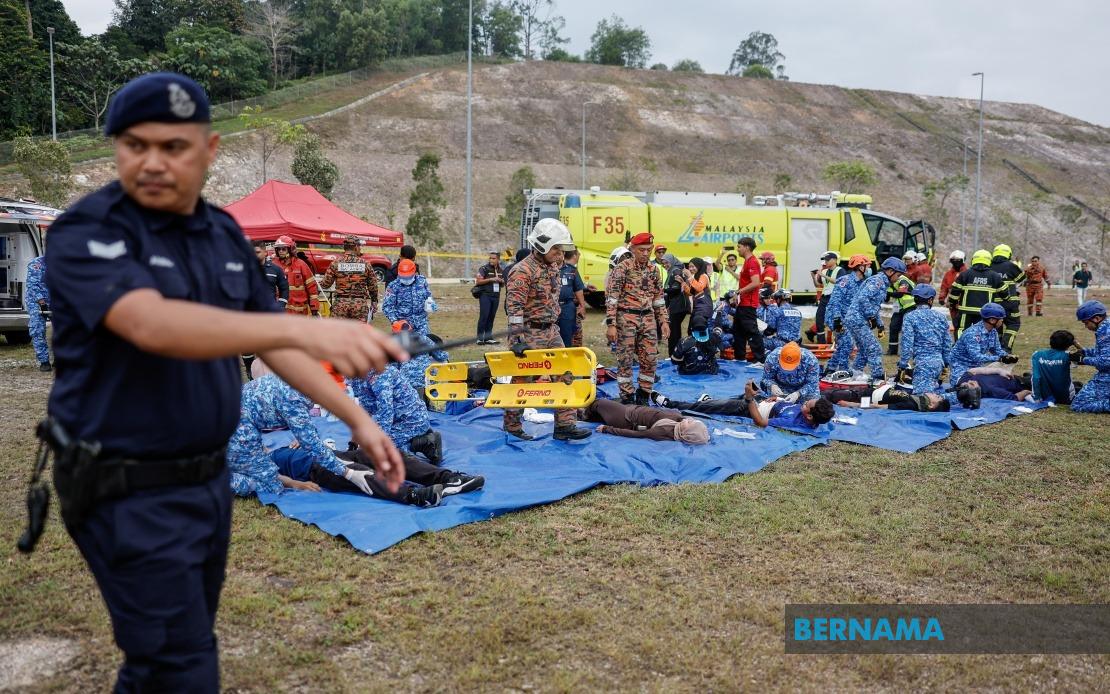
Malaysia's aviation disaster response framework faced its most rigorous test to date when more than 20 enforcement and emergency agencies participated in Ex Urban Falcon 2026, a comprehensive simulation exercise designed to evaluate how the country would handle an aircraft crash far beyond the airport perimeter. The drill, held at the Denai Alam Rest and Service Area along the Damansara-Shah Alam Elevated Expressway, brought together 450 personnel to rehearse procedures for managing an aviation emergency in an uncontrolled urban environment—a scenario that differs fundamentally from the traditional airport-focused disaster drills that have dominated Malaysia's aviation safety preparations.
The exercise centred on a fictional ATR72 aircraft incident occurring approximately six kilometres from Sultan Abdul Aziz Shah Airport in Subang, pushing response teams to navigate the complexities of coordinating rescue and firefighting operations across unfamiliar terrain and congested road networks. According to Airport Fire and Rescue Services general manager Muhammad Hidayat Ismail, this represents the first occasion Malaysia has comprehensively tested its capacity to respond to an aircraft emergency beyond the airport boundary, a gap in preparedness that has existed throughout previous iterations of emergency response drills.
Malaysia Airports Holdings Berhad and the coordinating agencies operated under the framework established by the National Aeronautical Search and Rescue Manual, which designates the Airport Fire and Rescue Services as responsible for emergency operations within an eight-kilometre radius of an airport's midpoint. However, the distinction between theoretical responsibility and practical execution became apparent during the exercise, particularly given the logistical hurdles posed by narrow roads and toll plaza passages that could significantly delay arrival times at a real crash site.
The operational environment for off-airport incidents presents distinctly different challenges compared to crashes occurring within controlled airport grounds. The uneven and irregular terrain surrounding urban areas substantially reduces survivor prospects compared to incidents within airport boundaries, where emergency infrastructure and flat landing zones facilitate faster, more coordinated response efforts. Muhammad Hidayat acknowledged that responders observed lower survival rates in off-airport scenarios, demanding a more sophisticated approach to Disaster Victim Identification operations, which fall under Royal Malaysia Police jurisdiction.
The exercise provided emergency teams with a realistically grim scenario in which casualties would likely overwhelm survivors, forcing agencies to coordinate mass casualty management across multiple agencies with limited prior experience in such coordination at off-airport locations. This distinction necessitates deeper inter-agency synchronisation, particularly regarding the logistics of evacuating and processing hundreds of potential victims from congested urban areas rather than the relatively organised environment of an airport setting.
From a technological perspective, Malaysia's aviation firefighting capabilities remain modern and internationally aligned. The Airport Fire and Rescue Services operates the latest aircraft firefighting vehicles constructed to specifications and standards mandated by the International Civil Aviation Organisation and the Civil Aviation Authority of Malaysia, ensuring that equipment meets global safety benchmarks. Yet technology represents only one element of the broader emergency response chain; the exercise underscored the critical importance of procedural coordination and inter-agency communication when responding to catastrophic incidents in complex urban environments.
Muhammad Hidayat observed that participating agencies largely executed their assigned responsibilities according to established protocols, with firefighting and rescue operations demonstrating proficiency within their respective domains. However, he indicated that the exercise's primary value lies in identifying refinement opportunities rather than celebrating current capabilities. The findings from this drill will undergo detailed review during a special workshop scheduled for July 26 and 27, where representatives from all participating agencies will convene to analyse challenges encountered and formulate enhanced procedures for coordinated disaster response efforts.
The Ex Urban Falcon 2026 exercise emerged from a strategic partnership between Malaysia Airports Holdings Berhad, the National Disaster Management Agency, the Selangor state government, and PROLINTAS-DASH, the expressway operator. This multi-sector collaboration reflects Malaysia's recognition that aviation disaster management transcends individual organisational boundaries and demands seamless integration across airport authorities, highway operators, law enforcement, medical services, and civilian emergency responders. The participation of 450 personnel from critical public and private-sector agencies demonstrated the breadth of stakeholder engagement necessary to manage complex emergencies.
For Malaysian aviation stakeholders and the broader Southeast Asian region, this exercise signals an evolution in how countries approach off-airport emergency preparedness. Many regional airports face similar geographic and infrastructural challenges, with urban areas increasingly surrounding aviation facilities. Malaysia's willingness to invest resources in testing response capabilities for scenarios that extend beyond airport perimeters establishes a model that neighbouring nations might consider adopting, particularly as air traffic volumes continue expanding across Southeast Asia.
The exercise carries significant implications for public confidence in Malaysia's aviation safety framework. Aviation incidents occurring outside airport territories often generate particular public anxiety, as they involve communities with limited familiarity with emergency procedures and infrastructure. Demonstrating that coordinated multi-agency response mechanisms exist for such scenarios—and that these mechanisms undergo regular, comprehensive testing—reinforces public trust in Malaysia's commitment to managing potential aviation disasters regardless of where they occur.
Muhammad Hidayat emphasised that the sustained commitment demonstrated by all participating agencies provides evidence of Malaysia's institutional preparedness to respond effectively to potential air disasters. Regular, large-scale simulation exercises serve dual purposes: they provide practical testing grounds for identifying capability gaps while simultaneously reinforcing the muscle memory and procedural familiarity necessary when personnel must execute emergency protocols under genuine crisis conditions. The willingness to conduct such exercises, particularly in scenarios representing less-tested contingencies, reflects mature institutional thinking about disaster preparedness.
Looking forward, the workshop sessions in late July will prove crucial in translating exercise observations into concrete procedural improvements. The identified challenges—particularly those related to navigation, traffic management, and inter-agency communication during rapid mobilisation—require systematic attention before they manifest during actual emergencies. The exercise has essentially created a detailed operational blueprint documenting what works well and where coordination breaks down, providing administrators with actionable intelligence for enhancing Malaysia's aviation disaster response capabilities.

