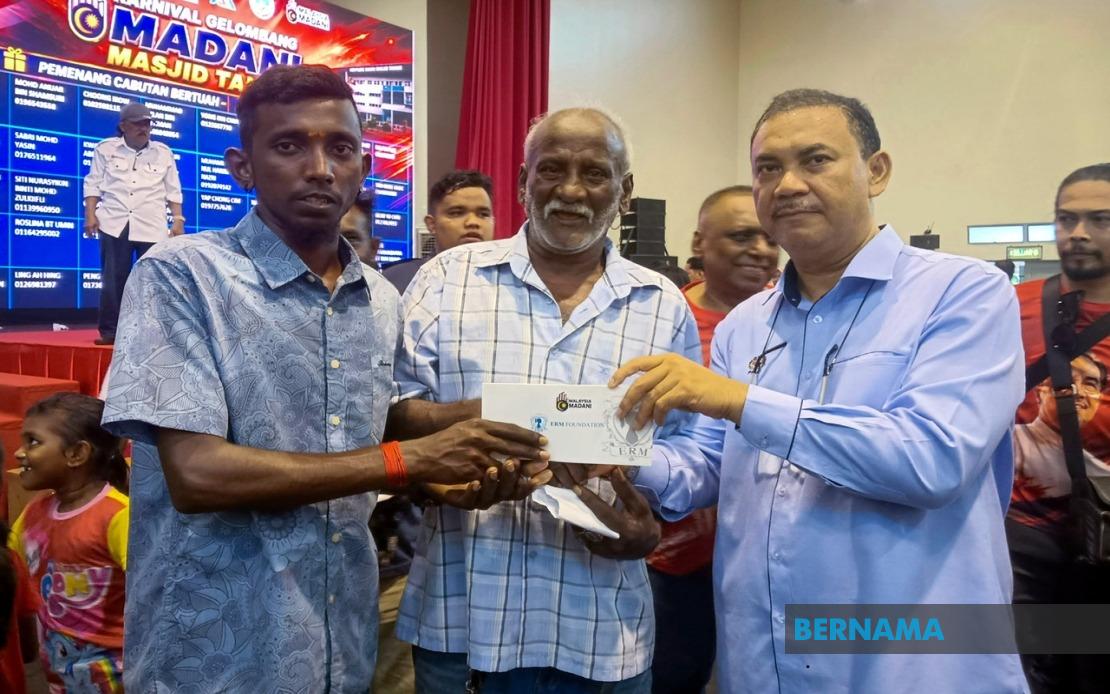
The Gelombang MADANI Carnival brought relief to approximately 2,000 underprivileged residents in the Masjid Tanah parliamentary constituency on August 7, with each beneficiary receiving RM200 in direct cash assistance. The initiative, known as Sentuhan MADANI Donation, represents a targeted approach to alleviating financial hardship among vulnerable segments of the population across the region. The assistance programme demonstrates the government's continued focus on social welfare measures designed to support those facing economic challenges in Melaka and other parts of peninsular Malaysia.
According to Datuk Azman Abidin, the Prime Minister's political secretary, the financial disbursement targeted households and individuals across the five state constituencies that collectively form the Masjid Tanah parliamentary division. These constituencies—Kuala Linggi, Lendu, Tanjung Bidara, Ayer Limau and Taboh Naning—each contributed a cross-section of eligible recipients for the assistance scheme. The geographic spread of the initiative underscores the government's attempt to ensure equitable distribution of welfare resources across different administrative boundaries within the parliamentary district.
The Sentuhan MADANI programme specifically prioritised four demographic groups identified as requiring targeted support: members of the B40 income bracket, individuals living with disabilities, elderly citizens, and workers earning below the defined income threshold. This categorised approach reflects a nuanced understanding of poverty and vulnerability that extends beyond simple income classifications to acknowledge the particular challenges faced by seniors and persons with disabilities. By recognising these distinct groups, the initiative acknowledges that financial need manifests differently across different populations and that targeted assistance can address specific vulnerabilities more effectively than blanket programmes.
Ramlah Othman, a 63-year-old resident from Tanjung Bidara, expressed profound gratitude for the contribution, emphasising how the assistance would directly ease her household's monthly expenses. Her testimony captures the practical significance of the RM200 transfer for families operating on limited incomes where such sums represent meaningful relief rather than nominal support. In the Malaysian context, particularly for households in the B40 category, such direct cash transfers can defray essential costs including food, utilities, transportation and other non-discretionary expenses that consume the majority of household budgets.
N. Mariappan, a 69-year-old stroke survivor residing in Ladang Sungai Baru, similarly highlighted how the programme acknowledged the government's recognition of elderly and disabled citizens as deserving of specific policy attention. His experience demonstrates how a single health crisis or chronic condition can fundamentally alter a family's financial circumstances, rendering even modest assistance programmes valuable for individuals managing both health challenges and financial constraints simultaneously. The integration of persons with disabilities into the beneficiary pool reflects acknowledgment that physical or health-related limitations often create additional financial burdens beyond standard living costs.
The Gelombang MADANI Carnival itself served as the institutional framework for delivering these benefits, transforming what might otherwise be a purely transactional assistance process into a community-oriented event. This approach generates broader engagement and reduces stigma sometimes associated with receiving state welfare, whilst simultaneously creating opportunities for government representatives to interact directly with constituents and understand local concerns. The carnival format also facilitates broader participation and creates a celebratory atmosphere around social assistance distribution.
The Masjid Tanah parliamentary constituency, located within Melaka state, represents a mixed demographic area encompassing both urban centres and rural communities. The inclusion of all five component state constituencies in the assistance programme suggests comprehensive coverage rather than selective targeting, ensuring that beneficiaries across geographically diverse areas within the constituency gain access to the programme. This approach reflects the political commitment to avoiding accusations of uneven distribution across different administrative zones.
The timing of this initiative during August 2024 places it within Malaysia's broader context of ongoing economic pressures facing lower and middle-income households. Inflationary pressures, cost-of-living increases and wage stagnation have maintained focus on targeted assistance programmes as policy responses to household financial stress. Direct cash transfers like the Sentuhan MADANI initiative address immediate liquidity constraints, though economists and policy analysts continue debating the relative merits of cash transfers versus structural economic reforms that might address underlying inequality.
For Malaysian readers, particularly those in similar constituencies or demographic groups, the Masjid Tanah programme illustrates the mechanics through which parliamentary constituencies translate electoral mandates into tangible welfare benefits. Understanding how such programmes operate—which groups qualify, how benefits are distributed, and what the practical impact amounts to—remains important for constituents seeking to evaluate whether government policies address their economic situations. The RM200 per capita assistance, whilst meaningful for beneficiaries, also invites consideration of whether such periodic transfers can substitute for sustained income generation or structural economic improvements.
The participation of government officials in distributing assistance directly, rather than through intermediary bureaucratic channels, signals a deliberate approach to maintaining political proximity to beneficiary communities. This personalised engagement approach, when repeated across multiple constituencies and regions, creates numerous opportunities for government representatives to understand constituent concerns, gather feedback and reinforce political messaging about government commitment to social welfare priorities.

