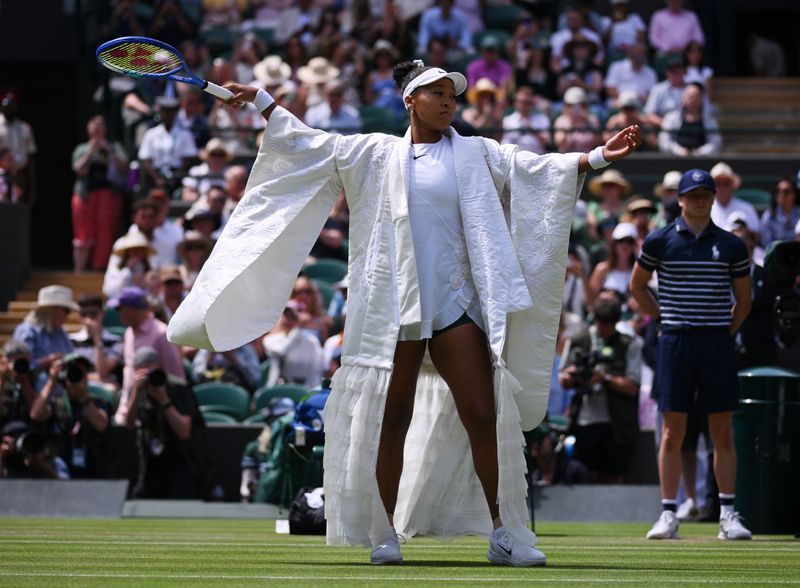
Naomi Osaka proved on Friday that her presence at Wimbledon extends well beyond the fashion statements that have captivated spectators during the opening week. The four-times Grand Slam champion from Japan overwhelmed unseeded Daria Kasatkina with a clinical 6-1 6-3 victory on Court One, securing her maiden appearance in the last 16 at the All England Club and signalling her emergence as a genuine contender in the second week.
The 14th seed has become synonymous with bold sartorial choices at this year's championship, walking onto court in a succession of striking ensembles that have drawn as much admiration as scrutiny. Against Kasatkina, Osaka arrived in another rendition of her "Kill Bill" themed kimono, this time featuring delicate floral patterns. Yet what distinguished Friday's performance was the substance behind the style—Osaka's tennis matched the theatrical presentation, displaying the kind of ruthless efficiency that characterised her Grand Slam-winning years.
From the outset, Osaka dictated play with aggressive baseline tennis and clinical shot-making. She broke Kasatkina's serve in the second game, unleashing a backhand winner that set the tone for what would prove a one-sided opening set. A deep, penetrating forehand soon followed, allowing Osaka to establish a double break and cruise through the first set without meaningful resistance. Her movement appeared fluid despite the grass surface, and her serve—traditionally her greatest weapon—remained a persistent threat throughout.
The second set began promisingly enough for Osaka as she maintained her intensity, but a moment of vulnerability emerged when she squandered an early advantage. Rather than capitulating, Osaka demonstrated the mental fortitude expected of a champion. She rallied impressively, ultimately manufacturing two match points and converting the second with characteristic authority. The 28-year-old's ability to recover composure and close out the match cleanly underscored why she remains ranked among tennis's elite competitors despite periods of inconsistency in recent seasons.
For Malaysian and Southeast Asian audiences, Osaka's progression holds particular resonance. As one of Asia's most prominent sporting figures and a frequent visitor to regional tournaments, she represents the potential for Asian players to compete at the highest levels of tennis. Her success on grass—traditionally a surface dominated by European players—challenges conventional wisdom about playing styles and the adaptability required to win at all major championships.
When interviewed courtside, Osaka reflected on the significance of her victory with characteristic humility. She revealed that she had never previously won on Court One, framing this encounter as an opportunity to create positive memories at the venue. Her gratitude toward the crowd reflected her growing comfort in navigating the unique pressures of Wimbledon, where tradition and expectation weigh heavily on competitors.
Osaka acknowledged the importance of match preparation, noting the accumulated benefits of playing multiple grass-court tournaments in the preceding weeks. The Bad Homburg International, where she reached the final before a retirement forced withdrawal, served as crucial preparation for this run. That experience, coupled with renewed confidence gained through successive victories, has clearly strengthened her grass-court credentials and challenged assumptions about her suitability for the surface.
Her next opponent represents a formidable obstacle. Osaka will face either world number one Aryna Sabalenka or former French Open champion Jelena Ostapenko in the round-of-16 encounter. Should she prevail, a quarter-final berth awaits—territory she has rarely reached at Wimbledon in recent years. The draw has opened up in her section, and Osaka's current trajectory suggests she possesses the form and mental resilience necessary to capitalise on this opportunity.
The broader narrative surrounding Osaka's Wimbledon campaign speaks to her ongoing evolution as a competitor. She has deliberately cultivated a persona that encompasses both artistic expression and athletic excellence, rejecting the conventional wisdom that players must choose between fashion and focus. This integration of personality and performance appears to be energising rather than distracting her, as evidenced by her clinical dismantling of Kasatkina.
Osaka's approach of concentrating on immediate challenges—taking matches one point at a time, as she stated—represents a philosophical shift toward sustainable excellence rather than explosive brilliance. This methodical mindset, combined with the technical improvements evident in her play, suggests her challenge at Wimbledon is far from concluded. Her advancement to the last 16 marks not merely a personal milestone but a demonstration that she remains a force capable of competing for major titles.

