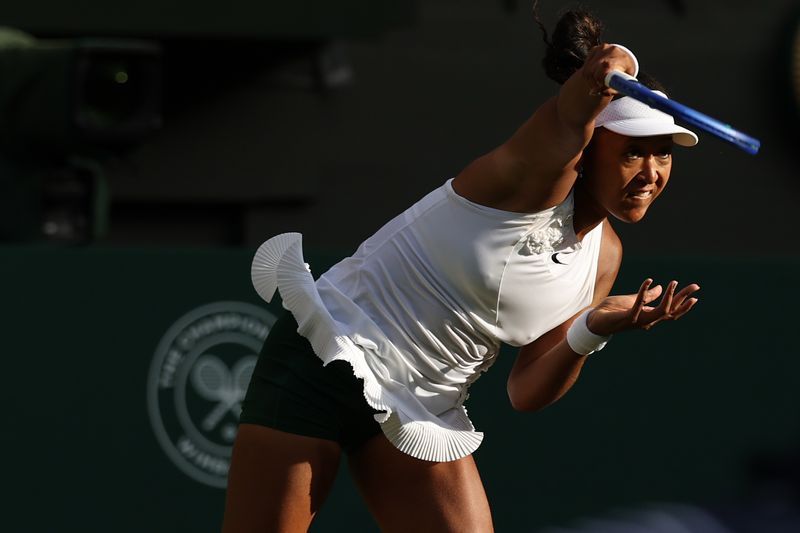
The opening week of Wimbledon has unfolded into one of the tournament's most unpredictable competitions in recent memory, with Naomi Osaka's devastating demolition of top seed Aryna Sabalenka crystallising a broader narrative of established order crumbling at the All England Club. Osaka, seeded 14th, dismantled her higher-ranked opponent with a clinical 6-2 7-6(2) display that recalled the Japanese star's most dominant Grand Slam performances from her championship years, advancing to her first Wimbledon quarter-final and in the process hastening the departure of one of the tournament's marquee contenders.
The magnitude of Osaka's victory extends beyond the scoreline itself. Her sustained power and precision throughout the encounter left Sabalenka visibly frustrated on Centre Court, with the Belarusian attempting but ultimately failing to generate the offensive consistency that has defined her career resurgence. For Osaka, returning to competitive tennis following maternity leave in 2024, this stands as her most significant tournament success since her comeback, representing a tangible validation of her gradual re-establishment at the sport's elite level. The performance carries particular resonance given the pair's recent history: Sabalenka had defeated Osaka three consecutive times this season before their meeting at Wimbledon, making the reversal all the more emphatic.
Osaka's path to the quarter-finals has coincided with an extraordinary collapse among the seeded players, fundamentally altering the women's tournament landscape. The defending champion Iga Swiatek and 2022 winner Elena Rybakina both exited in the third round, while Barbora Krejcikova, the fourth seed and a three-time Grand Slam champion, fell to compatriot Karolina Muchova in the fourth round. These cascading defeats mean the top three seeds have all been eliminated before the quarter-final stage, a development that guarantees Wimbledon will crown a first-time champion for the ninth consecutive year. For Malaysian and Southeast Asian tennis enthusiasts, this outcome underscores the increasingly unpredictable nature of Grand Slam competition, where consistency and title pedigree no longer guarantee deep runs.
While the women's draw has witnessed seismic shifts, the men's competition has proved somewhat more stable, though not without drama and contentious moments. Novak Djokovic advanced to his 17th Wimbledon quarter-final with a 7-6(6) 6-3 3-6 6-3 victory over Russian qualifier Roman Safiullin, a result that saw the 39-year-old Serbian maestro break Roger Federer's record with his 106th Wimbledon match victory. Yet Djokovic himself seemed decidedly unimpressed with the quality of his performance, later describing the encounter as lacking both satisfaction and enjoyment despite the successful outcome. His candid assessment reveals the psychological toll of competing at the sport's highest level while navigating the physical demands that accompany advancing age.
Djokovic's continued presence in the draw raises the possibility of a tantalising semi-final confrontation with defending champion Jannik Sinner, though considerable obstacles remain. The Serbian veteran must first navigate past Canadian third seed Felix Auger-Aliassime, who secured a gruelling four-hour 26-minute victory over Spain's Alejandro Davidovich Fokina in a fourth-round encounter that concluded with heated exchanges between the competitors at the net. The marathon duration and emotional intensity of Auger-Aliassime's victory illustrate the punishing nature of extended rallies and the mental resilience required to sustain focus across five sets of professional tennis at Wimbledon's grass courts.
Another unexpected development saw Polish 18th seed Hubert Hurkacz forced into retirement during the fifth set of his fourth-round clash with 36-year-old German veteran Jan-Lennard Struff, whose breakthrough Grand Slam quarter-final appearance at this advanced stage represents an exceptional personal achievement and testament to career longevity in professional tennis. Struff's advancement demonstrates that experience and tactical acumen can compensate for the physical advantages typically possessed by younger competitors, a narrative that resonates across professional sport globally.
The women's draw continues to showcase American strength, with five representatives reaching the last 16, the highest count since 2002. Among these, fourth seed Jessica Pegula advanced with a commanding 4-6 6-3 6-1 victory over 18-year-old Iva Jovic on Court One, a result that highlighted the experience-based advantages and match management sophistication that distinguish established professionals from emerging challengers. Pegula's performance, which matched her best previous Wimbledon achievement, positions her potentially to face fellow American Coco Gauff in subsequent rounds, contingent upon Gauff's outcome against Switzerland's Belinda Bencic.
Osaka's own quarter-final challenge will pit her against 10th seed Karolina Muchova, the Czech player who orchestrated Krejcikova's exit through a 7-5 5-7 6-3 victory that required exceptional mental resilience and tactical flexibility across a fluctuating three-set encounter. Muchova's progression through the draw via elimination of a far higher-seeded opponent mirrors Osaka's trajectory, suggesting that Wimbledon's grass surface has produced conditions favouring particular playing styles and temperaments beyond conventional seeding rankings.
From a broader perspective, Wimbledon's opening week has illustrated fundamental shifts in competitive tennis dynamics. The consistent penetration of lower-seeded players into the quarter-finals, combined with the early elimination of defending champions and previous winners, suggests that the sport's hierarchies have become increasingly fluid. For Malaysian and regional audiences following professional tennis, these developments indicate that contemporary Grand Slam tournaments no longer operate as predictable vehicles for seeded players' advancement. Instead, they increasingly reward adaptability, consistency within individual matches, and psychological fortitude during unexpected challenges—qualities that distinguish champions across all sporting disciplines.
The tournament's trajectory through the opening week has also highlighted the significance of grass-court preparation and facility-specific expertise. Traditional powerhouses and recent champions who may have prioritised other Grand Slams or preparation cycles found themselves disadvantaged against competitors specifically targeting Wimbledon's unique demands. This pattern carries implications for tournament strategy and player scheduling across the professional calendar, as the cost of specialised preparation at individual tournaments becomes increasingly apparent.
As the tournament progresses toward its conclusion, the combination of Osaka's resurgence, the collapse of established seeded competitors, and the emergence of unexpected contenders promises a conclusion substantially different from orthodox predictions. The guarantee of a first-time Wimbledon champion reflects not merely statistical probability but rather fundamental transformations in how professional tennis competitions unfold across the contemporary era.

