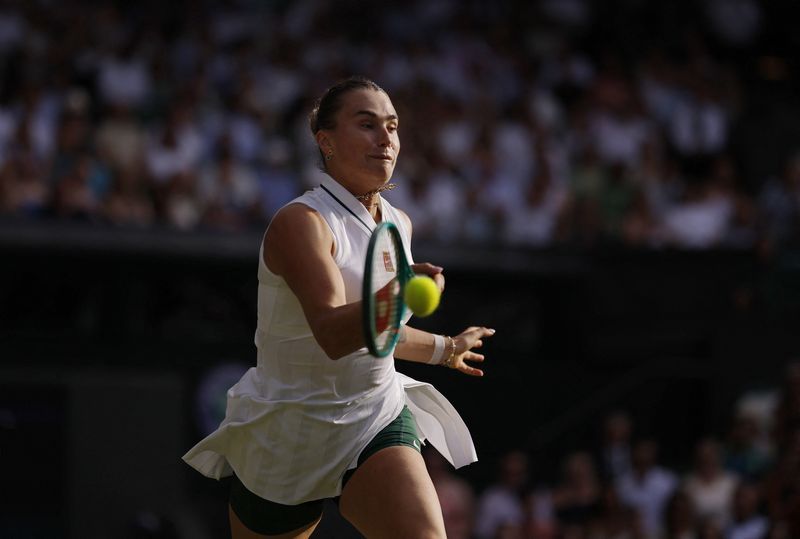
Naomi Osaka engineered one of the tournament's biggest upsets on Sunday when she dispatched world No. 1 Aryna Sabalenka in straight sets on Centre Court, securing a 6-2 7-6(2) victory that dramatically altered the complexion of Wimbledon's women's singles draw. The 14th-seeded Japanese player's composed performance dismantled the top seed's power-based game and sent shockwaves through the championship with the realisation that three of the tournament's highest-ranked players would not feature in the semi-final stage.
The encounter between two Grand Slam champions generated significant pre-match anticipation, yet the match itself unfolded very differently from what observers anticipated. Osaka's controlled aggression overwhelmed Sabalenka throughout the opening set, which lasted just 32 minutes as the Belarusian's typically formidable offensive arsenal completely misfired. Break opportunities materialised twice, and Osaka converted both with clinical precision, leaving Sabalenka visibly frustrated and banging her racket in desperation during the set's crucial moments.
While the second set provided a more competitive examination, Osaka's poise never wavered. She broke Sabalenka's remarkable streak of 21 consecutive tiebreak victories across Grand Slam tournaments—a streak that had become something of a psychological weapon in previous competitions. That breakthrough proved decisive when the set reached a decider, where Osaka's composed serving and sharp returns proved too much for her opponent to overcome. After surrendering a match point, Sabalenka's frustration boiled over into an outburst that saw her propel a tennis ball far beyond the stadium's perimeter in an act of raw anger.
Osaka's triumph marked her first appearance in a Wimbledon quarter-final and arrived at a particularly significant juncture in her career. The Japanese champion had returned to professional tennis in 2024 following the birth of her daughter, Shai, and this represented her most commanding victory since that comeback. Her composed demeanour on court stood in sharp contrast to Sabalenka's increasingly frayed composure, with Osaka managing the match's pressure admirably despite the magnitude of facing the world's highest-ranked player on one of tennis's most prestigious stages.
The scale of this upset gains further context from the tournament's trajectory over the previous 24 hours. Defending champion Iga Swiatek's third-round exit on Saturday had already opened significant cracks in the field, followed swiftly by the departure of second seed Elena Rybakina. These results suggested that Sabalenka, despite her three consecutive semi-final finishes at the championship, would finally navigate through to the latter stages. Instead, the American-based Belarusian found herself thoroughly outplayed by an opponent who appeared to elevate her game precisely when it mattered most.
Sabalenka's below-par performance raises important questions about her grass-court credentials, despite her dominance on harder surfaces where she has captured both her Grand Slam titles. The 28-year-old seemed unable to establish the rhythm that has defined her rise to the world rankings' summit, and her power game—normally an asset across most conditions—yielded diminishing returns as Osaka's superior court positioning and service returns continually disrupted her attacking patterns. By the time Sabalenka reached her post-match press conference, her emotional state had deteriorated noticeably, with the competitor expressing a desire to escape the tournament entirely rather than process the defeat professionally.
The two finalists represent a fascinating study in contrasts within professional tennis. Both players share essentially equivalent pedigrees, each claiming four Grand Slam titles exclusively on hard courts, yet their career trajectories diverged significantly before this encounter. Osaka achieved all her major victories before Sabalenka claimed her first, despite being marginally older than the Belarusian. They had not met in a major championship since their first encounter eight years ago, when Osaka defeated Sabalenka during her U.S. Open triumph, making Sunday's contest their first direct Grand Slam encounter in nearly a decade.
Osaka's resurgence at Wimbledon has manifested in dimensions beyond pure tennis mechanics. Her Japanese-inspired walk-on outfits have generated considerable media attention and social conversation, yet her actual on-court performances are increasingly commanding the spotlight. Against Sabalenka, she demonstrated the quality of returns that repeatedly caught her opponent off balance, while maintaining sufficient composure to navigate the match's pivotal moments without faltering under pressure—a marked contrast to Sabalenka's increasingly desperate demeanor as the match progressed.
With this victory, Osaka advances to face Czech 10th seed Karolina Muchova in the quarter-final stage, where she will attempt to extend her run deeper into the tournament than she has previously managed at Wimbledon. The Japanese player's presence in the latter stages of the championship now forces significant recalibration of expectations about the tournament's potential outcome. The traditional hierarchy of seeds has essentially collapsed, with the absence of the three highest-ranked competitors creating genuine uncertainty about which players might contest the final.
For Malaysian and Southeast Asian tennis followers, Osaka's performance carries particular resonance given her status as an Asian champion demonstrating elite-level performance across tennis's most prestigious stages. Her comeback from motherhood and her ability to compete at the championship's highest level offers a narrative that transcends sport, while her mental resilience against a notably superior-ranked opponent provides textbook examples of tactical execution and emotional management during high-pressure competition.
The implications of this result will likely reverberate throughout the remainder of Wimbledon's women's draw, as other competitors now face a tournament landscape fundamentally altered by the disappearance of three seeded players. Osaka's stunning upset has proven that form and confidence can supersede ranking and recent track record on grass, potentially opening opportunities for other unseeded and lower-seeded competitors to advance further than conventional tournament predictions would suggest possible.

